.jpg)
Numismatic Museum of Athens
The man who claimed to have found Troy decided he deserved a palace worthy of it. Heinrich Schliemann, the merchant-turned-archaeologist whose excavations at Hisarlik made him the most famous digger of his age, named his Athens mansion Iliou Melathron, the Mansion of Ilium. Built between 1878 and 1880, its rooms were covered in mosaics and murals drawn from the Trojan War, its interior modeled on the buried villas of Pompeii. Today this self-glorifying monument holds something Schliemann would have loved: more than half a million coins tracing the entire history of money.
The Palace of Troy
Iliou Melathron was the work of Ernst Ziller, the Saxon architect who shaped so much of nineteenth-century Athens. He blended Renaissance Revival grandeur with strict Neoclassicism, then borrowed the painted interiors of Pompeii for the inside. At its completion, the three-story house on Panepistimiou Street was considered the most magnificent private residence in the city. Schliemann filled it with antiquity, the way another rich man might fill a house with portraits of himself. After his death, his widow Sophia sold the building to the Greek state in 1927. For decades it served sober legal purposes, housing the Council of State and later the Court of Cassation, before finding its present role.
A Collection Among the Greatest
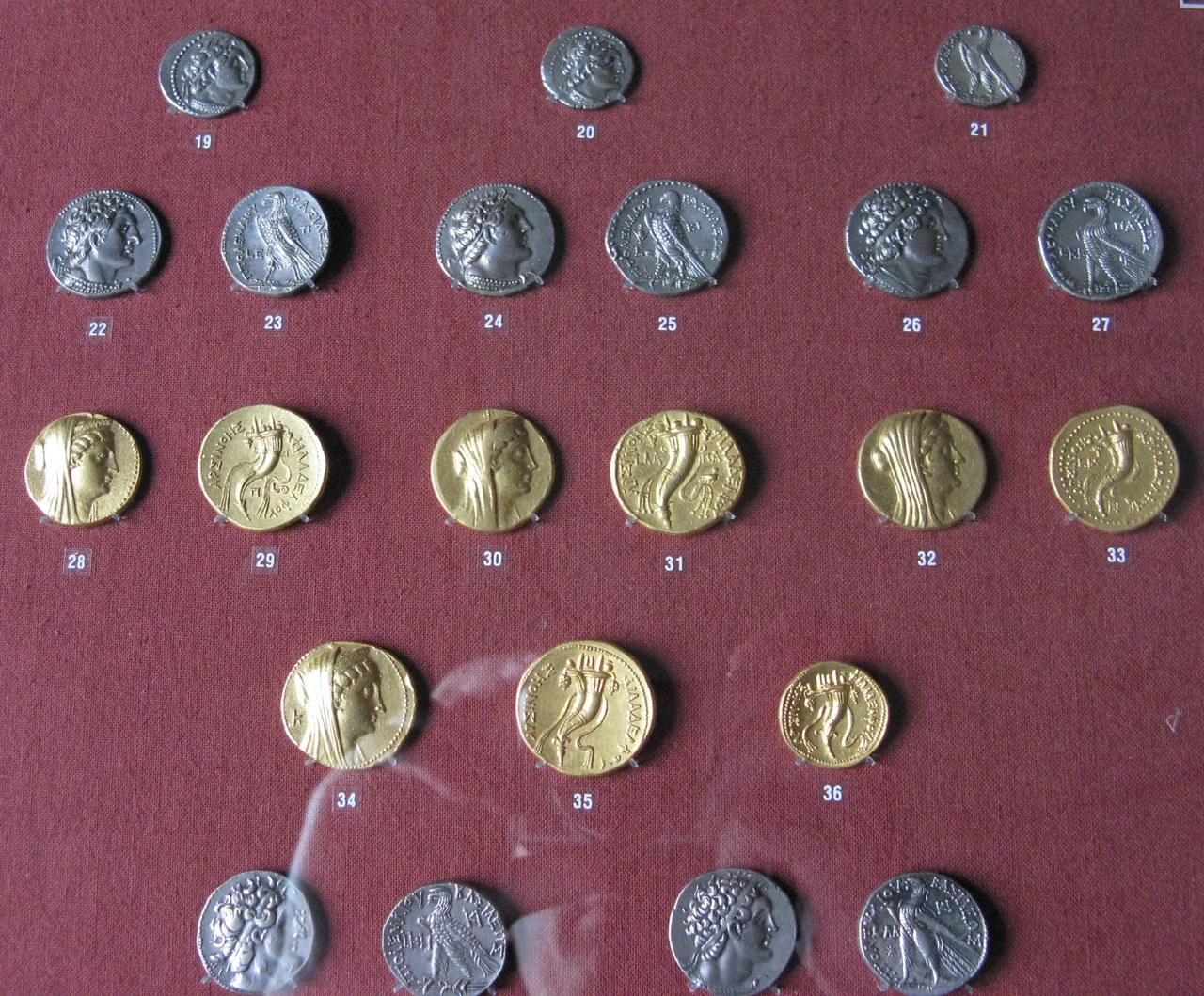
The Numismatic Museum's holdings rank among the richest on Earth, spoken of in the same breath as the British Museum, the Bibliothèque Nationale in Paris, the Hermitage in St. Petersburg, the Bode Museum in Berlin, and the American Numismatic Society in New York. The collection runs to roughly 600,000 objects: coins above all, but also medals, weights, dies, gems, and seals. They span from the fourteenth century BC to modern times, an unbroken thread of currency stretching across more than three millennia of human exchange, conquest, and trade.
History You Can Hold
The galleries are arranged to follow the story of coinage itself, so that walking through the rooms is like walking forward through time. Here are the coins of the Greek city-states, the poleis whose silver owls and turtles funded democracy and war. Here are the issues of the Hellenistic kingdoms and the Roman Empire, then the gold of Byzantium, medieval Europe, the East, and the Ottoman Empire. Many pieces surfaced in hoards, buried by people who never returned to reclaim them. Others descend from the old collection on Aegina or from excavations across the Greek mainland. A specialized library of 12,000 volumes and a conservation laboratory keep the scholarship alive.
The Garden in the City
For all its imperial ambition, the museum offers something gentle. It sits at 12 Panepistimiou Street, a short walk from Syntagma Square and its busy metro station, in the heart of Athens. Behind the ornate facade waits a quiet garden where a coffeehouse lets visitors sit among the greenery, the roar of the avenue softened to a murmur. It is an odd and lovely pairing, half a million coins and a cup of coffee under the trees, inside the house a Troy-obsessed dreamer built to outlast him. In that, at least, he succeeded.
From the Air
The Numismatic Museum sits at 37.978°N, 23.735°E on Panepistimiou Street in central Athens, a block from Syntagma Square and the Greek Parliament. The nearest airport is Athens International (LGAV), about 33 km east-southeast. From above, the museum lies within the dense civic core of Athens; the Acropolis rises roughly 1 km to the southwest, and the green expanse of the National Garden is just to the southeast. Clear Attic skies and low humidity make for excellent visibility most of the year.
Nearby Stories
- Great Sand Beach 5 km away
- Battle of Delium 7.7 km away
- Tower of Aliartos 9 km away
- HMHS Britannic 10 km away
- Saronic Gulf 15 km away
- Sousaki Volcano 17 km away
- Sanctuary of Apollo Maleatas 24 km away
- Skyros 66 km away