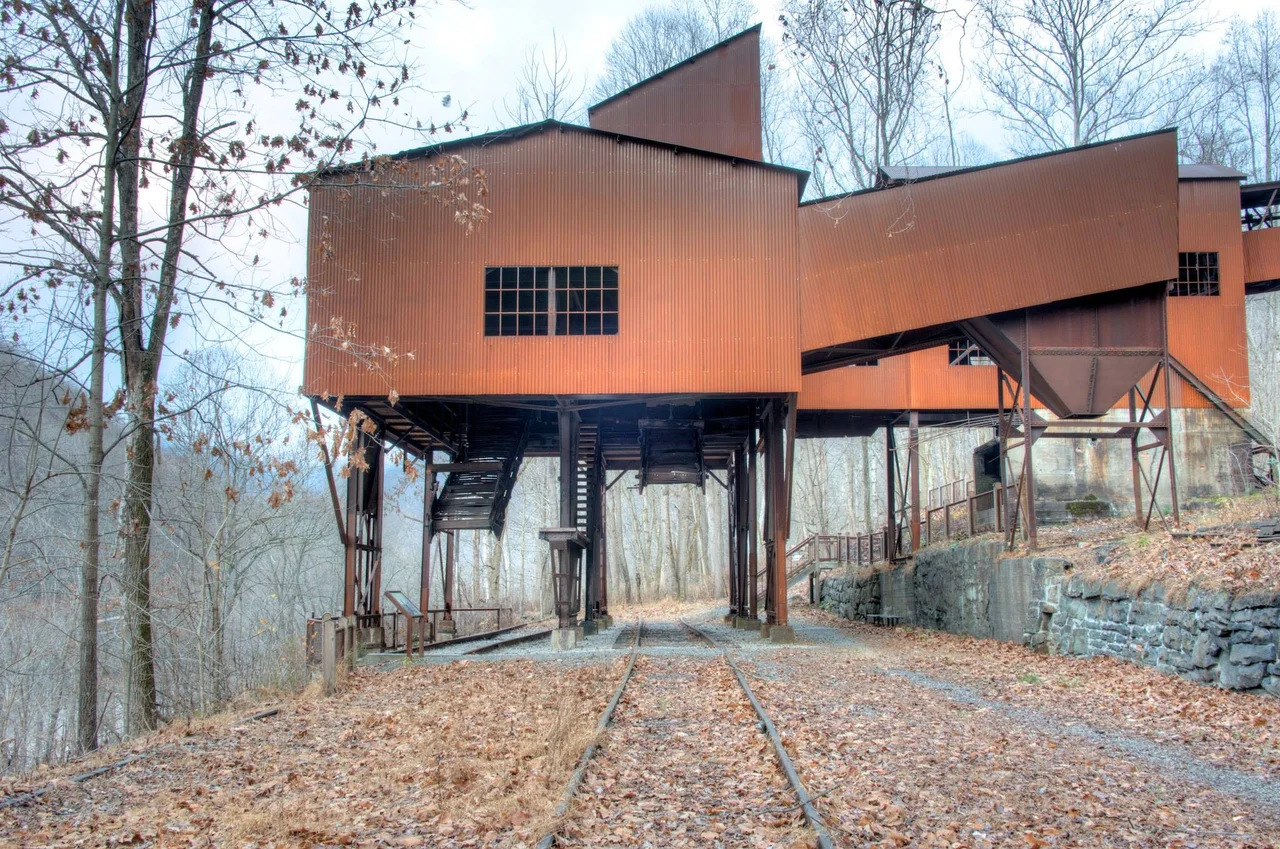

Nuttallburg Coal Mining Complex and Town Historic District
In 1870, three years before the Chesapeake and Ohio Railway pushed its mainline through the New River Gorge, an English-born coal man named John Nuttall placed a bet. He bought the rights to coal seams in a stretch of the gorge near present-day Winona and began building a mining town - houses, coke ovens, a tipple, the whole apparatus of an operating colliery - before the railroad even existed. When the C&O arrived in 1873, Nuttallburg was waiting. The town that grew here became one of the most distinctive coal operations in the New River Coalfield - a vertically arranged settlement that supplied Henry Ford's River Rouge plant for a few remarkable years in the 1920s, was sealed for good in 1958, and now sits preserved by the National Park Service inside the country's newest national park.
John Nuttall's Bet
John Nuttall had been at the coal-mine business for years when he turned his attention to the New River Gorge in 1870. The C&O had not yet been built, but its route was being surveyed, and Nuttall correctly read the map. He bought the coal rights in the bench above the river, sank his first shaft into the Sewell Seam, and began constructing a town. By the time the railroad arrived in 1873, he had built nearly 100 houses, 80 coke ovens, a variety of mining structures, and a tipple positioned at a siding off the main C&O line. The investment was paid back many times over. Coke from Nuttallburg ovens fed iron furnaces in Virginia and Pennsylvania, and the colliery became one of the early anchors of New River coal production.
A Vertical Town
The flat ground along the river was reserved for industry: the tipple, the rail siding, the coke ovens, the warehouses. Houses had to climb the hillsides above. The town was racially segregated, like nearly every Southern coal camp of its era. White workers lived on the west side of Short Creek; Black workers lived on the east side of the creek and on the flats between the railroad and the river. Because the town developed on both banks of the New River - the main settlement on the north side and an outpost called South Nuttall on the south - the operators needed a way to move people back and forth. In 1899, John A. Roebling's Sons Company - the bridge-building firm that had built the Brooklyn Bridge a few years earlier - constructed a pedestrian suspension bridge across the New River at Nuttallburg. It carried foot traffic for decades.
The Ford Years
In 1920, Henry Ford bought the Nuttallburg mines as a captive coal supply for his River Rouge plant in Dearborn, Michigan. The Rouge was Ford's vision of vertical integration - iron ore in, finished cars out, every step in between done within the same complex. To do that, he needed reliable coal of his own. He acquired the Nuttallburg operation under the Fordson Coal Company name and invested in modern mining equipment, including a new headhouse, a long mechanical conveyor descending the hillside, and improved processing facilities. For a few years, coal from this hollow in West Virginia rolled north to forge the steel of Ford automobiles. By 1928, however, interstate rail regulations had made the transport too costly, and Ford sold the operation to the New River Coal Corporation. The Fordson era left behind upgraded infrastructure that operated for thirty more years.
Sealed and Preserved
The mine was sealed in 1958. The town emptied. Most of the frame houses succumbed to weather or were dismantled for their lumber. What remained - the headhouse, the long conveyor descending the cliff face, the coke ovens lining the bottom, a few stone foundations - sat undisturbed for decades. In 1998, the National Park Service acquired the entire complex from the Nuttall Estate and incorporated it into New River Gorge National River. After years of stabilization work, the Park Service opened Nuttallburg as one of the most important interpreted industrial-archaeology sites in Appalachia. Visitors today can hike down to the headhouse, walk among the coke ovens, and read the layered history of an industrial town that, for one brief moment, helped power the American automobile.
From the Air
Nuttallburg sits at 38.05 N, 81.04 W, on the north bank of the New River in Fayette County, West Virginia, about 2.7 miles upstream from Fayette Landing. Recommended viewing altitude is 3,000 to 5,000 feet AGL. The long headhouse-conveyor descending the gorge wall is visible from the air; coke ovens line the river bank. Across the river is the similarly preserved Kay Moor complex. Nearest airports are Raleigh County Memorial (KBKW) in Beckley about 20 miles southwest and Yeager (KCRW) in Charleston about 40 miles west-northwest.
Nearby Stories
- West Virginia State Capitol 4.7 km away
- Greenbrier County, West Virginia 13 km away
- Beckley, West Virginia 13 km away
- Clay, West Virginia 16 km away
- The Greenbrier 18 km away
- Webster Sycamore 26 km away
- Kanawha State Forest 26 km away
- Welch, West Virginia 40 km away