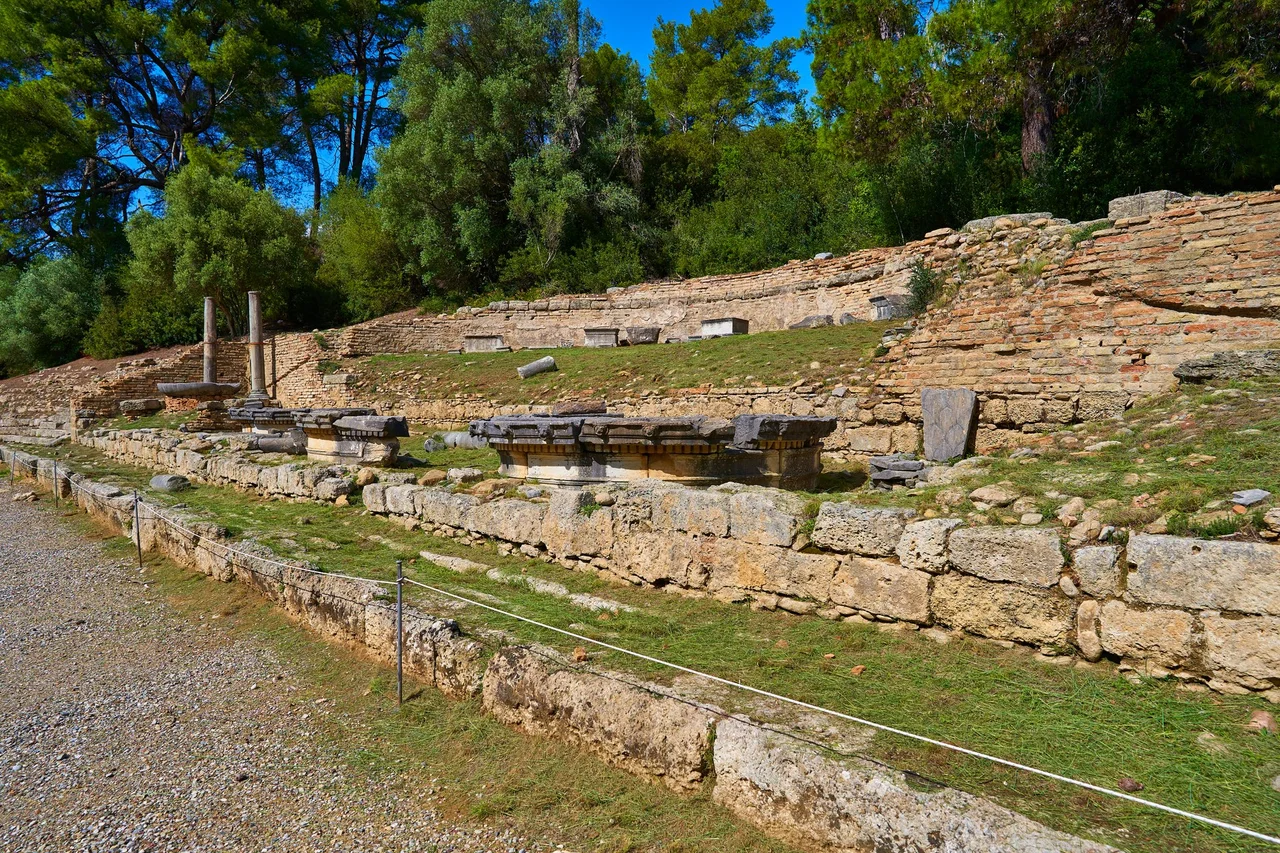

Nymphaeum of Herodes Atticus
Before the 2nd century AD, attending the Olympic Games meant suffering. Every four years, tens of thousands of people flooded the sanctuary at Olympia during the scorching heat of July and August, and each spectator had to carry in whatever water they could manage. Nine wells had been dug across the site, but lifting water by hand from nine wells was not nearly enough. Athletes, trainers, and officials fared only somewhat better — they had access to short channels fed by the Kladeos River, a stream that ran muddy whenever it rained and was never especially generous. The crowds simply went thirsty. That changed because of one well-connected man's field trip to the Games.
A Roman Billionaire's Promise
Herodes Atticus was not an ordinary visitor. A Greek-born Roman senator, scholar, and friend and teacher to emperors, he arrived at Olympia in the mid-2nd century AD with his wife Regilla — who had to be specially designated an honorary priestess of Demeter just to enter the site, since women were ordinarily excluded. When the couple experienced the water shortage firsthand, Herodes made a public promise: he would pay for an adequate water supply out of his own fortune. By the next Olympiad — four years later — the Nymphaeum bearing his name had been completed.
The structure he commissioned was called a nymphaeum, the standard Mediterranean name for an ornate terminal building at the end of an aqueduct. The name meant 'home of the nymphs,' the water goddesses of Greek tradition. This one, however, was above all practical. It received water from a new aqueduct into a cistern, then released it in stages through a network of open and concealed channels running throughout the sanctuary. Long troughs lined the sides of every playing field, so that athletes and spectators could dip their small drinking bowls — called paterae — directly into flowing water rather than queuing at a well.
Engineering the Water
The engineering challenge was substantial. The sanctuary at Olympia sat at roughly 35 to 50 meters in elevation, and the local rivers were either insufficient or too calcified from limestone to be drinkable — the Alpheios, the larger of the two rivers flanking the site, was so hard with dissolved carbonates that it was useless for drinking water. What Herodes' engineers needed was a higher-elevation freshwater source some distance from the site.
Archaeologists excavating the nymphaeum in 1877 and 1878 initially thought they had found a spring capture in the hill behind the structure. But the more they dug, the more complex the system became. They discovered a brick-lined tunnel, 88 meters in visible length, running east through the base of Kronion hill along the treasury terrace and then into the hillside, mounted atop a buttressed wall for both stability and elevation control. The visible portion drops from 55 meters at the hill entrance to 50 meters at the cistern — a modest but sufficient 5-meter gradient that would have sent water jetting impressively from the nymphaeum's spouts. Where that tunnel ultimately originated is still debated by scholars, but the best evidence points toward the Erymanthos River some 15 kilometers to the east, or to the municipal water system of ancient Pisa, which had likely already tapped mountain sources well above Olympia.
Water for the Whole Site
Once the cistern received water, the distribution network spread it everywhere. Publicly accessible troughs ran along the open areas. Hidden pipes ran through walls to wherever public access was not desired. The system fed newly constructed Roman-era baths and the swimming pool of what was apparently a grand hotel. Most importantly, those long drinking troughs beside every field transformed the experience of being at the Games.
Before Herodes, the 1st century had already seen Olympia become an international spectacle — Roman emperors competed, or sent competitors, and the site expanded greatly to accommodate the crowds. The stadium was moved; the palaestra was relocated. But the water infrastructure had never kept pace. Nine wells requiring manual lifting, a few short gravity channels from a muddy river — that had been the sum of it, across centuries of the world's most celebrated athletic festival. Herodes Atticus, in a single building campaign, ended Olympia's dependence on those inadequate local sources and brought fresh mountain water to every corner of the sanctuary.
What Remains
The nymphaeum was excavated in the 1870s, but the road built through the site around 1886 cut through the hillside above the tunnel, removing evidence of where exactly the aqueduct entered the hill. The visible structure today consists of the main curved wall with its semicircular apse and the remains of the cistern behind it — enough to convey the scale of what Herodes built, if not its original grandeur. Statues once stood along the facade, several of them carrying paterae in one hand, gesturing at the structure's primary purpose.
The building is late in the story of ancient Olympia — a Roman addition to a sanctuary that had existed for more than a thousand years. But it was arguably the most impactful single intervention ever made to the physical comfort of the site. The generations of spectators who had suffered the summer heat without adequate water, carrying their own jugs across the grounds of the most sacred athletic site in the Greek world, would have found the running troughs almost miraculous.
From the Air
The Nymphaeum sits at approximately 37.639°N, 21.630°E within the ancient sanctuary of Olympia, on the northeast edge of the Altis sacred precinct, against the slope of Kronion hill. Approaching from the Ionian Sea to the west, the valley of the Alpheios River forms a natural corridor through the western Peloponnese. The nearest major airport is LGRX (Araxos), approximately 40 km to the north-northeast. At low altitude, the tree-lined sanctuary grounds are visible as a distinct green enclosure beside the confluence of the Kladeos and Alpheios rivers. Recommended viewing altitude: 2,000–4,000 feet AGL for the full valley context. The Kronion hill ridge immediately north of the site is a useful landmark.
Nearby Stories
- Santameri Castle 4.6 km away
- Aristarchos 2.3 m Telescope 4.8 km away
- Lepreum 9.1 km away
- Arcadia (region) 13 km away
- Peloponnese 14 km away
- St. Mark's Roman Catholic Church 20 km away
- Strofades 22 km away
- County Palatine of Cephalonia and Zakynthos 39 km away