
Occupy Central (2011–2012)
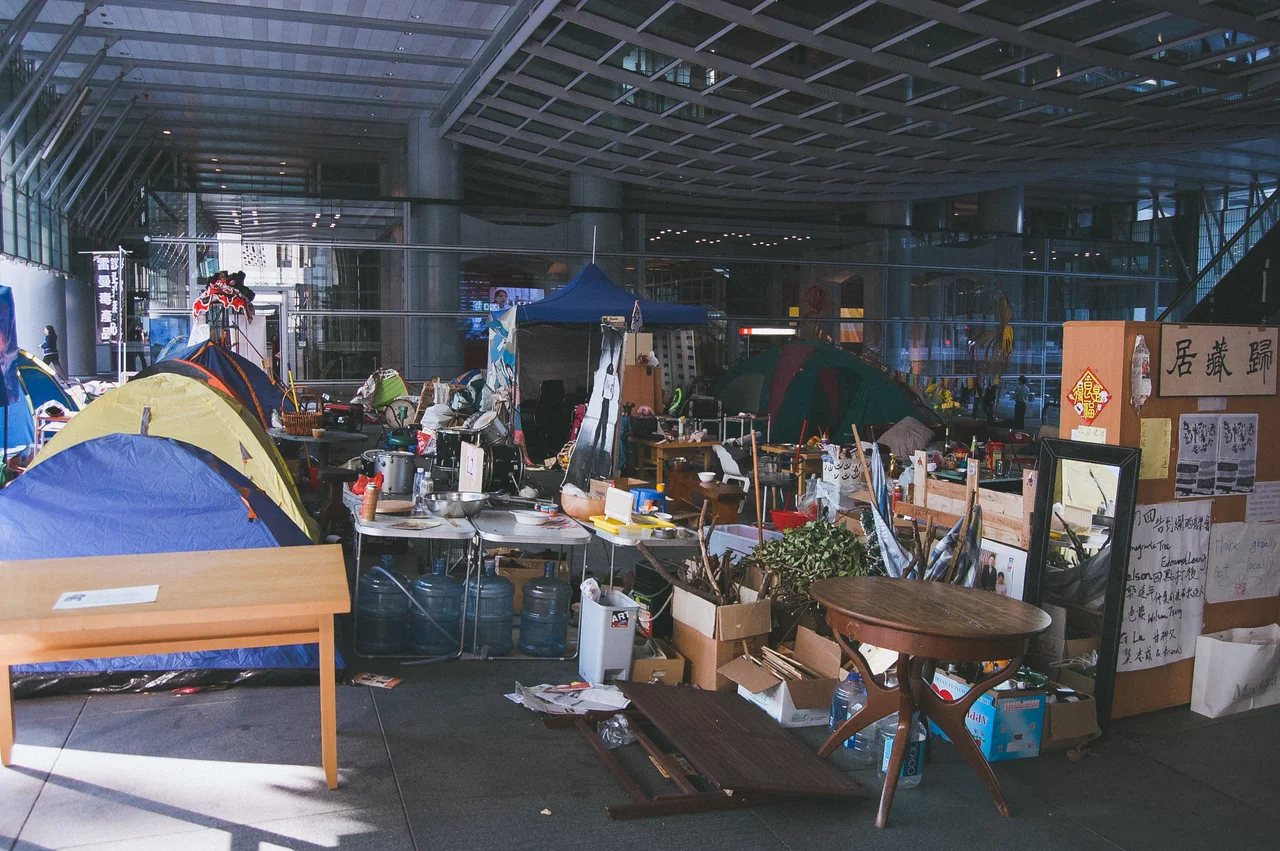
The plaza beneath the HSBC headquarters in Central had an unusual legal status. When the bank built its famous Norman Foster-designed tower, completed in 1985, the ground-level public space was deeded as a pedestrian passage — HSBC's property, but committed to public use. On 15 October 2011, that commitment was tested. Dozens of people brought tents and supplies to the plaza, joining a wave of occupation protests that had spread from Zuccotti Park in New York to cities on every continent. The Hong Kong encampment was modest in size — it never numbered more than around 20 people at its height — but it lasted nearly eleven months, becoming one of the longest-running Occupy movements anywhere in the world.
What They Were Protesting
The Occupy movement that crossed the globe in 2011 was not primarily about any single government or policy. Its focus was structural: the protesters argued that large corporations and the global financial system concentrated wealth and power in the hands of a small minority while undermining democratic governance. In Hong Kong — a city built on finance, where the HSBC tower is as much a civic icon as any government building — the symbolism of occupying that particular plaza was deliberate. The encampment drew students, young professionals, activists, and people with nowhere else to go: the unemployed, the homeless. What they had in common was less a unified political programme than a shared sense that the existing arrangement of things was neither fair nor stable. Some Hongkongers were sympathetic to this position. Others felt the camp had outlasted whatever point it was making.
Eleven Months Beneath the Bank
Through winter and into the humid heat of Hong Kong's summer, the encampment persisted. The numbers were small — by August 2012, roughly ten people remained — but the presence was steady. HSBC eventually sought legal relief, and on 13 August 2012, the High Court granted an injunction ordering the occupants to vacate by 9 p.m. on 27 August. The protesters stayed. Two weeks passed after the deadline. Then on the morning of 11 September 2012, court bailiffs arrived at the plaza. What should have been a brief administrative action stretched into an eight-hour operation. The occupants had not planned to go quietly. Some zipped themselves inside tents. Others confronted the bailiffs, insisting the officers had not produced proper documentation. Outside the building, additional supporters pushed past security guards; a handful of guards were injured and sent to hospital. Three people were arrested. By four in the afternoon, the last of the eleven remaining campers had been removed.
The People Who Stayed
It is easy, in retrospect, to measure the Occupy Central encampment against what came later in Hong Kong's political history — the much larger protests of 2014 and 2019 — and find it small. But the people who lived beneath that plaza for nearly a year were not acting strategically. They were acting from conviction, which is a different thing. They were students who believed inequality was a political problem rather than a natural condition. They were professionals who looked at the financial system that ran their city and felt something was wrong with its premises. They were, in some cases, people in difficult personal circumstances who found community in a shared space under a bank. When the bailiffs came, those people were evicted. The plaza was sealed — something that only happens otherwise during typhoons.
A Place, a Moment, a Longer Story
The HSBC plaza returned to its normal function after the clearance. People crossed it on their way to the MTR, paused to look at the bank's famous lobby, continued on their errands. The occupation left no permanent physical mark. What it left instead was a moment in the record of a city that would, in the following years, become increasingly contested — its public spaces, its legal institutions, its political future all subject to pressures that in 2011 were still gathering rather than breaking. Occupy Central 2011–2012 was neither the beginning nor the end of anything. It was one instance of people deciding to take a claim about economic justice and express it spatially, in a place whose symbolic weight they understood, for as long as they could manage it.
From the Air
The HSBC plaza at the centre of this story sits at approximately 22.280°N, 114.160°E in the Central district of Hong Kong Island — the heart of one of Asia's most concentrated financial districts. Approaching VHHH from the east at 3,000–5,000 ft, Central's tower cluster is the brightest and densest concentration of glass and steel along the northern shoreline of Hong Kong Island, directly opposite Kowloon's Tsim Sha Tsui waterfront across Victoria Harbour. The HSBC Main Building, designed by Norman Foster and completed in 1985, is among the most recognisable structures in the skyline.
Nearby Stories
- Lok Ma Chau Loop 2.3 km away
- Portas do Cerco 2.3 km away
- Kweilin Incident 17 km away
- Wanshan Archipelago Campaign 34 km away
- Nanxiong Formation 115 km away
- Battle of Nanpeng Island 148 km away
- Heyuan 169 km away
- Cape Maobitou 632 km away