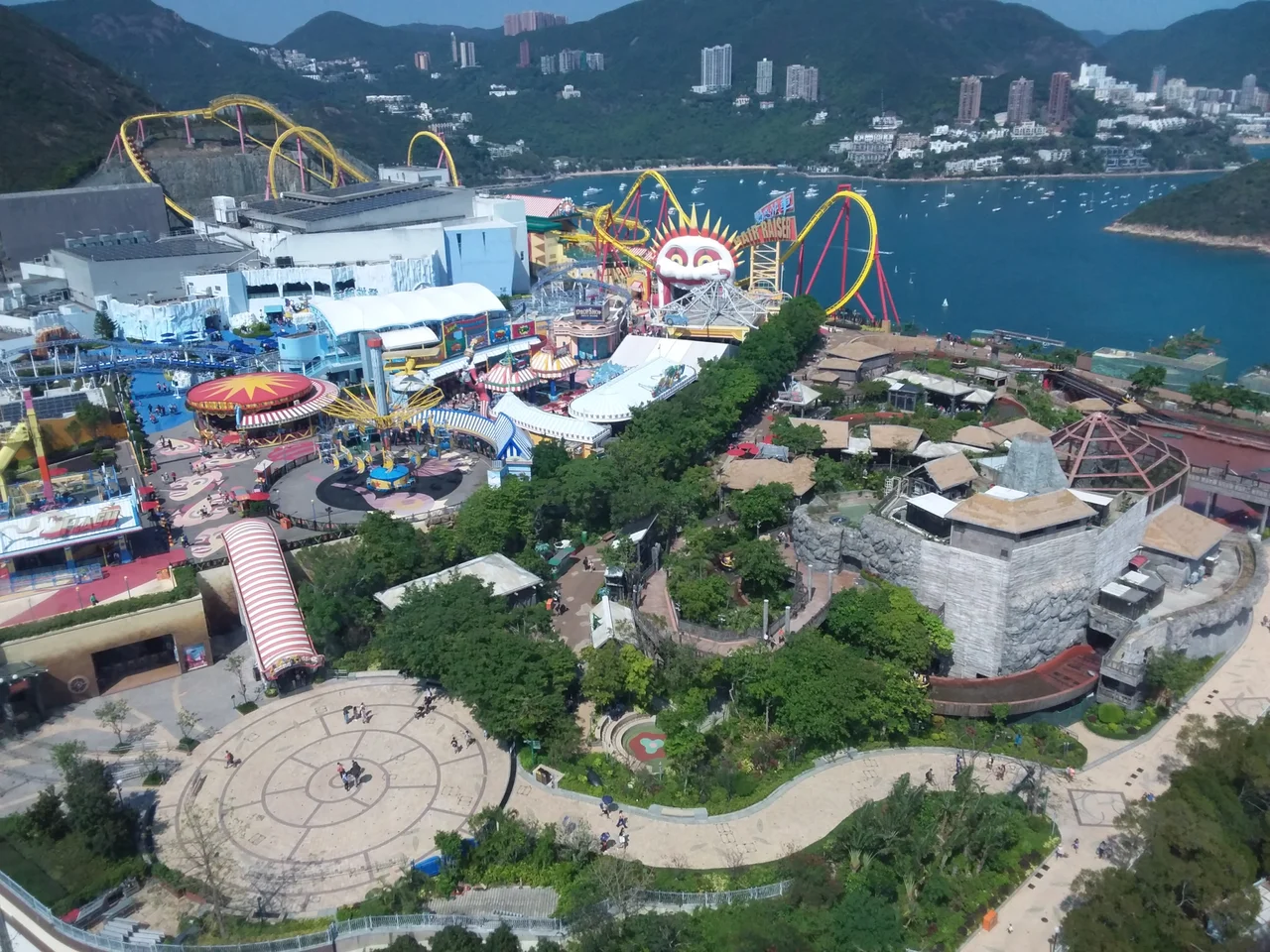

Ocean Park Hong Kong
The cable car ride between the Waterfront and the Summit is eight minutes long. On a clear day, with the South China Sea visible beyond the ridgeline and the cable cars swaying gently on their ropeways, it is one of the more quietly spectacular commutes in any theme park in the world. Ocean Park opened in January 1977 on a 91.5-hectare site straddling the hills of Wong Chuk Hang, and for nearly three decades it was simply Hong Kong's park — the place families came, the place school trips ended. Then Disneyland announced it was coming to Lantau Island, and predictions of Ocean Park's closure began circulating in earnest.
Built on a Mountain, Divided by One
The park's unusual geography is also its signature. A large hill separates the lower Waterfront area from the upper Summit, and the cable car system linking them — 252 cars on two pairs of ropeways, with a capacity of 4,000 passengers per hour — has been the park's most photographed feature since it opened. A second connection, the Ocean Express funicular, opened in September 2009 and carries passengers through a tunnel themed to resemble a submarine voyage, complete with dimmed lighting and ceiling animations simulating an underwater environment. Between 1979 and 1997, the park's most famous resident was Hoi Wai, an orca who became the symbol of the institution. The park has housed giant pandas since 1999, a relationship that deepened when animals loaned from mainland China became central to the park's identity and conservation messaging. At its peak in 2014, Ocean Park attracted 7.6 million visitors, making it the 13th most-visited theme park in the world.
The Disneyland Test
When Hong Kong Disneyland opened in September 2005, the conventional wisdom was that Ocean Park would suffer catastrophically. It did not. Average daily attendance dipped from 11,000 to 10,000 during Disneyland's opening period — a decline, but not a collapse. Forbes subsequently recognised Ocean Park as one of the ten most popular amusement parks in the world and dubbed its chairman Allan Zeman, who had been brought in to lead a turnaround in 2003, 'Hong Kong's Mouse Killer.' The description was playful, but the underlying situation had been serious: Ocean Park had recorded four consecutive years of deficits following the 1997 Asian financial crisis. Zeman's turnaround involved a billion-dollar redevelopment plan that added more than 80 attractions, reconfigured the park's zones around distinct themes — Aqua City, Marine World, Polar Adventure, Thrill Mountain, the Rainforest — and opened in phases between 2006 and 2012. In November 2012, the park became the first theme park in Asia to win the Applause Award, considered the most prestigious recognition in the amusement park industry.
The Animals
Ocean Park has always been divided between its identity as an entertainment venue and its claims to conservation. The Grand Aquarium, which opened as part of Aqua City in January 2011, features what was described as the world's largest aquarium dome and housed, at opening, 130 sharks and rays from 15 species, including the critically endangered largetooth sawfish. The Polar Adventure zone, which opened in July 2012, houses king penguins, southern rockhopper penguins, gentoo penguins, Pacific walruses, spotted seals, Steller sea lions, snowy owls, and Arctic foxes. The park has had documented success breeding Indo-Pacific bottlenose dolphins, sea lions, seahorses, and several species of sea jellies. Wildlife advocates, however, have long criticised Ocean Park for the wild capture of large marine animals — dolphins and orcas acquired from the wild — and for shows that required those animals to perform. The tension between the park's conservation rhetoric and its practices has never fully resolved. It remains part of what Ocean Park is.
A Difficult Decade, Then Recovery
The 2019 social unrest in Hong Kong reduced mainland tourist arrivals and pushed attendance to 5.7 million, down from a recent high. Then the COVID-19 pandemic closed the park entirely. By January 2020, Ocean Park was seeking HK$10 billion from the government for expansion, and its financial position was precarious. The city's borders fully reopened in February 2023, and by December 2023 the park had posted a surplus for the financial year ending June 2023 — its first after years of losses — with visitor numbers growing 45% year-on-year to 2.4 million across Ocean Park and its companion Water World facility, Asia's first all-season water park, which opened in September 2021 on a 55,740-square-metre site at Tai Shue Wan. A new Adventure Zone, incorporating an alpine coaster and ziplines, was under construction in late 2024 with completion expected around 2028. Ocean Park has proven repeatedly that it is harder to kill than its critics expect.
Halloween on the Mountain
For one month each autumn, Ocean Park transforms into something altogether different. The Halloween Bash — Hong Kong's largest Halloween event and, by the park's accounting, the largest in Asia — has become a cultural fixture in its own right. The park installs elaborate haunted installations, the cable cars acquire a different atmosphere in the dark, and the animal exhibits take on an eerie quality that the daytime visit does not prepare you for. The park perches between water and mountain, which means evening light behaves differently here than it does in the city below — the South China Sea catches the last sun while the Summit is already in shadow. That geography, which was always the park's great asset, becomes something almost theatrical once the daylight is gone.
From the Air
Ocean Park sits at approximately 22.248°N, 114.174°E on the southern shore of Hong Kong Island, in the hilly terrain between Wong Chuk Hang and Aberdeen. Approaching VHHH from the east or northeast at 3,000–5,000 ft, the park occupies the hillside between the southern shore and the South China Sea, clearly distinct from the dense urban fabric of the northern shore. The cable car system running over the ridge is the most distinctive visible feature from altitude on a clear day.
Nearby Stories
- Lok Ma Chau Loop 2.3 km away
- Portas do Cerco 2.3 km away
- Kweilin Incident 17 km away
- Wanshan Archipelago Campaign 34 km away
- Nanxiong Formation 115 km away
- Battle of Nanpeng Island 148 km away
- Heyuan 169 km away
- Cape Maobitou 632 km away