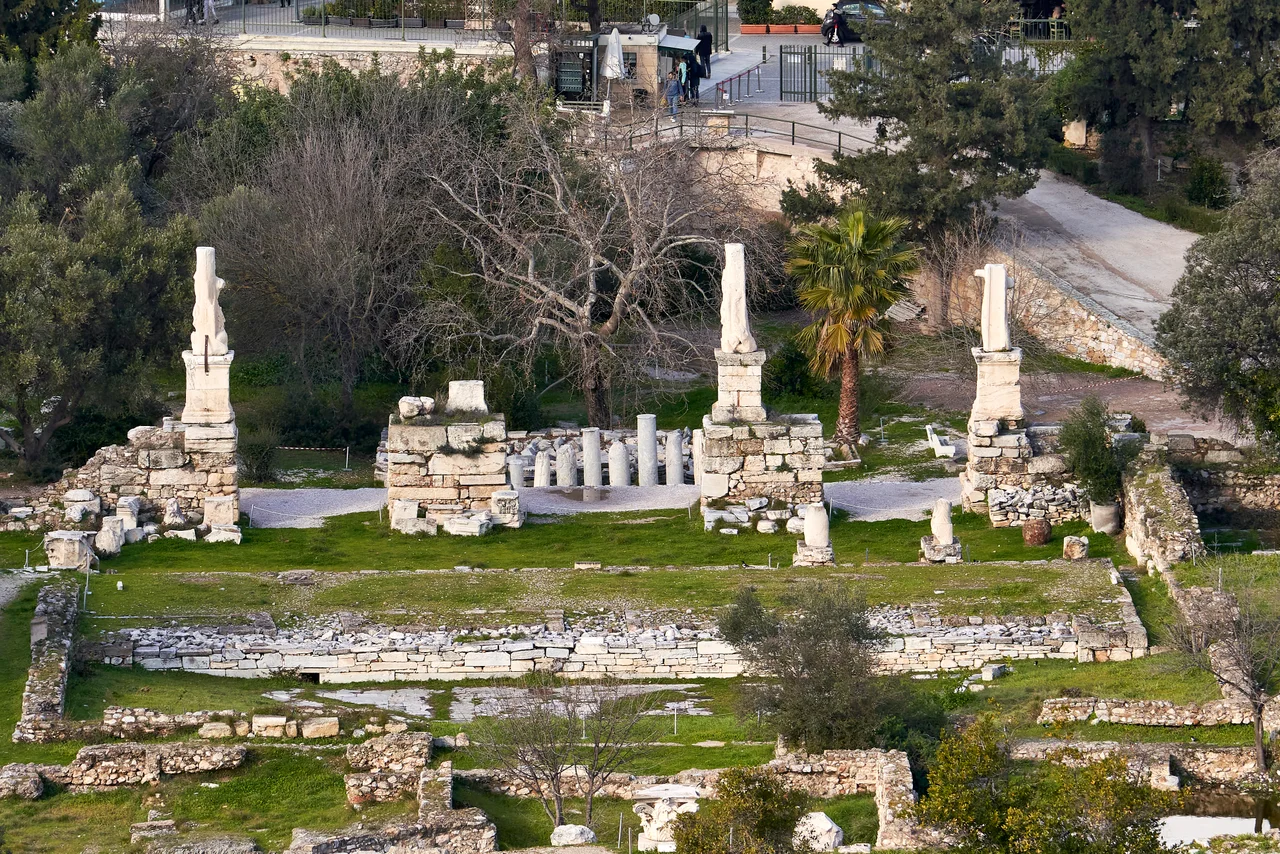

Odeon of Agrippa
Around 150 AD, the roof came down. For nearly two centuries the Odeon of Agrippa had stood in the middle of the Athenian Agora, a concert hall whose builders had reached too far. To span its auditorium, 25 meters wide, they had thrown up a roof with no interior columns to hold it, a daring piece of engineering that the laws of physics eventually overruled. When the timbers finally gave way, they buried a hall that had once seated a thousand. What rose in its place would be smaller, humbler, and guarded by giants.
A Roman's Gift to Athens
The building went up around 15 BC, planted squarely in open ground at the center of the Agora, the public square that had been the beating heart of Athenian life for centuries. It was a present from Marcus Vipsanius Agrippa, the Roman general and statesman who was the right hand of the emperor Augustus. The gesture was political as much as cultural: a powerful Roman placing his name in the most Athenian space imaginable. The two-story auditorium seated roughly a thousand spectators around a raised stage and a marble-paved orchestra. Corinthian pilasters dressed the exterior, and a subterranean passage, a cryptoporticus, wrapped three sides beneath the colonnaded stoae above.
The Roof That Reached Too Far
The hall's glory was also its flaw. A 25-meter span is an enormous distance to roof without a single internal support, and over the decades the structure could not bear it. Around 150 AD the roof collapsed. Rather than rebuild the same impossible hall, the Athenians scaled their ambitions down. The Odeon was reconstructed as a lecture hall seating only 500, half its former crowd. It was a quieter venue now, suited to philosophy and oratory rather than grand musical spectacle, an admission that some designs are best not attempted twice.
The Giants at the Gate
The rebuilt Odeon gained a new northern facade, and it is the most famous thing about the entire site. Its massive pillars were carved as colossal figures: Giants, their lower bodies coiling into serpent tails, and Tritons, ending in the tails of fish. These were not delicate ornaments but hulking guardians, mythological hybrids standing watch over the entrance. Even today, weathered fragments of these figures still rise from the Agora, the most recognizable survivors of the whole structure, staring out across the ruins with the patience of stone.
Destruction and Afterlife
The Odeon's story ended violently. In 267 AD the Herulians, a Germanic people who swept down through the Balkans, sacked Athens and destroyed the building. But its bones did not go to waste. In the early fifth century AD, a sprawling palace, sometimes called a gymnasium complex, was raised on the same ground, and its builders salvaged the great pillars of the giant-carved facade to form a monumental entrance. Walk through the Agora today, beneath the Acropolis, and those Giants are what you see: the recycled remnants of a Roman gift that aimed for the sky, fell to earth, and refused to disappear.
From the Air
The Odeon of Agrippa lies at 37.975°N, 23.723°E in the Ancient Agora of Athens, on the northwest flank of the Acropolis. The nearest airport is Athens International (LGAV), about 34 km to the east-southeast. From the air, the Agora is a green archaeological clearing just below the Acropolis rock and its temples; the reconstructed Stoa of Attalos forms a long rectangular landmark on the east side, and the Theseion (Temple of Hephaestus) crowns the low hill to the west. Athens' clear, dry light makes the Agora's ruins easy to pick out for most of the year.
Nearby Stories
- Great Sand Beach 5 km away
- Battle of Delium 7.7 km away
- Tower of Aliartos 9 km away
- HMHS Britannic 10 km away
- Saronic Gulf 15 km away
- Sousaki Volcano 17 km away
- Sanctuary of Apollo Maleatas 24 km away
- Skyros 66 km away