.jpg)
Odeon of Herodes Atticus
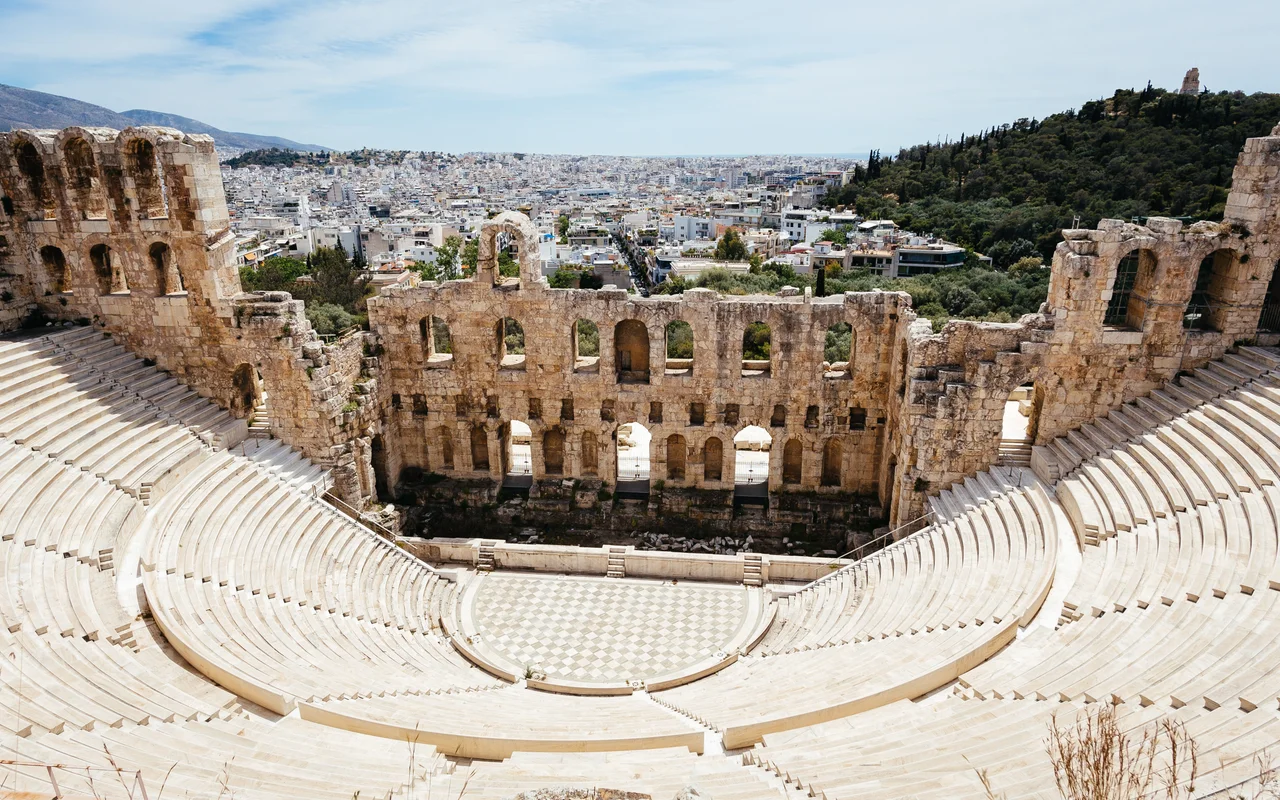
A man built this theatre because his wife had died. Herodes Atticus was the richest private citizen in the Roman world, a tutor of emperors and an orator whose name carried weight from Athens to Rome. None of it had saved Aspasia Annia Regilla. When she was gone, around the year 160, he poured his grief and his fortune into stone on the southwest slope of the Acropolis - a steep bowl of seats, a towering facade, a roof of cedar - and gave it to the city as a memorial that would outlast everyone who mourned with him.
A Monument to Grief
Herodes Atticus was a creature of two empires - Greek by blood, Roman by power, fluent in the politics of both. Regilla was a Roman aristocrat, his wife and the mother of his children. Her death around the year 160 shadowed the rest of his life. The odeon he completed in 161 was one of several monuments he raised in her name. Carved into the rock below the sacred citadel, the theatre could hold some five thousand spectators on its curved tiers. Behind the stage rose a three-story stone wall, and over the whole bowl stretched a roof of cedar timber - an engineering feat for a building of this size. It was generosity and mourning fused into architecture, a private sorrow made permanently public.
Ruin and Silence
The theatre stood intact for barely a century. In 267 the Heruli, a Germanic people sweeping down through the Balkans, fell on Athens and left much of the ancient city in ruins. The odeon was wrecked, its cedar roof gone, its seats fractured and buried. For nearly seventeen hundred years it sat as a skeleton on the hillside - a curved scar of weathered stone that travelers sketched and photographed in the 1800s, the Parthenon looming above, weeds claiming the orchestra floor. The music Herodes had built it for had long since fallen silent. What survived was the shape of his grief: the great hollow in the rock, still facing the sky.
The Music Returns
In the 1950s, restorers brought the dead theatre back to life. Workers rebuilt the audience tiers and the orchestra floor in gleaming Pentelic marble - the same white stone, quarried from the mountain northeast of Athens, that had built the Parthenon itself. Since then the Odeon has been the beating heart of the Athens Festival, which fills the summer months from May through October. The roll call of performers reads like a century of the arts compressed into one stone bowl. Maria Callas sang here in 1957. Frank Sinatra gave two benefit concerts for the city in 1962. Luciano Pavarotti returned twice. Nana Mouskouri came home to it after twenty years away.
A Stage Beneath the Acropolis
The list never stops growing. Vangelis premiered his Mythodea here in 1993; Yanni recorded his Live at the Acropolis in the same theatre that year. Sting, Elton John, Andrea Bocelli, ballet stars and full orchestras have all stood on Herodes' stage. In 2024 Coldplay filmed a music video against its ancient facade, and a Greek symphonic metal band played a set with an orchestra under the same floodlit walls. To sit on the marble at dusk, the lit Parthenon hanging overhead and a voice rising into the warm Attic night, is to feel exactly what a heartbroken man hoped for eighteen centuries ago - that beauty, given to a city, might keep a name alive forever.
From the Air
The Odeon of Herodes Atticus sits at 37.9708 N, 23.7245 E on the southwest slope of the Acropolis in central Athens, its curved stone bowl unmistakable just below the Parthenon. Athens International Airport (LGAV) lies about 33 km east-southeast. The Acropolis is the dominant visual landmark of the city, rising sharply from the surrounding low-rise sprawl; the theatre's semicircular shell is easiest to pick out in the clear, bright light typical of Attic summer afternoons. Best appreciated at low altitude on approach to or departure from the Athens basin.
Nearby Stories
- Great Sand Beach 5 km away
- Battle of Delium 7.7 km away
- Tower of Aliartos 9 km away
- HMHS Britannic 10 km away
- Saronic Gulf 15 km away
- Sousaki Volcano 17 km away
- Sanctuary of Apollo Maleatas 24 km away
- Skyros 66 km away