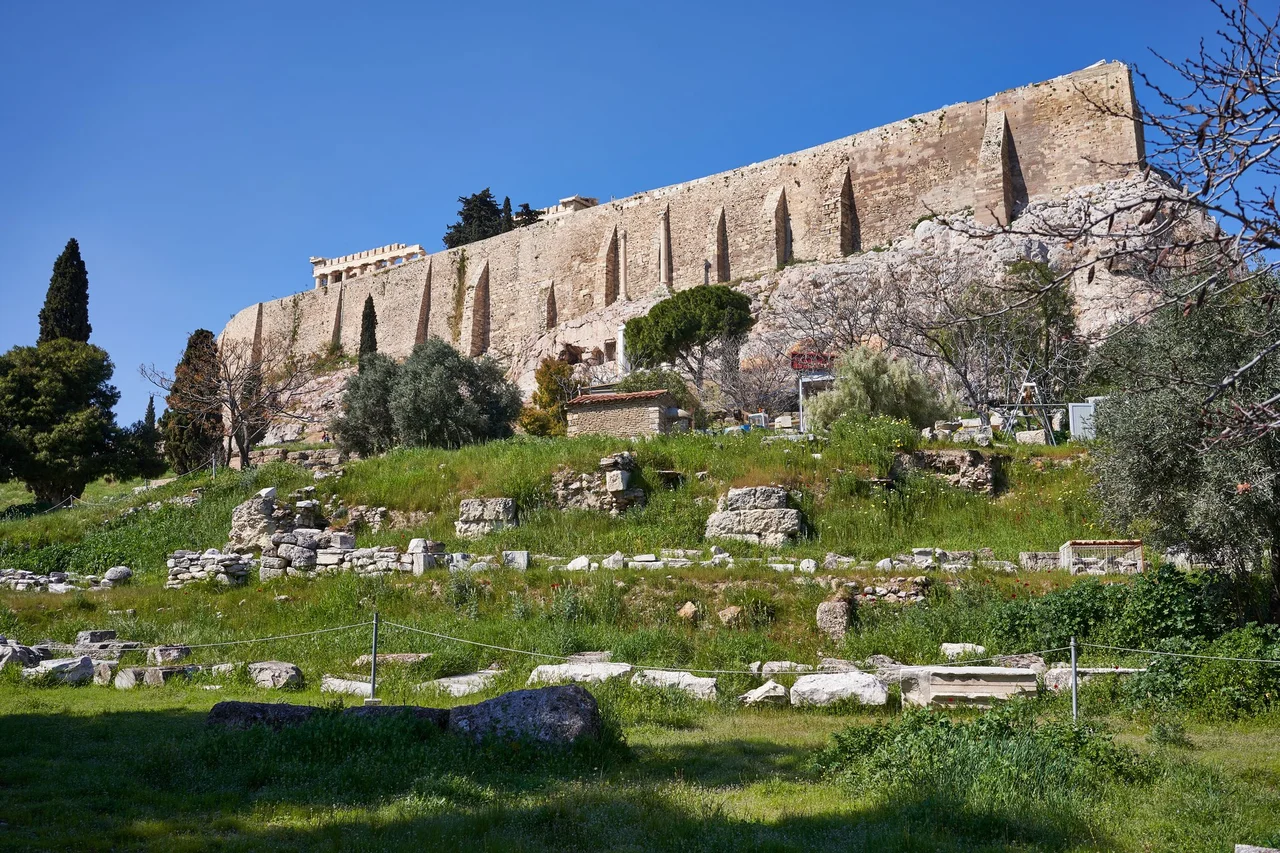

Odeon of Pericles
The roof was the trophy. When Pericles raised Athens' first great music hall beside the Theatre of Dionysus around 435 BC, he had it covered with the masts, spars, and rigging stripped from captured Persian ships - the timber of a defeated enemy reassembled into a pyramid that rose to a point like a tent. Ancient writers said its shape deliberately echoed the campaign tent of Xerxes, the Persian king whose vast invasion the Greeks had thrown back a generation earlier. Every concert held inside it was, quietly, a victory lap.
A Hall Made of War
The Odeon of Pericles broke the rules of its own building type. Where odeons were usually round, this one was square. Inside, a forest of pillars - ninety of them, set in nine rows of ten, as modern excavation of the foundations revealed - held up the conical roof. The effect was something between a temple and a tent, dim and dense with columns. It was built for the musical contests of the Panathenaea, the great festival of Athens, and it doubled as a practical shelter: when bad weather threatened, crowds from the open-air theatre next door could duck inside, and choruses used it to rehearse. Even Athenian courts borrowed the space, hearing alimony cases beneath that captured Persian timber.
Burned in a Siege
The building's end was as violent as its beginning was triumphant. In 87-86 BC, the Roman general Sulla laid siege to Athens during the First Mithridatic War. As his army closed in, the Odeon went up in flames. The sources disagree on who lit it. Some say Sulla himself; others blame Aristion, the city's own embattled leader, who is said to have torched the hall so that its great wooden roof beams could not be hauled out and used as siege engines against the Acropolis above. Either way, the music hall built from the spoils of one war was destroyed in another - its proud tent-shaped roof, three and a half centuries old, consumed in a single fire.
What Pausanias Saw
The hall did not stay a ruin. It was rebuilt, more lavishly than before, funded by Ariobarzanes II of Cappadocia and raised by the architects C. and M. Stallius and Menalippus. When the Greek traveler Pausanias passed through Athens in the second century AD, he judged the reconstructed Odeon 'the most magnificent of all the structures of the Greeks' - high praise from a man who had walked among the temples of an entire civilization. It was he who recorded the old tradition that the building's shape copied Xerxes' tent, a memory that had clung to the place for centuries. Today only foundations survive at the southeastern foot of the Acropolis, a faint rectangle in the dirt beside the Theatre of Dionysus. But the story they anchor - a concert hall born from a navy's wreckage and shaped like the enemy's tent - is one of the strangest victory monuments the ancient world ever raised.
From the Air
The Odeon of Pericles lies at 37.9706 N, 23.7286 E, at the southeastern foot of the Acropolis in central Athens, immediately beside the Theatre of Dionysus. Only its foundations remain, so from the air the surrounding Acropolis rock and the larger theatres are the navigational anchors rather than the odeon itself. Athens International Airport (LGAV) is roughly 33 km to the east-southeast. The Acropolis dominates the city skyline and is clearest in Attica's bright, dry summer light. Best viewed at low altitude over central Athens.
Nearby Stories
- Great Sand Beach 5 km away
- Battle of Delium 7.7 km away
- Tower of Aliartos 9 km away
- HMHS Britannic 10 km away
- Saronic Gulf 15 km away
- Sousaki Volcano 17 km away
- Sanctuary of Apollo Maleatas 24 km away
- Skyros 66 km away