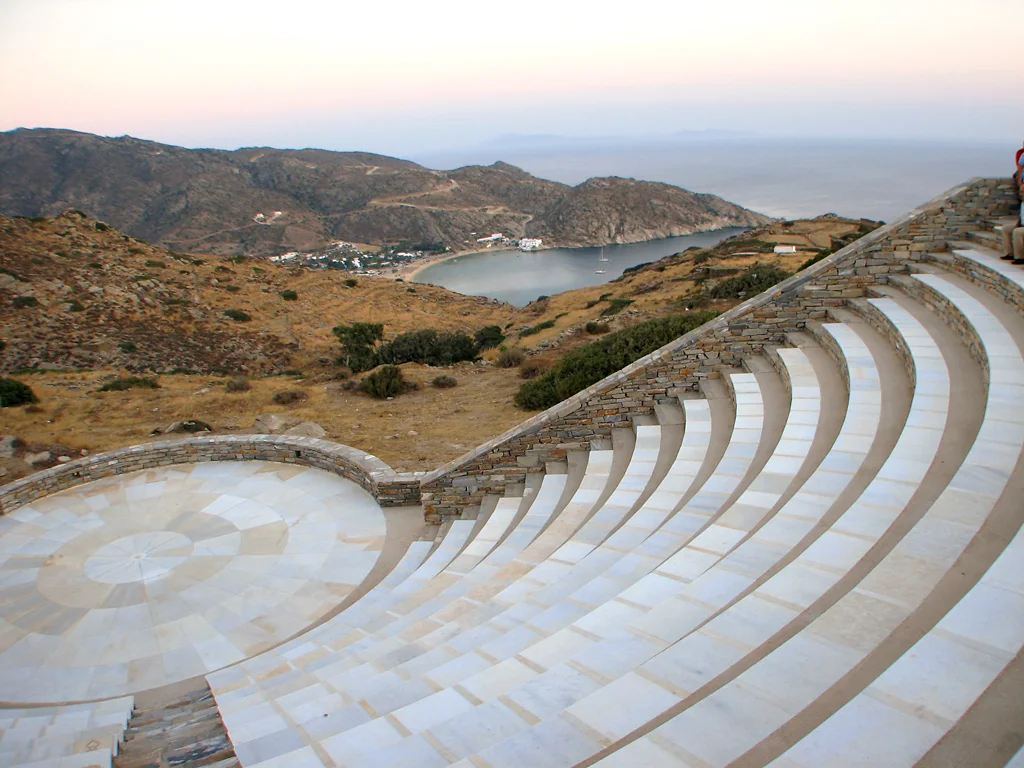

Odysseas Elytis Theatre
The name above the theatre's entrance carries two layers of literary weight at once. Odysseas Elytis — the Aegean poet who won the Nobel Prize in Literature in 1979 — shares his first name with Odysseus, the wandering hero whose story Homer told. And Ios, this small Cycladic island where the theatre stands, is the island where Homer himself, according to ancient tradition, died. A theatre honouring Elytis, on the island of Homer: the coincidence feels less like accident than inevitability.
Stone and Marble on a Hillside
The Odysseas Elytis Theatre was completed in 1997, the work of architect Peter Haupt, a professor at the University of Berlin. Haupt looked to the ancient theatres of Greece and Magna Graecia for his model, and the result sits comfortably in that tradition: marble seating for 1,100 spectators, local stone for the rest of the structure, and a stage with a diameter of 12 metres. The seats face south — a deliberate choice that gives every audience member a view across the Aegean and shields them from the prevailing summer winds that sweep through the Cyclades. There is something fitting about this orientation. The sea is not backdrop here; it is part of the performance.
The Poet the Theatre Honours
Odysseas Elytis was born in 1911 in Heraklion, Crete, and grew up immersed in the light and saltwater landscapes of the Greek world. His poetry is saturated with the Aegean — its clarity, its harshness, its mythological weight. He received the Nobel Prize in Literature in 1979, cited for poetry that depicts the struggle of modern Greece against a background of Greek tradition. His most celebrated work, 'Axion Esti' (It Is Worthy), is a long poem that draws on Byzantine liturgy, folk song, and the raw beauty of the Greek landscape. To name a theatre after him on an island in the heart of the Cyclades is to place his voice exactly where it belongs.
Homer's Shadow
Ancient sources associated Homer — the poet who composed the Iliad and the Odyssey — with Ios. According to tradition, Homer died on the island and was buried there, though no grave has ever been identified with certainty. Ios honours this connection every year through the Omireia cultural festival, held from May through September. The festival takes its name from the Greek for Homer — Omiros — and draws together events that range from a theatre competition among Cycladic schools to art exhibitions, photography shows, and athletic contests. The Odysseas Elytis Theatre serves as the centrepiece for these gatherings, hosting concerts by major Greek and international artists alongside the festival's other programmes.
An Amphitheatre Alive
Open-air theatres in Greece carry a particular quality after dark. The marble stays warm from the day's sun long into the evening, and in a theatre facing south over the Aegean, the horizon is visible during late-afternoon performances, the sea catching whatever light remains. The Municipality of Ios runs the concert and events programme in cooperation with the local tourism development company, keeping the venue active through the summer season. For a small island, the scale of what happens here — national-calibre performers, an annual festival rooted in Homer — is quietly remarkable. The theatre holds its own against the landscape rather than being overwhelmed by it.
From the Air
The Odysseas Elytis Theatre sits near Ios Chora at approximately 36.72°N, 25.29°E, on the hillside above the town. Ios is in the central-southern Cyclades, roughly 200 km southeast of Athens. The nearest major airport is LGAV (Athens International Eleftherios Venizelos); Ios itself has no airport and is reached by ferry from Piraeus (roughly 7-8 hours by conventional ferry, under 4 hours by fast catamaran). From the air at around 5,000 feet, the island is recognisable by its compact, whitewashed Chora clustered on the hill above the natural harbour of Ios port. The open bay to the south is Mylopotas. The theatre is not visible from altitude but lies on the northern slope of the Chora hill. Summer visibility over the Cyclades is typically excellent.
Nearby Stories
- Cyclades 9.9 km away
- Phylakopi 15 km away
- 1956 Amorgos Earthquake 26 km away
- Serifos 28 km away
- Ikaria 87 km away
- Archaeological Museum of Chania 110 km away
- Heraklion Archaeological Museum 117 km away
- Archaeological Museum of Agios Nikolaos 133 km away