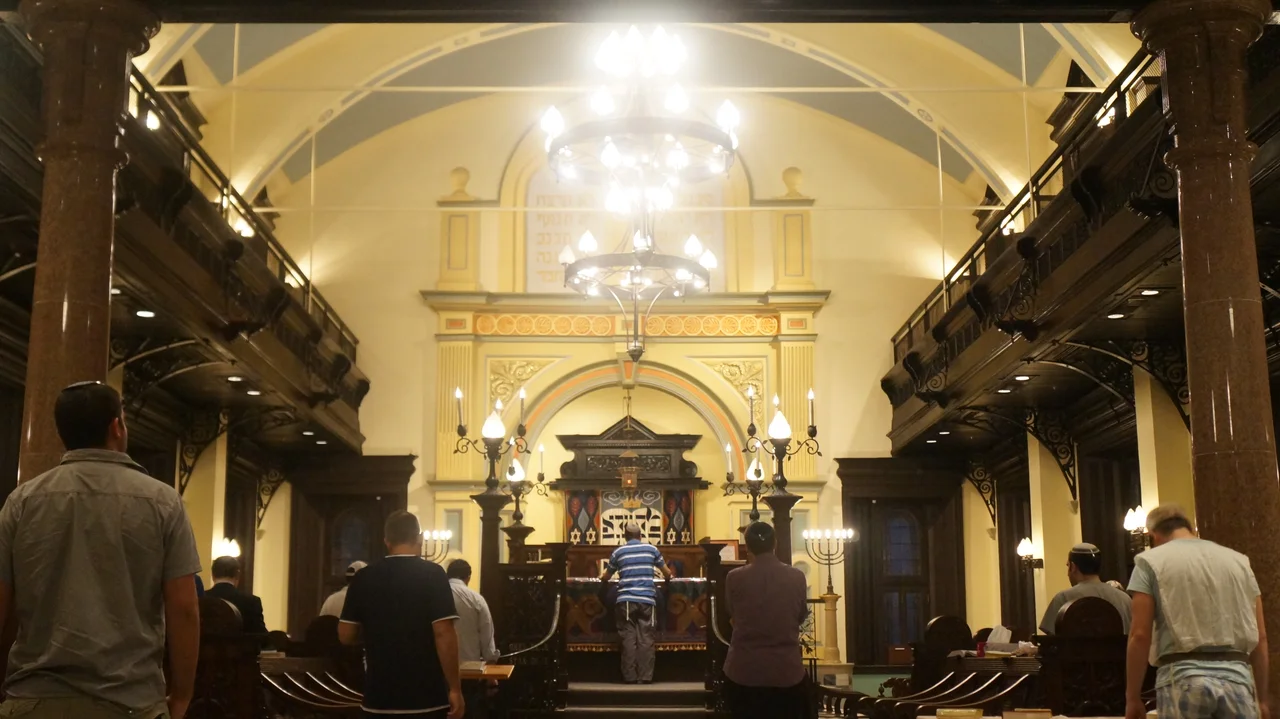

Ohel Leah Synagogue
The building is whitewashed and turreted, two storeys tall, and it sits on the slope of Hong Kong Island's Mid-Levels in a way that is easy to miss if you are not looking for it. Glass towers press in from all sides. The Ohel Leah Synagogue does not compete with them in height or in spectacle. What it offers instead is continuity: it has been here since 1902, and it has been in continuous use ever since. The name means 'Tent of Leah' in Hebrew — a memorial to Leah Sassoon, whose sons Jacob, Edward, and Meyer donated the land on which the synagogue was built.
The Sassoon Gift
The Sassoon brothers who funded the Ohel Leah were among the heirs to a trading empire built by their family in the 19th century. The Sassoons were Baghdadi Sephardic Jews who had moved from Baghdad to Bombay and then, following the expansion of British colonial trade, to Hong Kong and Shanghai. By the mid to late 1800s, they were among the most prominent merchant families in East Asia. Their decision to donate land for a synagogue on Hong Kong Island was part of a broader pattern — the family also funded the Ohel Rachel Synagogue in Shanghai — of using accumulated wealth to create permanent institutional anchors for the Sephardic communities they were part of. The synagogue was designed by the architectural firm Leigh & Orange and completed in 1901–1902. Its Edwardian Colonial style was standard for the era's prestige civic buildings in Hong Kong, but the whitewashed exterior and the turreted roofline give it a character distinct from the more austere commercial buildings nearby.
A Community Centre, Not Just a Building
The Ohel Leah has never operated in isolation. Since its establishment, it has functioned alongside the adjacent Jewish Recreation Club and the Jewish Community Centre as a compound — religious, social, and recreational life concentrated in a single hillside precinct. The original congregation was predominantly Baghdadi Sephardic, and the synagogue operated under the superintendence of the Haham of the Spanish and Portuguese Congregation of London. The congregation received its first officially appointed rabbi in 1961, nearly sixty years after the building opened. Today, the Ohel Leah is fully independent, drawing members from across the Jewish diaspora — Ashkenazi, Sephardic, and communities in between. Three other Jewish congregations have since emerged in Hong Kong: a Sephardic congregation dominated by Israeli expatriates, the Chabad Lubavitch, and the United Jewish Congregation, which aligns with Reform and Conservative movements. Many Hong Kong Jews hold memberships in more than one congregation simultaneously.
The Near-Demolition
In July 1987, the Hong Kong government listed the Ohel Leah as a Grade I historic building — the highest heritage classification available. By December of the same year, the listing had been voluntarily withdrawn. Talk of demolishing the building had emerged, and the government moved quickly: rather than allow the situation to develop, the Antiquities Authority declared the Ohel Leah a proposed monument, a designation that provided immediate protection against demolition while a longer-term arrangement was negotiated. The building was relisted as Grade I in 1990. The episode illustrates both the precariousness of heritage protection in Hong Kong's property market and the speed with which institutional protections can be mobilised when the will exists. The synagogue survived, which was not inevitable.
Restoration and Recognition
Beginning in 1996, the Ohel Leah underwent a US$6 million restoration that returned its interiors and exteriors to their original condition, with a formal rededication ceremony held in October 1998. The work was thorough enough to earn the Outstanding Project Award at the 2000 UNESCO Asia Pacific Heritage Awards for Culture Heritage Conservation — a recognition that placed it among the best heritage restoration projects in the region that year. Walking inside, the restored interior reflects the original design intentions of Leigh & Orange: the proportions of a Victorian-era place of worship translated into a tropical climate, adapted for the Sephardic liturgy with which the building was designed to resonate. Most of Hong Kong's Jewish community lives within short distance of the synagogue, which is not accidental — the Mid-Levels hillside has long concentrated the city's expatriate professional population.
From the Air
The Ohel Leah Synagogue sits at approximately 22.282°N, 114.149°E in the Mid-Levels of Hong Kong Island, on the slope between Central and the Victoria Peak area. Approaching VHHH from the west at 3,000–5,000 ft, the Mid-Levels residential terraces are visible as a dense residential band between the commercial towers of Central below and the green ridgeline of Victoria Peak above. The synagogue itself is not individually visible from altitude, but its neighbourhood — densely planted with mature trees between apartment towers — is one of the more visually distinctive parts of Hong Kong Island's northern slope.
Nearby Stories
- Lok Ma Chau Loop 2.3 km away
- Portas do Cerco 2.3 km away
- Kweilin Incident 17 km away
- Wanshan Archipelago Campaign 34 km away
- Nanxiong Formation 115 km away
- Battle of Nanpeng Island 148 km away
- Heyuan 169 km away
- Cape Maobitou 632 km away