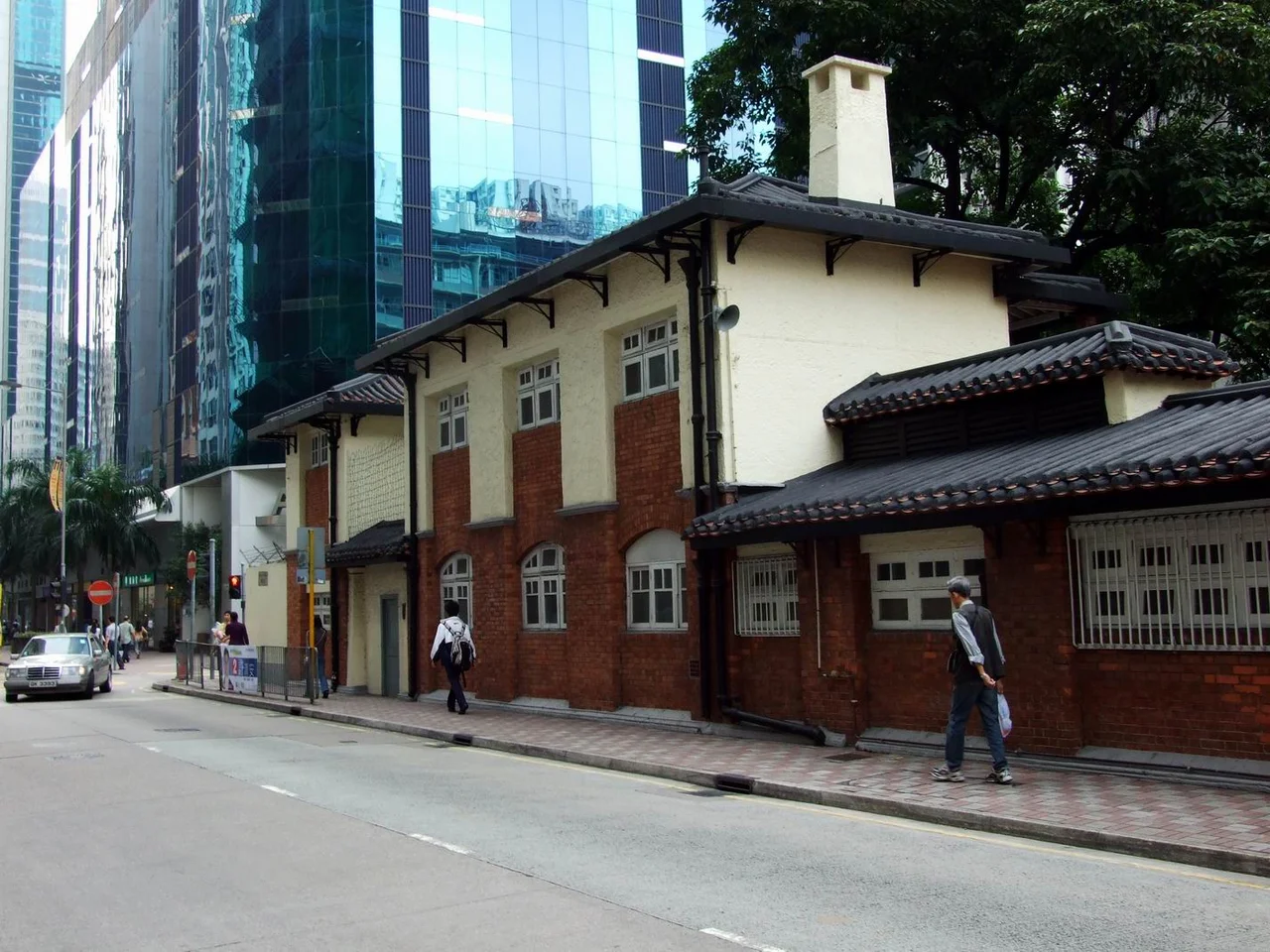

Oi! (Hong Kong)
The exclamation mark is not an accident. When Hong Kong's Leisure and Cultural Services Department chose a name for the art space at 12 Oil Street, they picked something that demands a response — a shout, a greeting, a call to look twice at what surrounds you. "Oi!" derives from the street name, but in Cantonese the Chinese characters form a homonym for the address's number: 12 sounds like "release." The name carries both meanings deliberately. This building has always been about releasing something — first sailors from their working days, then artists from the margins, now communities from the idea that art belongs only to galleries and institutions.
The Yacht Club That Time Forgot
In 1908, North Point's shoreline met the harbour directly, and the Royal Hong Kong Yacht Club's new clubhouse had an unobstructed water view. Governor Sir Frederick Lugard formally opened the building on 21 March 1908 — a two-storey Arts and Crafts structure of warm brick and wide verandahs, built to host the colony's sailing elite. For thirty years the club's members gathered here before land reclamation gradually severed the building from the water it faced. By 1938, the Yacht Club had relocated to Kellett Island, taking its boats and banquets but leaving the architecture behind.
What followed was an undistinguished middle age. After World War II the buildings served as a garage, government staff quarters, and a storage depot. Decades passed. The complex sat overlooked in its own city, hemmed in by the commercial density of North Point, until the Antiquities and Monuments Office recognised it as a Grade II historic building — a designation it received in 1995.
Two Years That Changed Everything
Between 1998 and 2000, something unexpected happened on Oil Street. The Government Supplies Department had vacated its adjacent depot, and rather than leave the space empty, authorities offered short-term tenancies to local artists and organisations. What emerged — informally, organically — became known as the Oil Street Artist Village: the first locally formed art community in Hong Kong.
The village lasted only two years before the building was vacated again, but those two years seeded something lasting. The artists dispersed, some relocating to the Cattle Depot Artist Village in To Kwa Wan, but the idea that this particular corner of North Point could anchor creative life refused to die. When the Antiquities and Monuments Office eventually cleared out and planners began thinking about adaptive reuse, there was already a community memory of what the space could become.
Art as Infrastructure
Oi! opened in May 2013. The government's framing was explicit: this was not a museum, not a gallery in the traditional sense, but a platform for co-creation. The programme divides into three streams. Y! Projects supports young artists with exhibition space and professional exchanges. E! Projects bring the wider community into the creative process. A! Projects focus on artist development and experimental exchange. The ambition threading through all three is the same: that art should be woven into ordinary life, not set apart from it.
The complex — a main building and two ancillary structures — has grown since its founding. A major extension opened on 24 May 2022, adding the Oi! Glassie, Oi! Garden, Oi! Lounge, and Oi! Deck. The old clubhouse verandahs, where yacht club members once watched their boats on the harbour, now look out over a city that has long since claimed that water for land.
What Arts and Crafts Means in North Point
The original 1908 building still carries its architectural character clearly. Red Canton brickwork, granite string courses, and moulded cornices define the exterior. Wide verandahs wrap the facade, keeping the interiors shaded in the way that colonial builders learned from tropical climates. The Arts and Crafts movement valued honest materials and human-scaled craftsmanship over industrial grandeur — qualities that sit comfortably against the dense residential towers now surrounding the site.
Inside, the rooms that once hosted sailing committees and club dinners have been opened into exhibition spaces. The building holds the tension between its origins and its present use without forcing a resolution. Reclaimed, not erased.
From the Air
Oi! sits at 22.2888°N, 114.1930°E on Hong Kong Island's north shore in the North Point district. From the air at 3,000 feet, the neighbourhood's dense urban grid is visible along the waterfront east of Causeway Bay. The nearest major airport is Hong Kong International Airport (VHHH), located on Lantau Island approximately 30 km to the west-southwest. Approaching from the east over Victoria Harbour, the distinctive reclaimed waterfront of North Point and the Island Eastern Corridor elevated highway mark the area. Clear days reveal the full sweep of Kowloon across the harbour.
Nearby Stories
- Lok Ma Chau Loop 2.3 km away
- Portas do Cerco 2.3 km away
- Kweilin Incident 17 km away
- Wanshan Archipelago Campaign 34 km away
- Nanxiong Formation 115 km away
- Battle of Nanpeng Island 148 km away
- Heyuan 169 km away
- Cape Maobitou 632 km away