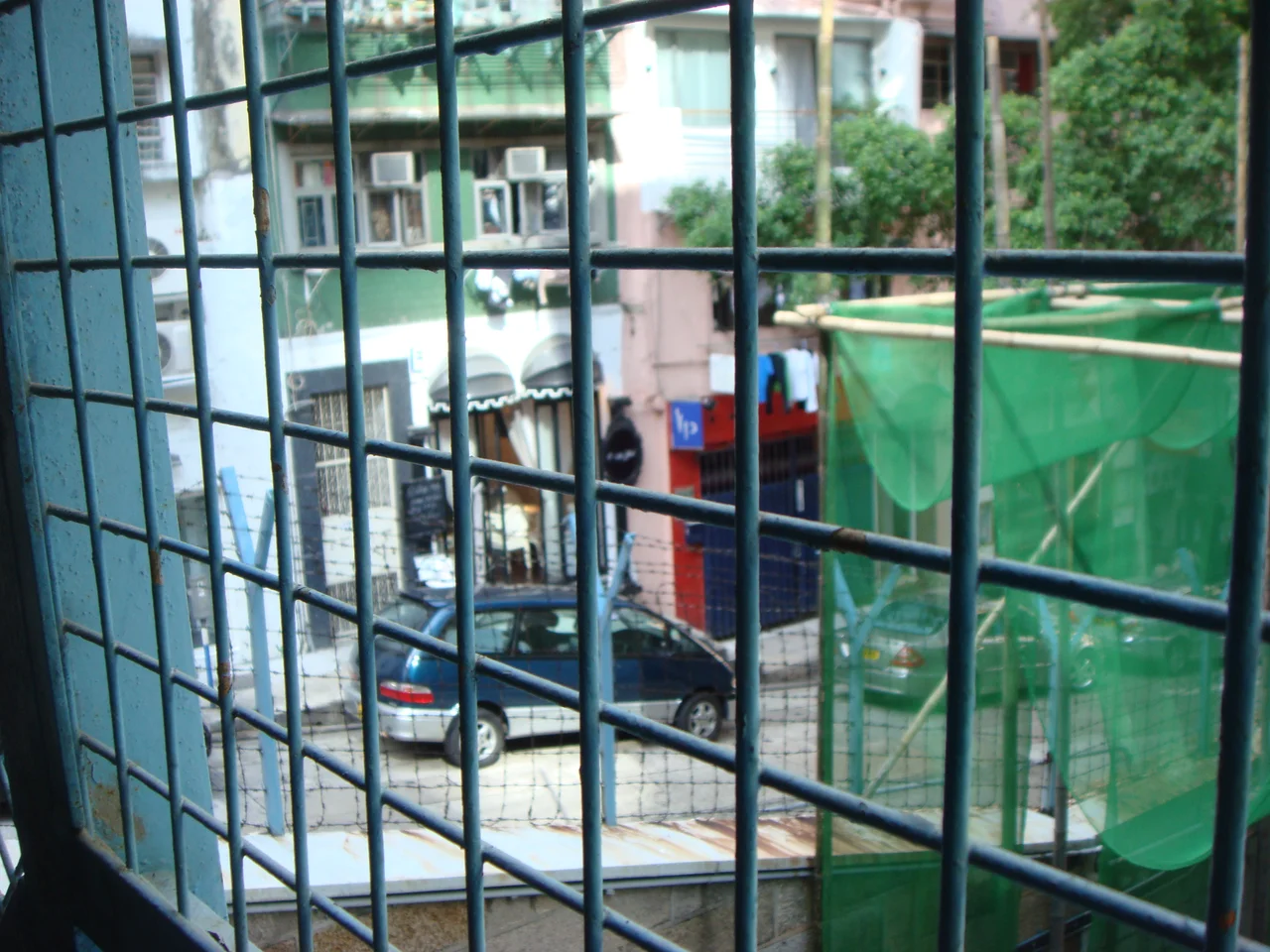

Old Bailey Street
The street is steep enough that its sidewalks required 74 stairs to make them passable, and its name imports the full weight of English criminal justice to a hillside in Hong Kong. Old Bailey Street — named for the London street that houses the Central Criminal Court of England and Wales — was built for one reason: to connect Hollywood Road to the gate of Victoria Gaol, the colony's first prison, constructed in 1841. Everything that followed, over nearly two centuries, accumulated around that original purpose and its shadow.
The Gate at the Bottom of the Slope
Victoria Gaol was Hong Kong's first prison, built in 1841 in the earliest years of British rule. The street that served its entrance was known by a simpler name before it acquired its formal designation: locals called it "the long slope." The explanation is double-edged. Topographically, the street does slope. But the folk etymology that has attached to the name is more human: prisoners completing their sentences walked out of the gaol gate onto Old Bailey Street, and the slope they descended led away from confinement toward whatever life came next. Whether or not the story is literally true, it captures how streets that border institutions of punishment absorb the emotional weight of the traffic that moves through them.
The gaol grew as the colony's population grew. By 1925, with Stanley Prison under construction, those sentenced to more than a year were increasingly housed further from the city centre, and Old Bailey Street's character began slowly shifting.
Parades, Cangues, and the Temple Plaza
During the early decades of colonial rule, punishment in Victoria Prison was partly public. Prisoners were forced to parade through the streets — beaten with a cane, arms locked in a cangue, a wooden board on which their names and crimes were written for anyone to read. Policemen, often of Indian descent, would escort the prisoners from the gaol down to a plaza in front of the Man Mo Temple on Hollywood Road, where passers-by were expected to condemn them aloud. After a few hours of public shaming, the prisoners were returned to Old Bailey Street and the gaol.
This form of punishment was abolished after World War I. What it reveals about the colonial administration's approach to crime and its relationship with the local population sits uncomfortably in retrospect — spectacle as deterrence, humiliation as justice. The people subjected to these parades had names, families, and lives that the system reduced to an inscription on a board.
Bombs and Girls' Education
Old Bailey Street carried two very different institutions by the late nineteenth and early twentieth centuries. At No. 16 Hollywood Road, on the corner where the street meets its northern anchor, the Government Central School for Girls was founded in 1890. Later renamed Belilios Public School, it aimed to provide — in the language of the time — "an ordinary middle-class English education" to the daughters of Chinese, European, and Indian residents. The school's founding on this street, within sight of the gaol, says something about how closely education and punishment were administered in the same colonial geography.
On the afternoon of 15 December 1941, during the Battle of Hong Kong, Japanese bombs struck the junction of Old Bailey Street and Caine Road, along with several other Central targets. The bombardment was part of a systematic attack on Hong Kong Island's north shore. The street survived, but its wartime scar joined the layers of history it was already carrying.
Tai Kwun and the Long Aftermath
Victoria Prison closed in December 2005. The old Central Police Station at the intersection of Old Bailey Street and Hollywood Road — which had stood since 1841 alongside the gaol — closed around the same time. After years of consultation, both structures, along with the Former Central Magistracy, were redeveloped into Tai Kwun, a heritage and arts centre that opened to the public on 29 May 2018. The name means "big station" in Cantonese — a name that acknowledges, without quite resolving, what the site was for most of its history.
Meanwhile, the mid-1990s had already begun changing the street's feel. Bars and restaurants moved in as SoHo's entertainment district expanded up the hill. The Old Bailey Street Police Married Quarters at 17A, completed in 1986, was fortified with razor wire following the 2019-20 pro-democracy protests. At the corner of Hollywood Road, No. 20 — on a lease dating to 1844, one of the earliest lots sold in Hong Kong — stands as a four-storey Art Deco building from 1953, listed Grade III historic. The street accumulates.
From the Air
Old Bailey Street sits at approximately 22.2813°N, 114.1535°E in the Central district of Hong Kong Island, on the steep hillside between Hollywood Road and Caine Road. At altitude, the dense mid-levels terrain is visible as a sharp rise from the harbour. Tai Kwun, the heritage complex that includes the former Victoria Prison, occupies a notable footprint at the street's northern end. Hong Kong International Airport (VHHH) is on Lantau Island approximately 28 km to the west-southwest. The Central business district and its waterfront piers are less than a kilometre to the north.
Nearby Stories
- Lok Ma Chau Loop 2.3 km away
- Portas do Cerco 2.3 km away
- Kweilin Incident 17 km away
- Wanshan Archipelago Campaign 34 km away
- Nanxiong Formation 115 km away
- Battle of Nanpeng Island 148 km away
- Heyuan 169 km away
- Cape Maobitou 632 km away