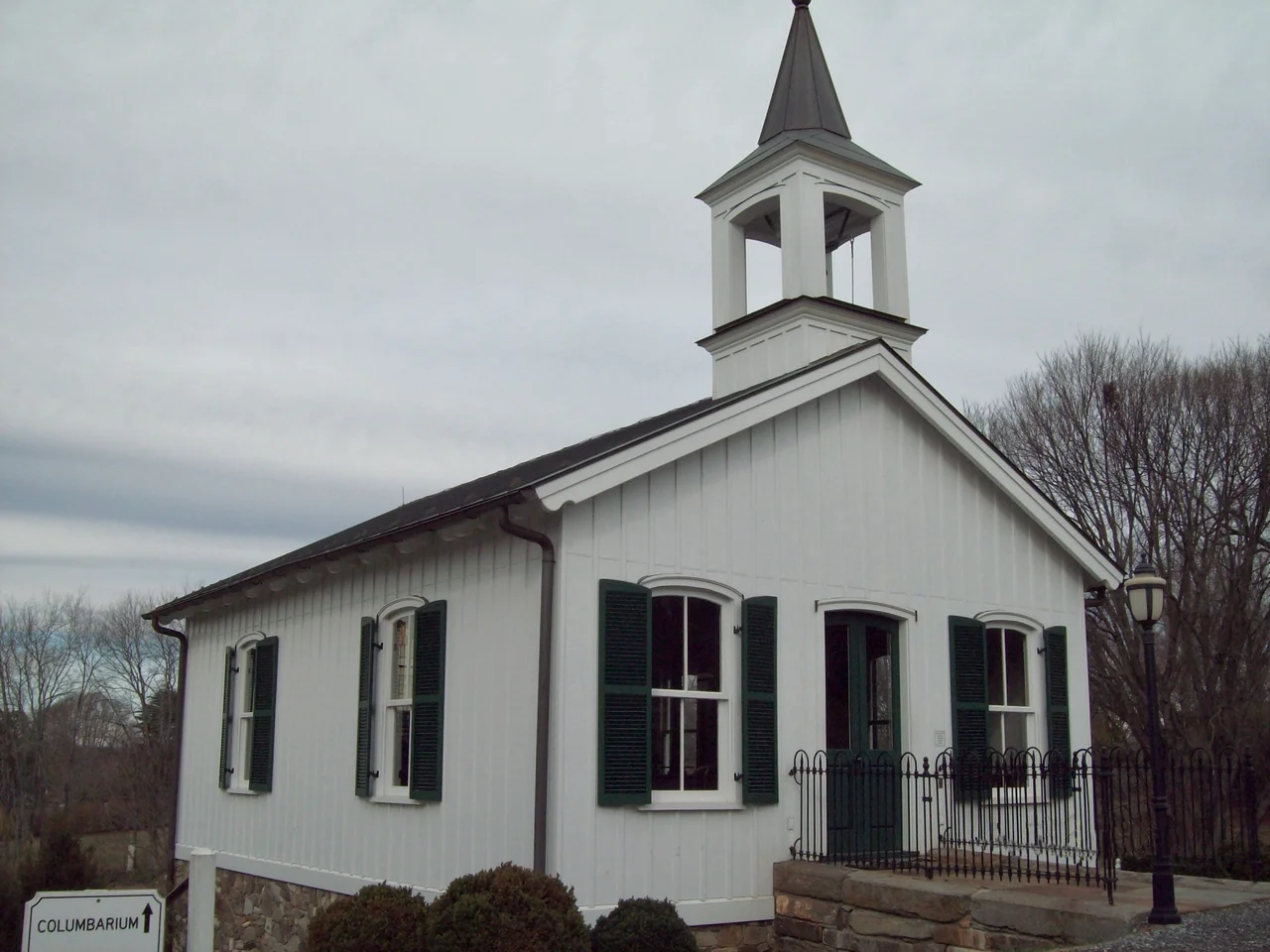

Old City Cemetery
John Lynch and his wife Mary gave the City of Lynchburg one acre on a hill on the west side of the road to New London in March 1806. The deed said the land was to be used as a public burying ground or for a house of worship — and "for no other purpose whatsoever." Two centuries later, the Old City Cemetery is still doing exactly what John and Mary Lynch said it should do. Twenty-seven acres of green hill above downtown, an estimated 18,000 to 20,000 people resting here, and two-thirds of those burials are African American. It is the oldest municipal cemetery still in use in Virginia, and one of the oldest in the United States. It is also, today, an arboretum and a history park and a working rose garden, the last of which holds one of the largest public collections of heirloom roses in the South.
Who Lies Here
The burials in Old City Cemetery represent an unusually broad cross-section of the early American South. There are the founding families of Lynchburg — Lynches and Cabells and Daniels — buried in marked plots near the entrance. There are German and Irish immigrants who came to work in the tobacco factories. There are paupers in unmarked graves and strangers who died passing through town and were buried at city expense. There are more than 2,200 Confederate soldiers from fourteen states, men who died in Lynchburg's military hospitals during the Civil War and were buried in long rows in a section that still bears the Confederate names. But the largest single group — by a wide margin — is African American. From 1806 to 1865 this was the only burial ground in the area available to African Americans outside private family graveyards. Over ninety percent of Lynchburg's enslaved and free Black population was laid to rest here.
Ota Benga
One of the most heartbreaking American stories ends — probably — in this cemetery. Ota Benga was a Congolese man, born around 1883, first brought to the United States by the businessman Samuel Verner for display at the 1904 St. Louis World's Fair, and then — after a return to Africa — brought back to the United States and exhibited at the Bronx Zoo in 1906 in the monkey house as a curiosity. He was paraded as a "pygmy" — the period word for the small-statured peoples of central Africa — for the entertainment of white crowds who came to gawk. After protests by Black clergy, he was released to a Black orphanage in Brooklyn, and eventually came south to Lynchburg, where he lived for several years, worked at a tobacco factory, and was taken in by the local African American community. He had filed his teeth into points as a young man in the Congo, before any of the rest of this had happened to him. In March 1916, unable to afford passage home to the Congo and unable to bear staying any longer, he shot himself. His burial likely happened here at Old City Cemetery, though his remains may have been moved later to White Rock Hill Cemetery. He was thirty-two.
The Pest House and the Lynchburg Method
The cemetery includes four small house museums. The most striking is the Pest House Medical Museum — a quarantine hospital that served Lynchburg through the nineteenth century, where patients with smallpox, scarlet fever, and yellow fever were isolated. The phrase Lynchburg Method refers to a set of nineteenth-century quarantine and sanitation practices developed locally to handle yellow fever outbreaks, before germ theory was widely accepted. The other museums tell adjacent stories: the Hearse House and Caretakers' Museum on the history of funerals; the Station House Museum, a reconstructed C&O Railway depot furnished as it would have been during World War I, when Lynchburg's rail station saw thousands of soldiers passing through; and the Mourning Museum on Victorian and Edwardian mourning customs, from black crepe to memorial photography of the dead. They are small and quiet and worth the walk.
A Garden, Too
Since the 1990s the cemetery has also been operated as an arboretum and rose garden. The Southern Memorial Association — a Lynchburg women's group founded in 1866 to maintain Confederate graves and later expanded to care for the whole cemetery — has overseen the planting and maintenance. Heirloom roses thread through the burial plots, some of them varieties that predate the Civil War. A non-denominational chapel built for the bicentennial in 2006 sits at the high end of the grounds, with a small columbarium below for present-day burials. The cemetery does not stop accepting new burials — it remains active. It is one of the most-visited historic sites in Lynchburg, and at any time of year you will see local people walking the paths, reading the headstones, naming the dead.
From the Air
Old City Cemetery sits on a hill in southwest Lynchburg, approximately 37.415 N, 79.1567 W, between Fifth Street and Park Avenue. A 27-acre green clearing in the urban grid, with the small chapel and several historic outbuildings visible from low altitude. Nearest airport: Lynchburg Regional (KLYH), 4 nm south.
Nearby Stories
- Appomattox-Buckingham State Forest 4.8 km away
- Hollins University 12 km away
- Franklin County, Virginia 13 km away
- Buena Vista, Virginia 15 km away
- Smith Mountain Lake 24 km away
- Alleghany County, Virginia 26 km away
- Murder of Hannah Graham 36 km away
- Staunton River State Park 44 km away