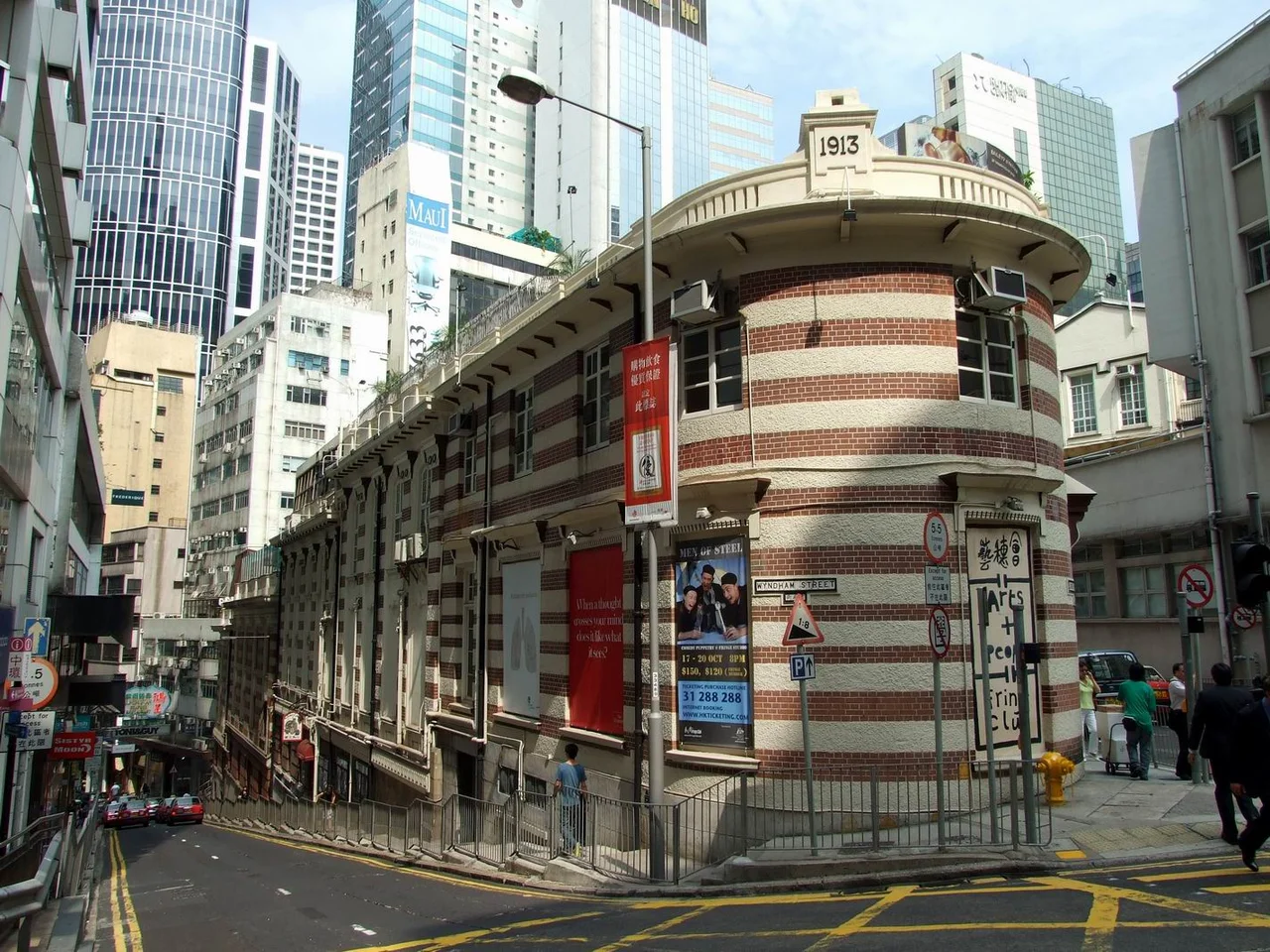

Old Dairy Farm Depot
Milk was the original cargo. In 1892, the Dairy Farm company erected a low-rise brick-and-stucco warehouse on Lower Albert Road to keep their product cold in Hong Kong's subtropical heat, and the building has been quietly reinventing itself ever since. What once held butter and winter garments now hosts late-night debates among journalists and experimental theatre in a city famous for tearing down yesterday to build tomorrow. That this particular yesterday is still standing — on one of the most valuable patches of real estate in the world — is the real story.
Cold Storage, Hot City
When architects Danby & Leigh (today operating as Leigh & Orange) drew up the original plans in 1892, refrigeration was still a novelty in the tropics. The company needed a reliable cold chain for dairy products arriving from farms across the region, and the Lower Albert Road site — set back slightly from the commercial frenzy of Queen's Road — offered the footprint they needed. The initial building covered roughly half of what visitors see today, occupying just the southern portion of the lot. Over the next three decades, expansions in 1913, 1917, and 1925 transformed it incrementally: a dairy shop was added, then a room for smoking meats, then cold storage for seasonal goods, and finally residential quarters for the general manager. By the time the additions were complete, the depot had become a small compound of colonial-era functionality, each wing added as the business demanded.
From Dairy to Dispatch
The Dairy Farm company used the building as its operations hub for decades, and when the business outgrew it in the 1970s and moved on, the question of what to do with an aging Victorian structure in the middle of Central became pressing. Hong Kong was in the midst of its economic boom, and the pressure to redevelop was immense. The building's survival owed something to timing, something to advocacy, and something to the particular character of the two organisations that moved in. The Foreign Correspondents' Club took over the North Block in 1982, finding in its worn plaster and high ceilings an atmosphere more suited to long lunches and fierce arguments than any glassy tower could provide. The Hong Kong Fringe Club followed in 1984, occupying the South Block and turning it into one of the city's most consequential venues for alternative arts — performance, exhibitions, and the kind of work that doesn't quite fit anywhere else.
The Weight of a Grade I Listing
Official recognition came in stages. The building was first listed as a Grade II historic structure in 1981, a designation that acknowledged its historical interest without guaranteeing protection. The more significant upgrade came in 2009, when it was elevated to Grade I — the highest tier in Hong Kong's heritage grading system, reserved for buildings of outstanding significance that merit every effort to preserve. Between those two dates, the South Block underwent a careful renovation and conversion, work that earned the 2001 Hong Kong Heritage Award from the Antiquities Advisory Board and the Antiquities and Monuments Office. That award recognised not just the physical quality of the work but the approach: treating the building as a living institution rather than a relic behind glass. The wrought-iron details, the stucco facades, the proportions that speak of another century — all of it remains, now framing theatre posters and the clink of the correspondents' ice.
Two Institutions, One Corner
Stand at the corner of Lower Albert Road and Wyndham Street on any given evening and the building reveals its double life. From one side, the FCC's barroom hum filters out — journalists, diplomats, and analysts who have made this address a fixture of the city's news culture since 1982, meeting here when the stories they were covering were themselves writing history. From the South Block entrance on Lower Albert Road, a different current flows: theatre-goers, artists, the particular energy of a city that has always needed spaces for the work that doesn't seek official approval. That the same 1892 butter depot contains both says something about how Central functions — layered, adaptive, and quietly unwilling to let its best buildings simply disappear.
From the Air
The Old Dairy Farm Depot sits at 22.2803°N, 114.1558°E in Central, Hong Kong Island, roughly 500 metres east-northeast of Hong Kong's Central waterfront reclamation. At 3,000 feet AGL on approach to VHHH (Hong Kong International Airport), the dense mid-levels cityscape of Central is visible to the south. The building is tucked below the green slopes of Glenealy and the forested upper Mid-Levels, identifiable by the break in the glass-and-steel towers around it. Kai Tak (the former airport site) lies across the harbour to the northeast; Cheung Chau island is visible to the southwest on clear days.
Nearby Stories
- Lok Ma Chau Loop 2.3 km away
- Portas do Cerco 2.3 km away
- Kweilin Incident 17 km away
- Wanshan Archipelago Campaign 34 km away
- Nanxiong Formation 115 km away
- Battle of Nanpeng Island 148 km away
- Heyuan 169 km away
- Cape Maobitou 632 km away