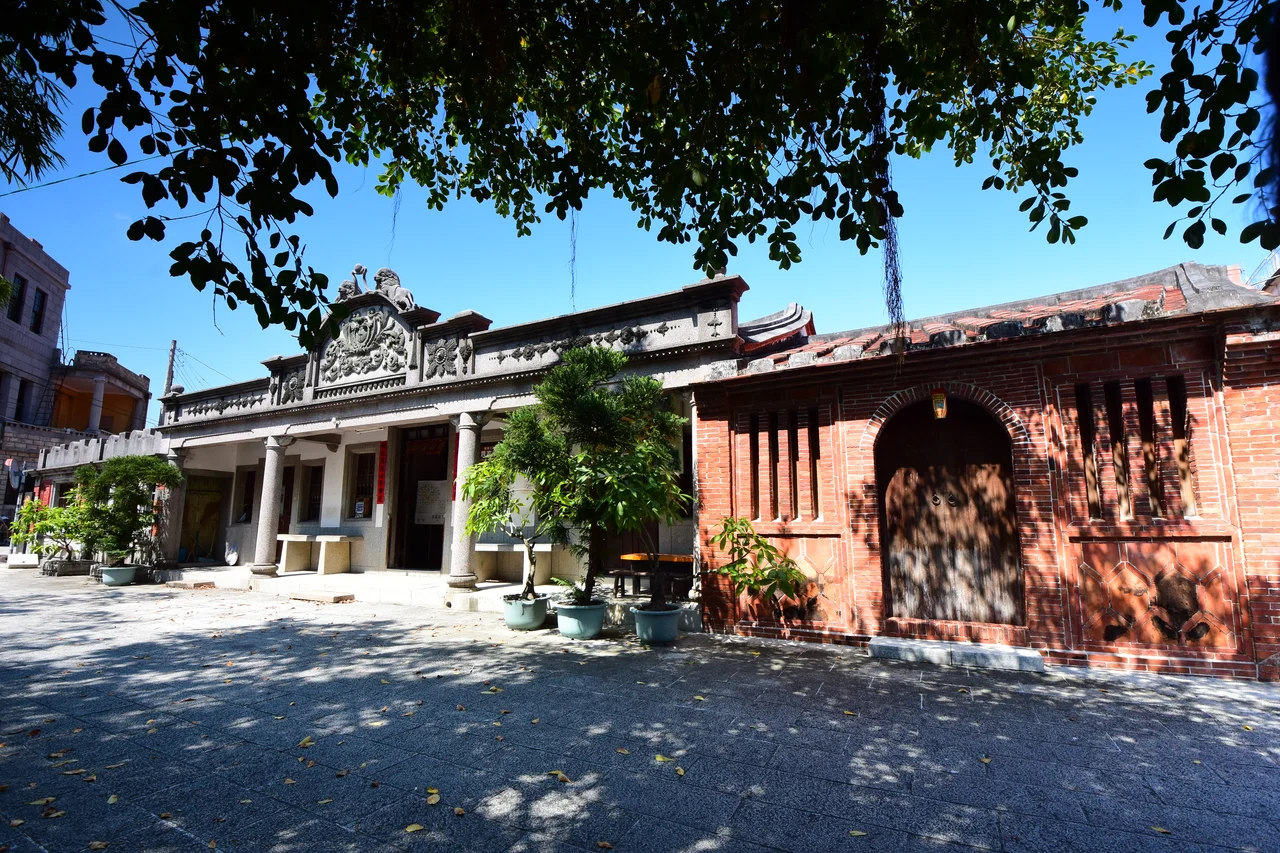

Old House of Siiao Family
The construction took twenty years. The Siiao family began building in 1860 and finished in 1880 — two courtyards, five blocks, more than fifty rooms spread across 4,000 square meters of Jiadong Township, Pingtung County. By the time they were done, they had a compound worthy of a prosperous Hakka merchant clan that had traveled from Guangdong to make a new life on the edge of southern Taiwan. Fifteen years later, the Qing Dynasty handed Taiwan to Japan, and shooting started in the lanes outside.
Merchants from Guangdong
The Siiao family arrived in Taiwan from Guangdong, part of the Hakka migration that brought tens of thousands of people from southeastern China to the western plains of Taiwan over the eighteenth and nineteenth centuries. They worked as businessmen — the precise nature of their trade is not recorded, but the scale of their ambition is: they chose to build a compound that would serve not just as a home but as a declaration of arrival. The construction began in 1860 and ran through 1880, twenty years of quarrying stone, shaping timber, and laying out the two courtyards and five interlocking blocks that give the house its formal structure. By the standards of the region and the era, it was a significant undertaking.
A House Built in Five Blocks
Hakka domestic architecture in southern Taiwan follows a recognizable logic: a main axis running from gate to ancestral hall, with wings on either side that enclose a central courtyard, and an outer ring of buildings that provide additional rooms and define the compound's edges. The Siiao house is built on that principle, with two courtyards and five distinct blocks. The entrance hall faces south, as tradition requires. Behind it lies the room holding ancestor tablets, a formal space where the family's dead remained present in domestic life. Alongside that, a shrine room for the Gods of Heaven and Earth. The remaining blocks served as living quarters for a family whose number, across generations, must have filled those fifty-plus rooms with some regularity. The total floor area of 4,000 square meters is not a small inheritance to manage.
The Year the Empire Changed Hands
In April 1895, the Qing Dynasty signed the Treaty of Shimonoseki, ceding Taiwan to Japan. What followed was not a peaceful transfer. Across the island, local resistance to Japanese rule broke out almost immediately. In the south, where the Siiao family compound sat in Jiadong Township, the conflict was close enough to mark the walls. Shooting happened outside and, apparently, through the building: bullet holes remain visible on the interior walls of the house today, physical evidence that the compound was not insulated from the violence of that transition. Who fired, and at whom, the record does not clearly say. But the walls hold the answer in their own way.
What Remains
The Old House of Siiao Family was registered as a Class 3 historical site — the Taiwanese designation for a structure of local historical significance, entitled to a degree of official protection. In a region where rapid agricultural and industrial development has erased many Qing-era buildings, that status matters. The compound survives largely intact: the courtyards open to the sky, the blocks arranged as they were in 1880, the bullet holes unrepaired as a form of testimony. The Hakka Affairs Council has cited the house in its documentation of Hakka heritage in Pingtung County, and local tourism literature places it among Jiadong Township's points of interest. It is not a famous site on the national circuit, but within the landscape of southern Taiwan's Hakka heritage, it carries real weight.
Jiadong Township Today
Jiadong Township lies east of Linbian and a few kilometers from the coast, set in the flat agricultural plain that defines this part of Pingtung. The Siiao house sits at roughly 22.42°N, 120.55°E — coordinates that place it in a quiet stretch of lowland country, surrounded by farms and small villages. For visitors who come specifically for the house, the experience is quiet: a large compound that takes time to walk, walls that demand close looking, a sense of domestic life paused rather than ended. The Siiao family's descendants are not listed in available records, but the house itself continues to perform the function the family originally intended — presence, permanence, endurance.
From the Air
The Old House of Siiao Family lies at approximately 22.42°N, 120.55°E in Jiadong Township, Pingtung County, on the flat agricultural plain between the coast and the central mountain foothills. From the air the compound is not easily distinguished from surrounding farmland, but the area is visible as an orderly grid of fields and village clusters east of the Taiwan Strait coastline. Nearest major airport: RCKH (Kaohsiung International), approximately 35 km to the north. Recommended viewing altitude: 2,000–3,000 feet for the Pingtung plain's full sweep, with the Central Mountain Range visible to the east.
Nearby Stories
- Zhiben Hot Spring 8.7 km away
- Fo Guang Shan 8.8 km away
- Duoliang Station 11 km away
- Checheng Fu'an Temple 32 km away
- Orchid Island 62 km away
- Dongji Island 68 km away
- South Penghu Marine National Park 96 km away
- Hong Kong 12 548 km away