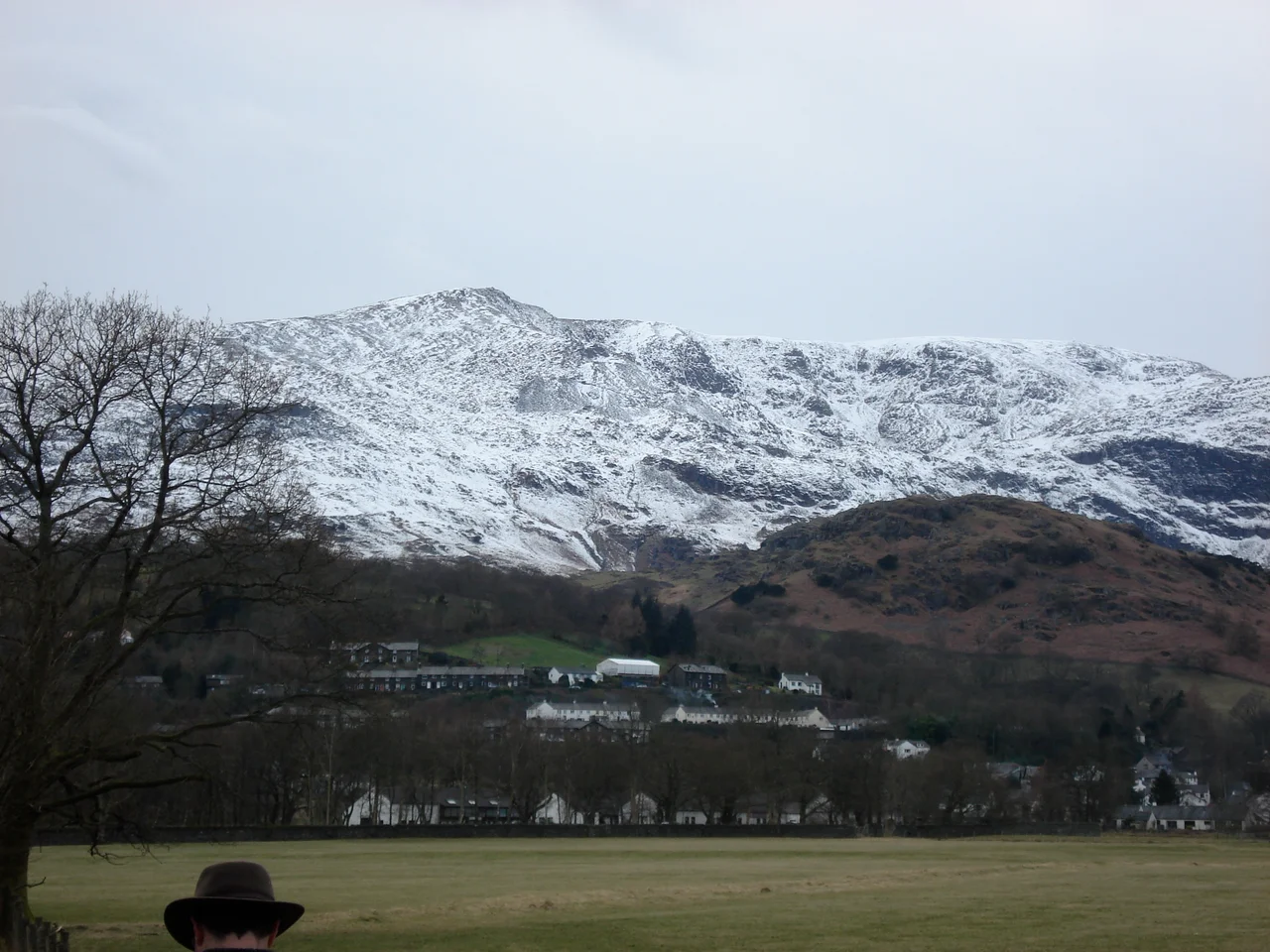

Old Man of Coniston
From the top of the Old Man of Coniston on a clear day, you can see Blackpool Tower. On a really clear day, the Isle of Man. The summit cairn - a combined slate platform and pile of rock - sits at 802.42 metres of natural ground, or 803.53 metres if you climb onto the man-made plinth, an 18-inch difference that mountain surveyors care about and almost nobody else does. The Old Man is the highest fell in the Furness Fells, and the highest point in the historic county of Lancashire. It is also the most worked-over mountain in the southern Lake District. For eight hundred years, men have been pulling copper and slate out of its sides, and the slopes still bear the proof.
Volcano, Tilted Up
The fell is built from the wreckage of an ancient volcano. It sits inside the Ordovician Borrowdale Volcanic Group, laid down roughly 450 million years ago when this part of England was an island arc south of the equator. A band of dacitic lapilli-tuffs of the Lag Bank Formation crosses the summit itself - rocks that were once airborne fragments of pumice and ash. South of the top, the slopes shift to volcaniclastic sandstones of the Seathwaite Fell Formation; to the north, rhyolitic tuffs of the Paddy End Member run toward the old Coppermines valley. None of this is obvious to a walker at first. But the silvery-grey slate that came out of Low Water Quarry, Scald Kop Quarry, and Saddlestone Quarry near the summit is the same volcanic rock, split clean.
The Long Story Underground
Quarrying on the Old Man may have begun as early as the 12th or 13th century, though physical evidence is patchy. By the 1500s, the slate trade was well established, the rock cut from open cuttings near the summit, then later from underground workings hollowed back into the hillside. At Saddlestone, two great caverns mark where stone was prised out. At Scald Kop, surface extraction created a single large cavity. The Coniston copper mines below, in the valley of Church Beck, are reputed to be among the largest in Britain - vertical workings dropping roughly two thousand feet, worked into the 19th century. The mines were dangerous, profitable, and seasonal. They drew Romans first, then medieval prospectors, then Victorian companies. The spoil tips down the north-east flank of the Old Man are their durable signature.
The Walk Up
Most walkers approach the Old Man from Coniston village, climbing first up a metalled road, then a track past the old quarries via Church Beck and the mines. The path winds past quiet tarns and through the spoil heaps before swinging up to the summit ridge. An alternative climbs the south ridge from Walna Scar Road; another swings via Goat's Water, a long deep tarn tucked beneath Dow Crag to the west, fifty feet deep and stocked with trout and char. The Old Man sits on a short truncated spur off the main Coniston ridge - the inverted-Y shape Wainwright described - which is why it feels taller than it is. The drop on three sides is steep. Below the tourist path, a discernible rib falls east to The Bell, a rocky top at 1,099 feet with one of the best lake-and-village views in the Lakes.
Fictional and Sacred
Cultural ownership of this fell runs deep. Arthur Ransome made it the Kanchenjunga of Swallowdale - the great peak that the Swallows and Amazons climb in the second book of his series. The slate quarries and copper mines became the inspiration for Pigeon Post, four books later. The 2020 fantasy novel The Left-Handed Booksellers of London, by Garth Nix, uses the Old Man as a principal location. And in a less expected register, the Aetherius Society - a religious group founded in 1955 - counts the Old Man among its 19 sacred mountains worldwide. On a Sunday in summer, the summit can hold dozens of walkers in waterproofs, a few road bikes carried up by determined cyclists, the occasional Aetherius pilgrim, and dogs of every conceivable size, all sharing a view that has been there since the volcano cooled.
From the Air
The Old Man of Coniston peaks at 802 m / 2,633 ft at 54.37 N, 3.12 W, immediately west of Coniston Water in the southern Lake District. From altitude the summit is the most prominent point of the Furness Fells - look for the curved ridge running north over Brim Fell, Swirl How, and Great Carrs, with the Old Man on the southern truncated spur. Goat's Water sits in its western cwm. Nearest airfield is Walney Island (EGNL), about 25 km south-south-west; Carlisle Lake District (EGNC) lies 70 km north. Recommended viewing altitude 4,000-6,000 ft AGL to stand off the summit safely. Hill weather is severe here - cloud often caps the fell when the valleys are clear, and rotor turbulence is common with westerly winds.
Nearby Stories
- Morecambe Bay 4.1 km away
- Caldbeck 8 km away
- Pendragon Castle 8.1 km away
- Egremont Castle 8.5 km away
- Upper Teesdale 13 km away
- Solway Firth 13 km away
- Malham Cove 21 km away
- Santon Railway Station 70 km away