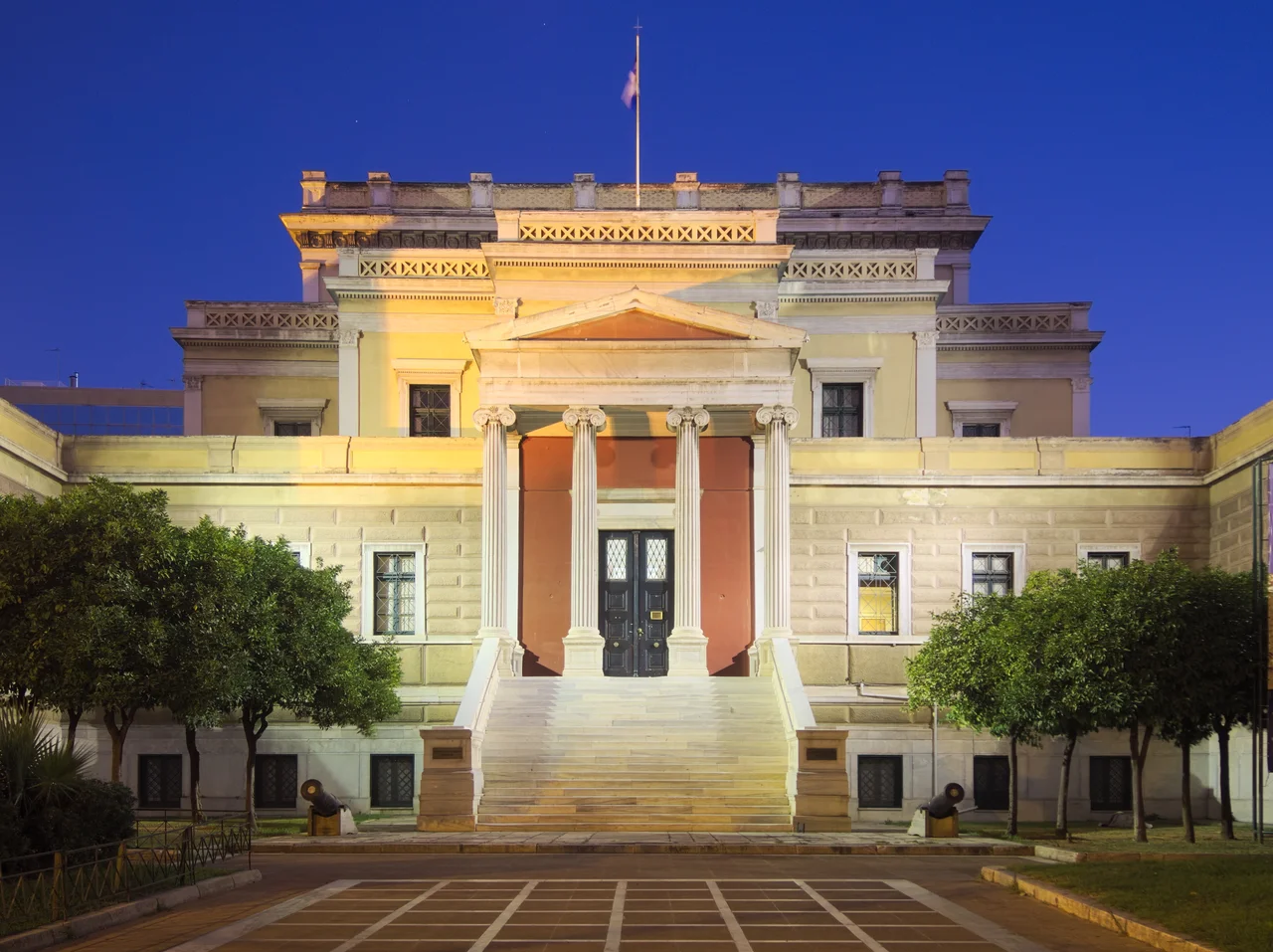

Old Parliament House, Athens
On 13 June 1905, the prime minister of Greece climbed the steps of the Parliament and was stabbed to death before he reached the door. Theodoros Deligiannis fell on the threshold of the very chamber where he had spent his career, knifed by a gambler enraged that the premier had cracked down on the gaming dens. For sixty years this building on Stadiou Street was where modern Greece fought out its destiny - in speeches, in coups, in blood on the marble - and that murder on the steps was only one act in a long and turbulent drama.
Built on Ashes
The site began as the mansion of Alexandros Kontostavlos, an Athenian magnate. When Athens became the capital of the new Greek kingdom in 1833, the young Bavarian-born King Otto moved into the house as a temporary residence while a proper palace was planned. History gathered there quickly. A grand banquet hall was added in 1835, and after the bloodless revolution of 1843 forced Otto to grant a constitution, the National Assembly convened in those rooms. Then, in October 1854, the house burned to the ground. Queen Amalia laid the foundation for its replacement in 1858, but funds ran dry within a year and work stalled. Construction only resumed after Otto himself was deposed in 1863. The Greek architect Panagiotis Kalkos finished the building in 1871.
The Shanty and the Chamber
Politics could not wait for masons. During the long years the new Parliament stood half-built, the deputies needed somewhere to sit, so in 1863 a brick shed was thrown up at the back of the square. Athenians called it, with affectionate contempt, 'the Shanty.' When the finished hall finally opened to the legislature in 1875, it inherited everything the Shanty had only witnessed from outside. For the next six decades the Hellenic Parliament met under this roof, through assassinations and abdications and the slow, contested birth of a modern state. On 25 March 1924 - the anniversary of the 1821 revolution - the Second Hellenic Republic was proclaimed from this floor, the monarchy formally set aside in the same room where kings had once been debated.
The General Points to the Stables
Out front rides a hero in bronze. The equestrian statue of Theodoros Kolokotronis - the fierce, mustachioed commander who led the armies of the 1821 revolution - was cast by the sculptor Lazaros Sochos and moved here in 1954. Its pedestal carries reliefs of the Battle of Dervenakia and a session of the revolutionary senate. But the statue's real fame is a joke. Kolokotronis faces Stadiou Street while twisting his head back toward Parliament, his arm flung out toward where the royal stables once stood. Athenians decided the old general was telling the deputies exactly where they belonged: because they bowed too readily to the king, the stables were their rightful seat. The bronze has been pointing the same insult for seventy years.
A Nation's Memory
Parliament left in 1935, moving to the Old Palace on Syntagma Square where Greek lawmakers still sit today. The vacated building served briefly as the Ministry of Justice, then found its lasting purpose. In 1961 it was restored and handed to the National Historical Museum, run by the Historical and Ethnological Society of Greece - a body founded back in 1882 and the oldest of its kind in the country. Inside now hang the weapons, costumes, paintings, and relics of the long struggle from the fall of Constantinople in 1453 to the Second World War, with the Greek Revolution at its heart. The great assembly hall, where a republic was once declared, hosts conferences. The building that helped make Greek history is now the place that remembers it.
From the Air
The Old Parliament House stands at 37.9776 N, 23.7328 E on Stadiou Street in the heart of central Athens, a neoclassical block roughly 600 metres northeast of Syntagma Square and the current Parliament. From the air the dense central Athens grid and the green of the National Garden help orient; the Acropolis rises about a kilometre to the southwest. Athens International Airport (LGAV) is about 33 km to the east-southeast. Best viewed at low altitude over the city center in clear Attic daylight.
Nearby Stories
- Great Sand Beach 5 km away
- Battle of Delium 7.7 km away
- Tower of Aliartos 9 km away
- HMHS Britannic 10 km away
- Saronic Gulf 15 km away
- Sousaki Volcano 17 km away
- Sanctuary of Apollo Maleatas 24 km away
- Skyros 66 km away