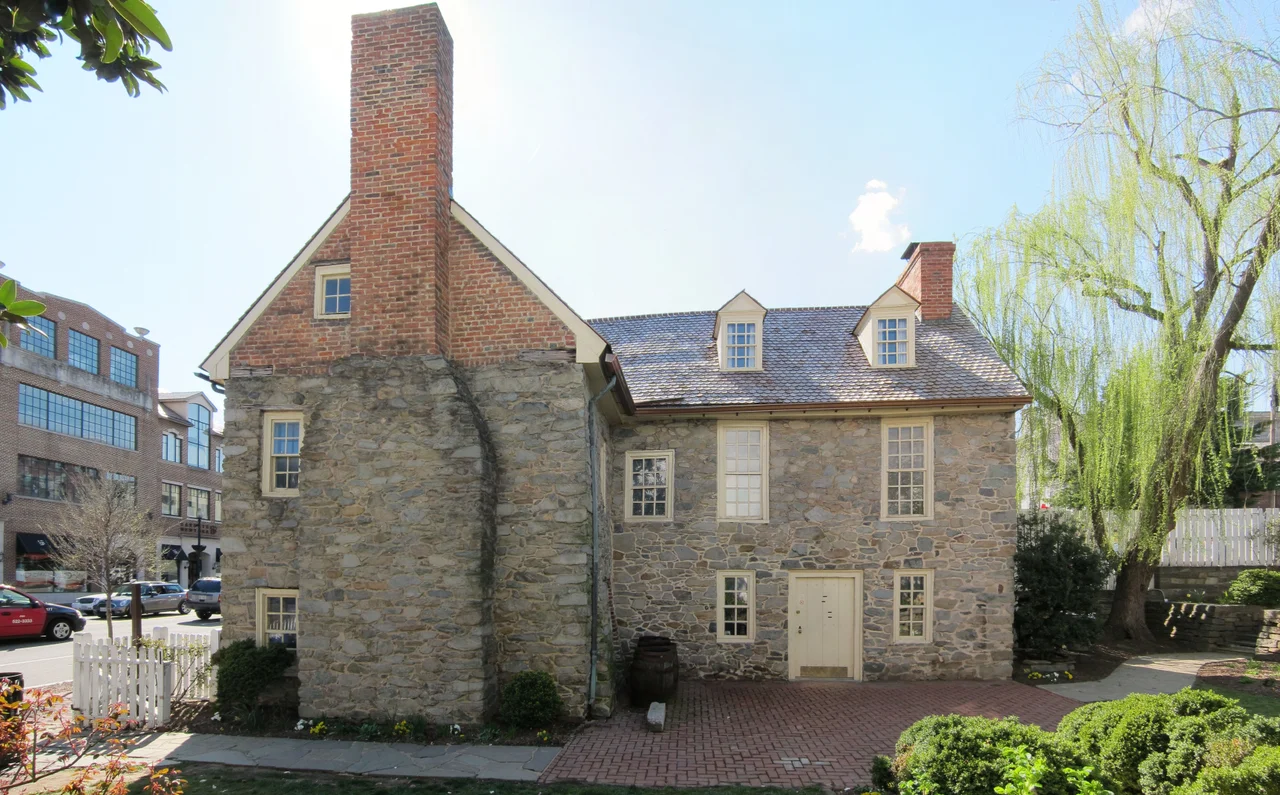

Old Stone House (Washington, D.C.)
For nearly two centuries, locals believed George Washington had used the Old Stone House at 3051 M Street as his headquarters in Georgetown. The story was passed down through generations of Washingtonians, posted on a sign over the front door, and used as justification for keeping the building standing while the rest of the original colonial fabric of Georgetown was torn down and replaced with brick rowhouses, then storefronts, then commercial blocks. When the National Park Service acquired the building in 1953 and began researching its history, they discovered that the story was wrong. George Washington had never used the house. He and Pierre L'Enfant had actually held their early planning meetings at Suter's Tavern, four blocks west. By the time the Park Service learned the truth, however, they already owned the building. The folklore had done its work. The Old Stone House survived. It is now the only pre-Revolutionary colonial structure left standing in Washington.
Christopher Layman's House
In 1764, Christopher and Rachel Layman bought Lot Three in Georgetown's commercial district for £1 10 shillings. The lot faced Bridge Street - the road that would later be renamed M Street. The Laymans built a simple one-room stone house in 1765, with walls two to three feet thick built from local blue granite and fieldstone quarried near the Potomac River. Christopher Layman died unexpectedly the same year the house was completed. The inventory of his possessions listed his carpentry tools, a stove, Bibles, and some furniture. Rachel Layman remarried two years later and sold the house to Cassandra Chew, an upper-middle-class widow who owned several properties around Georgetown. Chew's wealth allowed her to expand the house substantially - a rear kitchen addition in 1767, a second floor between 1767 and 1775. A third floor was added by 1790 after a property line dispute required the dismantling and rebuilding of the west wall. Chew used the rebuilding as an opportunity to add the upper story.
Suter's Tavern, Not the Stone House
The folklore that protected the building was based on a real but misidentified historical event. In March 1791, George Washington and city designer Pierre L'Enfant met with the local landowners of what would become the federal district to negotiate the terms under which the new capital would be built on their property. The meetings took place at Suter's Tavern, a public house owned by John Suter near the corner of 31st and K Streets NW. At the time of the meetings, John Suter Jr. - the tavern keeper's son - happened to be renting a room at the Old Stone House. Local memory eventually conflated the two locations and remembered Washington and L'Enfant as having met at the stone building rather than the tavern. The sign over the door reading George Washington's Headquarters reinforced the legend for generations. Suter's Tavern was demolished. The Old Stone House was not.
Hatters, Tailors, Locksmiths
Through the nineteenth and early twentieth centuries, the building cycled through commercial uses that reflected the changing economy of Georgetown - a hat shop, a tailor, a locksmith, a clockmaker, a house roofer, a house painter, various small commercial tenants. The Layman-Chew family had departed long before. By 1953, the building was operating as a used-car dealership; the back yard had been paved over as a parking lot. The federal government purchased the property that year for $90,000 and transferred it to the National Park Service. Between 1953 and 1960, NPS removed most of the nineteenth and twentieth-century commercial intrusions, restored the interior to approximate its eighteenth-century configuration, and rebuilt the paved back yard as a Colonial Revival garden enclosed by a white picket fence. The garden runs 399 feet deep and 76 feet wide. The walls in the house are still the original local blue granite and fieldstone. The building is now 85 percent original to its eighteenth-century construction.
Surviving the Folklore
When NPS historians researched the building during the 1950s and 1960s, they conclusively established that Washington had never used the house and that the Suter's Tavern story was the correct one. The folklore that had justified preserving the building was false. But by then the building had been preserved, the federal government owned it, and the alternative - tearing down the only surviving pre-Revolutionary colonial structure in Washington - was unthinkable. The Old Stone House was added to the National Register of Historic Places in 1973. It is a contributing property to the Georgetown Historic District, a National Historic Landmark. The Park Service operates the house as a free museum open seven days a week, 11 a.m. to 6 p.m. Monday through Thursday and 11 a.m. to 7 p.m. Friday through Sunday. The garden is open every day from dawn until dusk.
What Vernacular Architecture Looks Like
The building has no grand architectural pretensions. It was built by a Pennsylvania-German immigrant family for their own use, then expanded by a widow who needed more space, then modified to satisfy a property line dispute. The result is an example of what architectural historians call vernacular - building made by ordinary people for ordinary needs, without reference to formal style. The local granite and fieldstone tell the story of what was available on the spot. The thick walls reflect both insulation needs and the structural limitations of working with stones of variable size. The slow accumulation of additions over four decades records how a single household used what space it had. The Old Stone House sits between modern Georgetown's M Street storefronts - now a high-end retail corridor - and offers the visitor the rare experience of standing inside something that was built before the federal city itself existed. The country it predates is now 250 years old. The house is 260.
From the Air
The Old Stone House sits at 38.9056 N, 77.0608 W, at 3051 M Street NW in Georgetown, Washington. Best viewed from 1,500 to 2,500 feet AGL. The small two-and-a-half-story stone building is largely concealed by surrounding storefronts and difficult to identify from the air; the white picket-fenced Colonial Revival garden behind the house is more visible. The Potomac River lies a quarter mile south. The Kennedy Center and Watergate complex sit a half mile east. Reagan National (KDCA) is three nautical miles south. The site is inside the Washington Flight Restricted Zone; GA overflight prohibited.
Nearby Stories
- Gunston Hall 1.1 km away
- 2023 Baltimore Shooting 4.9 km away
- Battle of Middleburg 6.6 km away
- Crownsville Hospital Center 10 km away
- Battle of Loudoun Heights 13 km away
- First Battle of Rappahannock Station 20 km away
- Howard County, Maryland 21 km away
- Harriet Tubman Underground Railroad 50 km away