.JPG)
Old Tai O Police Station
In 1855, British naval forces from the China Station engaged and defeated a pirate fleet at the Battle of Ty-ho Bay, in the waters just off what is now Tai O. Half a century later, the colonial government built a police station on the hill above the harbor to make sure the problem stayed solved. That station — two-storey stone blocks connected by a footbridge, Arts and Crafts details on the outhouse, a commanding view of the approaches — stood watch over the fishing village and its waters for more than a century. It has since become a nine-room boutique hotel. The pirates are gone. The view is unchanged.
A Post Built Against the Sea
Tai O sits at the southwestern tip of Lantau Island, at what amounts to the westernmost inhabited point of Hong Kong. The town is built partly on stilts over tidal channels — a fishing community that has occupied the site for centuries, trading dried seafood, shrimp paste, and salt. The position made it strategic and exposed in equal measure. Piracy and smuggling were persistent problems in the Pearl River Delta's coastal waters, and the 1902 police station was designed specifically to address them, giving colonial authorities a permanent presence at the harbor mouth. The building's hill-top location was deliberate: it offered sightlines down the estuary and across Tung Chung Bay. For decades the station was the first and last institution a vessel entering Tai O would encounter from the sea.
The Cost of Keeping Watch
The station's records include at least one death on duty. In 1940, Detective Constable Hing Ip of the Tai O station was shot and killed by robbers while working in the village. His name appears in the Hong Kong Police's provisional list of officers who died in the course of duty between 1841 and 1941 — a list that runs to dozens of names, mostly from an era when policing the colony's outer islands and waterways was genuinely dangerous work. The station continued operating through the Japanese occupation, the post-war years, and into the modern era. Above it on the same hill, the Tai O Barracks of the PLA Hong Kong Garrison now occupy what was, before the 1997 handover, the Naval Coastal Observation Station. The hill has been a place of institutional authority — colonial, military, post-colonial — for more than a century without interruption.
Revitalised, Contested, Open
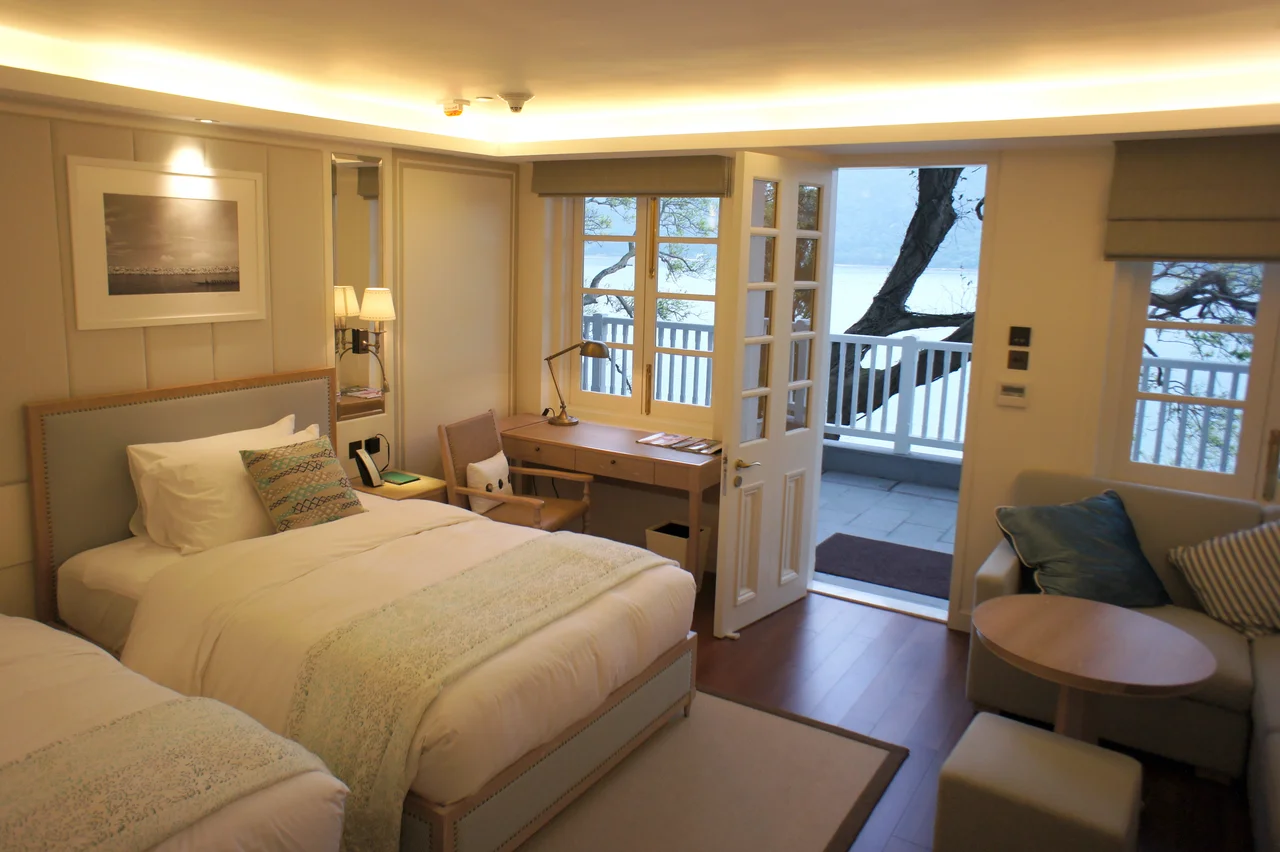
When the police station was decommissioned, it was included in 2008 among the first seven buildings selected for the Hong Kong Government's Revitalising Historic Buildings Through Partnership Scheme — a program designed to find adaptive reuse for government-owned heritage structures. The government accepted a proposal from the Hong Kong Heritage Conservation Foundation to convert the building into a boutique hotel. That process was not without controversy: Legislator Fernando Cheung publicly accused the Foundation of being a one-man NGO with ties to Robert Ng's Sino Group, set up for commercial rather than social purposes. The project cost an estimated HK$64.9 million. The resulting Tai O Heritage Hotel has nine rooms arranged in the original building's two blocks, and operates in what it describes as a social enterprise model, with over half of its staff drawn from Tai O or the broader Lantau community. The Arts and Crafts detailing on the outhouse block — decorative timber, bay windows, period joinery — survived the conversion intact.
Tai O at Low Tide
The hotel's nine rooms look out over a village that still functions as it always has, at least partly. Fishermen still go out before dawn. Shrimp paste is still made in the traditional way and sold in the market lanes. The stilt houses over the channels are lived in, not preserved in amber, though some have become guesthouses or restaurants. The pink dolphins that patrol the Pearl River estuary sometimes surface in the waters off the point. The ferry pier below the hotel connects Tai O to the rest of Lantau, and the bus route from Tung Chung brings day-trippers who fill the alleys by mid-morning and are mostly gone by late afternoon. In the quiet that follows, from the hill where the police station stands, the view west over the Pearl River Delta is enormous — China visible on clear days across a stretch of water that was once the most pirated shipping lane in the region.
From the Air
The Old Tai O Police Station sits at 22.2532°N, 113.8537°E on the hill above Tai O Ferry Pier, at the southwestern tip of Lantau Island, Hong Kong. The building is visible from low-altitude approaches as a white colonial structure on the headland, with the stilt village and tidal channels of Tai O visible below. Hong Kong International Airport (VHHH) lies approximately 15 km to the northeast on Chek Lap Kok. Approach from the west at 1,000–1,500 feet for the best view of the site, the village, and the Pearl River estuary opening to the west. The Pearl River Delta coastline of mainland China is visible to the northwest on clear days.
Nearby Stories
- Tai Tau Chau (Southern District) 0.7 km away
- Lai Chi Wo 3 km away
- Wanshan Archipelago Campaign 3.2 km away
- Pearl River Delta 3.7 km away
- Battle of Yamen 13 km away
- Jiangmen 15 km away
- Hong Kong 12 32 km away
- Battle of Nanpeng Island 114 km away