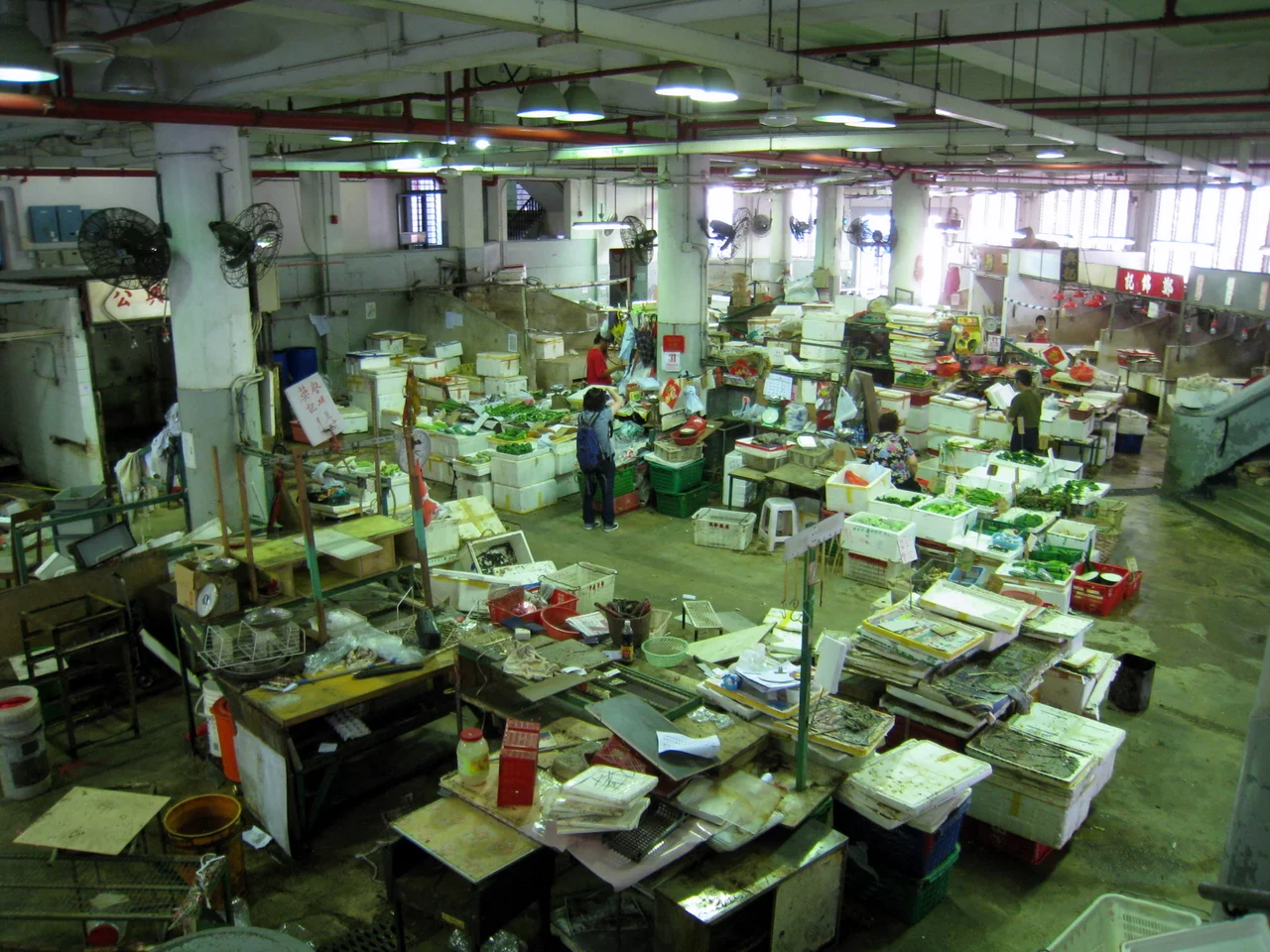

Old Wanchai Market Building
Every morning for seven decades, the same ritual played out on Queen's Road East: vendors hauled ice-packed fish through the curved doorways of a low, white building whose horizontal lines seemed to make it crouch against the hillside. Nobody called it Streamline Moderne. They called it the market. The Old Wanchai Market Building opened in 1937, just four years before the Japanese occupation that would transform its basement from a place of commerce into a place of horror, and it has been outrunning demolition ever since.
Curves in a City of Angles
In the mid-1930s, Hong Kong's Public Works Department was building utilitarian structures across the colony — functional, unadorned, forgettable. The market at 264 Queen's Road East was different. Its architects drew on Streamline Moderne, the design movement that had swept through Depression-era America and Europe, softening industrial forms with aerodynamic curves and horizontal banding that suggested speed and modernity. The result was a building that looked like it was moving even when it stood still. Rounded corners, smooth cream render, and the low horizontal profile gave it an almost nautical quality — a ship docked at the base of the Wan Chai hillside. It is often mistakenly called Bauhaus, but the Bauhaus aesthetic is angular and austere; this building is all flow. The distinction matters, because the market's curves are the reason people fought to keep it.
The Wet Garage and Darker Uses
The building's history predates its 1937 construction. The wet market on this site was named in 1917, known in its early years as much for bullock carts as for vegetables and fish — merchants parked their draft animals here along with their goods, earning it the blunt nickname 'Wet Garage.' The 1937 structure replaced something humbler and gave the market a monumental quality it had never had before.
Then came the Japanese occupation of Hong Kong, which lasted from December 1941 to August 1945. During those years, the market's basement served the occupying forces as storage for the bodies of those who died under their control. The building that had been built for daily life became part of wartime death. That history sits quietly beneath the cheerful curves of the facade — unannounced, unmarked, present nonetheless.
The Long Fight to Stay Standing
By the 1990s, Wan Chai was transforming fast. In 1996, the Urban Renewal Authority and Chinese Estates — the property company controlled by developer Joseph Lau Luen-hung — announced plans to redevelop the site into a luxury residential-commercial complex. The old market building, with its Grade III historic designation, was squarely in the path of demolition.
The market kept trading while the negotiations dragged on. In 2007, the Urban Renewal Authority and the Development Bureau reached a compromise: the facade and front portion of the building would be preserved and incorporated into the new development. The wet market itself relocated in September 2008 to the lower levels of The Zenith, a new residential tower directly across the street. The vendors packed up their stalls and crossed the road. The old building, now empty, stood and waited to find out what it would become.
A Building That Crossed Into Fiction
While urban planners debated its fate, the market had already achieved a kind of immortality in popular culture. In Deus Ex, the landmark 2000 action role-playing game developed by Ion Storm and published by Eidos Interactive, the Wan Chai Market features as a location in the near-future Hong Kong of the game's second act. Players navigate its stalls amid cyberpunk intrigue, which means a building that opened in 1937 is now embedded in a vision of a dystopian 2052. Whatever its future as a physical structure, the building has a digital afterlife that will outlast any renovation.
The preserved facade now faces The Zenith across Queen's Road East — two buildings from different centuries eyeing each other across four lanes of traffic. The Grade III designation means the building's historical significance is recognized, even if the protections it confers are less robust than those for Grade I and II structures.
Wan Chai, Layered
The Old Wanchai Market Building sits on the Wan Chai Heritage Trail, a walking route through one of Hong Kong's most historically dense neighborhoods. Step back from the market building and the layering becomes visible: the blue-and-white residential towers of the 1970s, the colonial-era tenements with their covered walkways, and between them, this low cream structure with its aerodynamic horizontals. Wan Chai has always absorbed contradictions — treaty port commerce, wartime occupation, postwar reconstruction, the hostess bars of the 1960s, the financial services offices of the 2000s. The market building holds all of that without explaining any of it. Some buildings carry history loudly. This one carries it in its curves.
From the Air
The Old Wanchai Market Building sits at 22.2746°N, 114.1743°E on Hong Kong Island, in the Wan Chai district. Approaching from the sea, it lies roughly 2.5 km east of Hong Kong Central and about 1.5 km north of the Peak. At low altitude over the harbor, the curved white facade is visible among the denser commercial blocks of Queen's Road East. The nearest airport is Hong Kong International (VHHH), approximately 28 km to the northwest on Lantau Island. Suggested viewing altitude: 500–1,000 ft over Victoria Harbour on the Wan Chai waterfront approach, looking south toward the hillside where the building sits below the residential towers.
Nearby Stories
- Lok Ma Chau Loop 2.3 km away
- Portas do Cerco 2.3 km away
- Kweilin Incident 17 km away
- Wanshan Archipelago Campaign 34 km away
- Nanxiong Formation 115 km away
- Battle of Nanpeng Island 148 km away
- Heyuan 169 km away
- Cape Maobitou 632 km away