
Olst-Wijhe
In a meadow outside the village of Eikelhof stands a small stone cross. The Gothic Dutch carved into its face has been there since 1493: IN THE YEAR OF OUR LORD 1493, JOHAN LUCKENS DIED HERE, PRAY FOR THE SOUL. Nobody alive knows what Johan Luckens did or why he died on that road. He was murdered. Someone - his killer, perhaps; or his family; or the community he died near - paid for the stone, set it in the ground, and asked passing travelers to remember him for as long as they walked by. They have, for more than five centuries.
Two Old Towns, One New Name
Olst-Wijhe is a recent invention built on ancient stock. The two main towns it joins - Olst and Wijhe - have been around since before there was a Netherlands. Olst is believed to have been founded in the 7th century and is first mentioned in chronicles in 947, as Holsto. Wijhe surfaces a few years later, in 960, as Wie. They lived side by side for a thousand years as separate parishes, then separate municipalities, until on January 1, 2001 the Dutch government merged them as part of a national push to reduce administrative overhead. The new municipality first kept the name Olst, then briefly debated neutral alternatives, then gave up and combined both names on March 26, 2002. Olst-Wijhe was finally a place.
Bricks, Cattle, and the IJssel
The river dominates everything here. The IJssel partly flows through the municipality and partly forms its border with Gelderland, and the towns turn their backs to the rest of the world to face the water. For centuries the local economy ran on what the floodplains offered: fruit, cereals, cattle, meat processing, and bricks. Open-air brickworks lined the riverbanks, turning floodplain clay into the warm orange building blocks that gave so many Dutch cities their color. Most of the kilns are gone now. The agriculture remains. Both Olst and Wijhe got their own railway stations on the Zwolle-Nijmegen line in 1866, and most working residents today commute to Deventer or Zwolle, leaving the villages quieter than they were in the industrial nineteenth century.
A Knickerbocker, a Cabaret Star, and a Chief Scout
Around 1648, a child was born in one of these villages who would later cross the Atlantic to the Dutch colony of New Netherland and settle in the Hudson Valley. His name was Harmen Jansen Knickerbocker, and his descendants would become so prominent in old New York that Washington Irving would borrow the family name for a satirical history that gave New York its own literary identity. The Knickerbockers became synonymous with Dutch-descended New Yorkers; the New York Knicks basketball team are their distant linguistic grandchildren. Olst-Wijhe has kept producing notable people in unlikely numbers for so small a place. Wijhe gave the Netherlands a naval officer and Chief Scout in Jean Jacques Rambonnet, the chemist Gerrit Berkhoff, and the beloved cabaret singer Conny Stuart, who became a household name in the 1950s and 60s. The footballer Danique Kerkdijk, born in Olst in 1996, played for Brighton before returning to FC Twente.
Mansions, Windmills, and a Cable Ferry
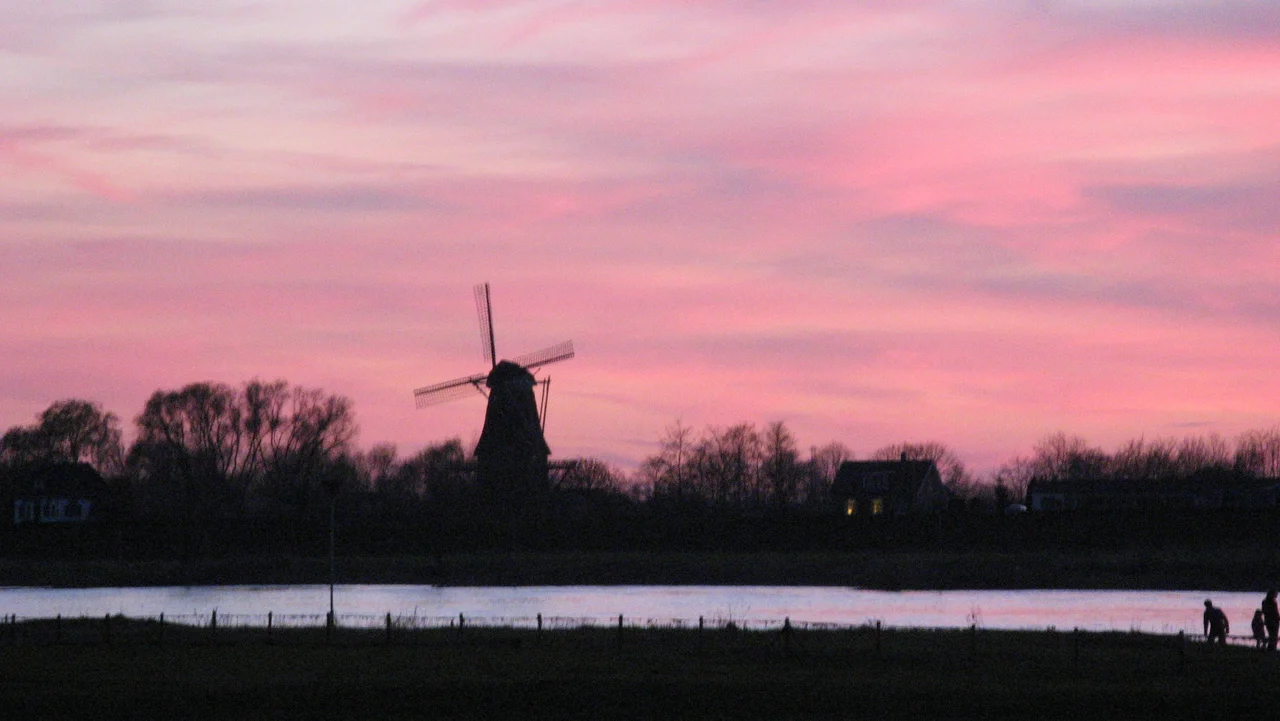
Country mansions dot the wooded interior - Groot Hoenlo, Klein Hoenlo, Nijendal, De Haere, Wijnbergen, De Hei, and Nijenhuis - most of them eighteenth-century, most still in private hands. The grounds are usually open to walkers. Nijenhuis, near the Raalte border, has become an art museum; its collection includes works by Constant Permeke and Van Gogh, and its sculpture garden holds pieces by Ossip Zadkine. Windmills survive at Welsum, Olst, Boskamp, Wesepe, Marle, and Wijhe - four of them still fully functional, sails turning when the wind comes from the right direction. And because the IJssel cuts the municipality in two and there are no bridges within Olst-Wijhe itself, the river is crossed the old way: cable ferries run between Olst and Welsum, and between Wijhe and Vorchten on the Gelderland side. The ferries are pulled across by a steel cable strung above the current. The crossing takes about three minutes.
From the Air
Olst-Wijhe is centered at roughly 52.33 degrees north, 6.10 degrees east, on both banks of the IJssel river between Deventer and Zwolle. From the air, the IJssel's broad meanders make the municipality easy to identify; the cable ferries at Olst and Wijhe show as small straight lines across the river. Nearest major airport is Schiphol (EHAM) about 100 km west; Lelystad (EHLE) is closer. The flat green floodplains contrast with the slightly higher woodlands of the interior.
Nearby Stories
- Twickel Castle 4 km away
- Putten 4.3 km away
- Winterswijk 7.6 km away
- Den Hulst 9.7 km away
- Liemers 9.8 km away
- Urk 12 km away
- Coevorden 13 km away
- Assault on Nijmegen 17 km away