.jpg)
Olympiacos–PAOK Rivalry
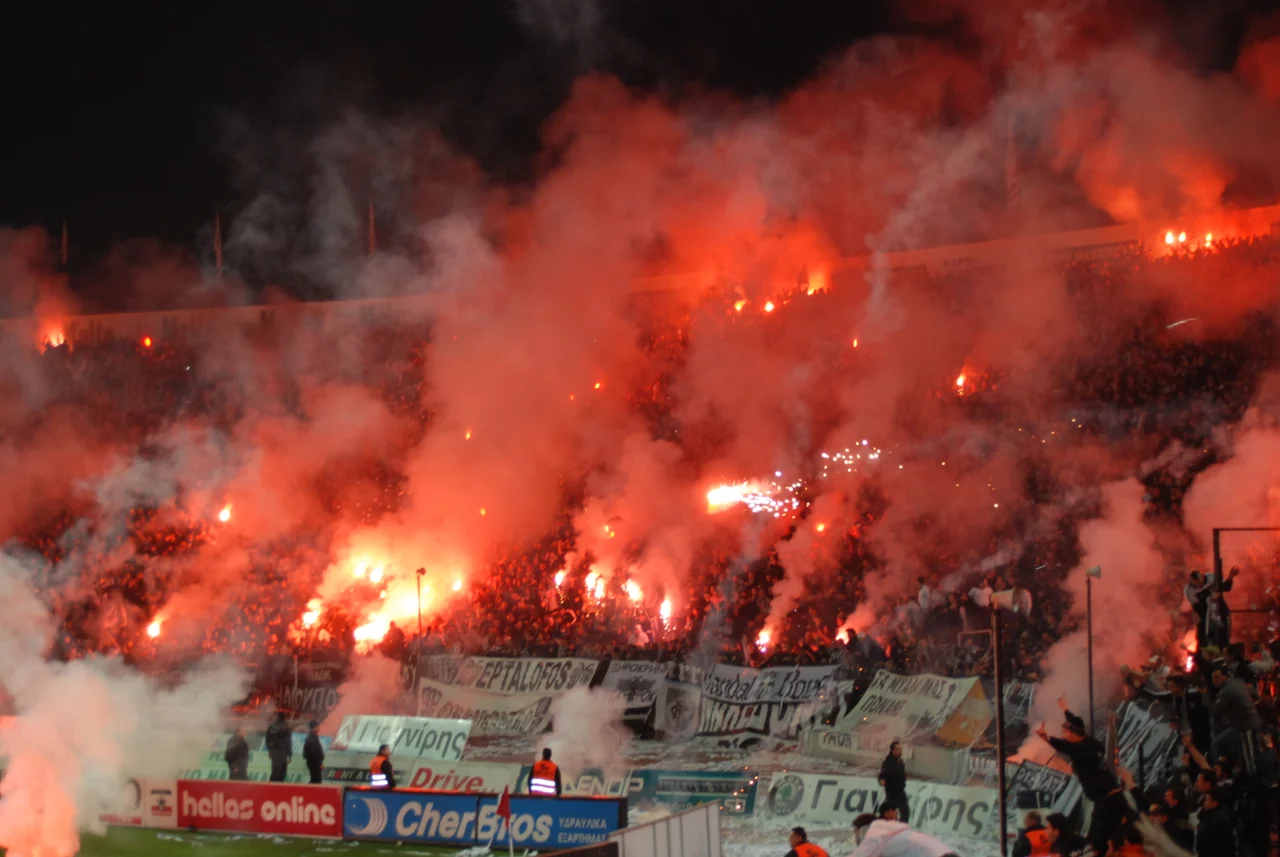
Two cities, one argument, decades of football. Piraeus has Olympiacos, founded in 1925 on the docks of Greece's great port, playing in red and white at Karaiskakis Stadium beside the sea. Thessaloniki has PAOK, founded in 1926 by Greek refugees from Constantinople, playing in black and white at the Toumba — a fortress of a ground in the north of Greece's second city. When they meet, the match is never simply a football match.
The City Behind the Club
Understanding the Olympiacos-PAOK rivalry requires understanding what each club represents to its city. Olympiacos emerged from Piraeus, the port that made Athens rich and powerful — a club associated with working-class pride, with the commercial and political weight of the capital region. PAOK was founded in 1926 by refugees who had fled Constantinople after the catastrophe of 1922, Greeks who arrived in Thessaloniki with little more than their identity intact. From the start, PAOK carried the burden and dignity of displacement, and the club became a vehicle for Thessalonian pride more broadly. Thessalonians have long felt that Athens — and especially Piraeus — has received preferential treatment from the Greek state in matters of funding, infrastructure, and football governance. For PAOK supporters, a victory over Olympiacos is not just three points. It is a verdict in a debate that the country has never fully settled.
Karaiskakis and the Toumba
The two stadiums anchor the rivalry in geography. Karaiskakis Stadium, rebuilt and reopened in its modern form in 2004, sits on the Piraeus waterfront with views across the Saronic Gulf. It is a modern bowl, intimate and loud, named after the Greek revolutionary hero Georgios Karaiskakis. The Toumba — officially the Toumba Stadium — stands in the Toumba neighbourhood of eastern Thessaloniki, a ground famous for its atmosphere and its noise. It holds the attendance record for a PAOK home match against Olympiacos: 45,147 on 5 December 1976. The Olympiacos home attendance record in this fixture is larger still: 74,232 at the Athens Olympic Stadium on 2 October 1988, when that neutral-ground venue was pressed into service.
Records Kept in the Books
The fixture history runs deep. Olympiacos's largest league win over PAOK was 6-0 at Karaiskakis on 3 June 1962. PAOK's equivalent at home was 6-1 at Serres Municipal Stadium on 6 December 1987. In the away column, PAOK won 4-0 at Karaiskakis on 4 January 1976; Olympiacos won 4-0 at the Toumba on 27 January 1965. These are not merely statistics. They are the specific moments that supporters invoke when the argument about which club is greater reaches a certain pitch. In the Greek Cup, the overall series stands at Olympiacos 16, PAOK 12. In the league, Olympiacos's longest winning streak against PAOK ran from February 1998 to October 2001 — seven consecutive victories.
Matches That Became Incidents
Not all of the history fits neatly into a scoreline. The fixture has been suspended multiple times: a league match stopped at the 27th minute, with Olympiacos awarded the result; a Cup match halted at the 90th minute; another abandoned before kick-off. These interruptions reflect a match that operates at a level of intensity that occasionally crosses into disorder. The rivalry between Olympiacos and PAOK has been called the fiercest intercity rivalry in Greek football — a judgement that accounts not just for the competitive record but for the atmosphere, the meaning, and the occasional incidents that have followed both clubs across their long shared history.
Still Contested
The rivalry continues to generate results that matter beyond the table. In January 2026, PAOK won 2-0 at Karaiskakis — another entry in a ledger that neither club ever really closes. What makes Olympiacos versus PAOK different from most football rivalries is that the stakes are not purely sporting. Behind every match stands the older argument: Athens or Thessaloniki, south or north, the capital's weight against the second city's pride. Football is the arena where that argument gets played out most publicly, most passionately, and with the most immediate result. The answer changes every time they play.
From the Air
The two clubs are separated by roughly 500 km of Greek territory: Karaiskakis Stadium sits at approximately 37.96°N, 23.66°E in Piraeus, and the Toumba Stadium in Thessaloniki lies at approximately 40.61°N, 22.97°E. Athens International Eleftherios Venizelos (LGAV) is approximately 30 km east of Karaiskakis at 37.94°N, 23.95°E. From cruising altitude between the two cities, the topography of central Greece unfolds below: the Pindus mountains, the plains of Thessaly, and finally the Thermaic Gulf where Thessaloniki meets the sea. Thessaloniki's own airport, Macedonia International (LGTS), serves the northern city.
Nearby Stories
- Parnitha 3.4 km away
- Kea (island) 7.3 km away
- Sanctuary of Apollo Maleatas 11 km away
- Sousaki Volcano 12 km away
- Battle of Leuctra 14 km away
- Great Sand Beach 18 km away
- Agios Georgios (island) 23 km away
- Skyros 84 km away