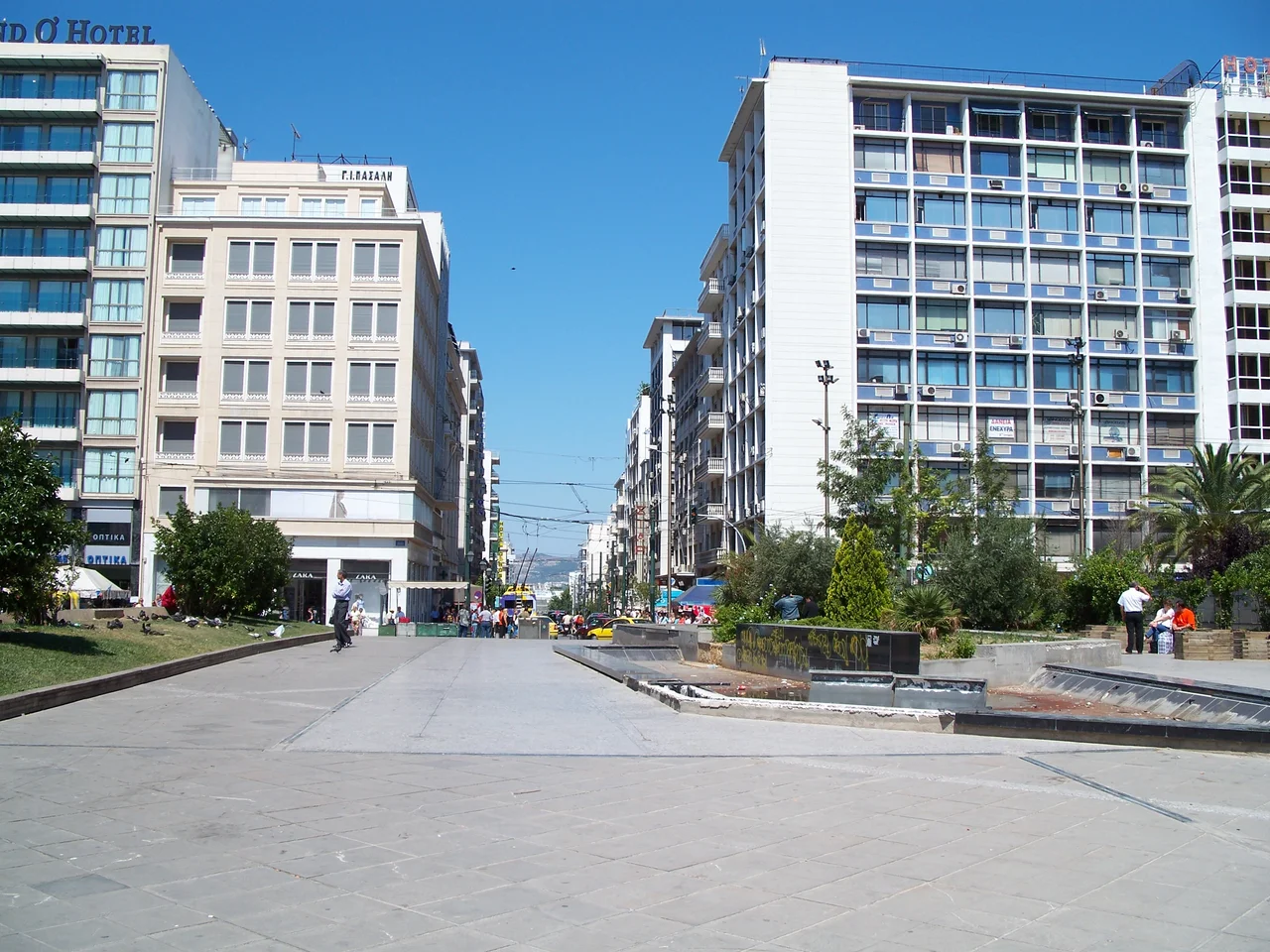

Omonoia Square
Six streets pour into Omonoia Square, and for nearly two centuries the city has never stopped arguing about what to do with the space where they meet. It has been a palace plot, a railway terminus, a circle, a sunken plaza, a fountain, a building site, and a fountain again. Its very name is a promise of harmony - Omonoia means 'concord' - bestowed after rival political factions stood here and swore an oath to stop fighting. The irony is that few places in Athens have been fought over, dug up, and redesigned more relentlessly than the square named for peace.
The Oath of Concord
When the square was laid out in 1846, it was meant to hold a palace. The German-trained architects Stamatios Kleanthis and Eduard Schaubert planned the royal residence here, and the space took the name Plateia Anaktoron - Palace Square. The palace went elsewhere, and the square was renamed Othonos Square after King Otto, the Bavarian prince who became Greece's first modern king. Then Otto was thrown off the throne in 1862, and the place needed a third name in sixteen years. This one stuck. The leaders of the warring political factions came to this spot and gave an oath of peace - omonia - to end their hostilities. The square has carried that hopeful word ever since, a monument to a single moment when Athenians chose to stop tearing at each other.
The Restless Heart
Omonoia became the social engine of Athens. By the late nineteenth century it was lined with trees and hotels, lit by new electric lamps, and anchored by the railway - the square was the line's starting point, so travelers and crowds churned through it constantly. The twentieth century would not leave it alone. When the underground railway between Piraeus and Athens was built in the late 1920s, the square was reshaped into a circle. In 1931 the mayor tried covering the metro ventilation shafts with eight statues of the Muses; Athenians disliked them so much the sculptures were removed. The 1950s brought underground shops, banks, and a post office. A celebrated 1958 fountain became a genuine city landmark, immortalized in the Greek films of the era.
Demolition and Rebirth
Then the cycle turned destructive again. In November 1992, the beloved fountain and its 'Runner' sculpture were torn out so crews could excavate the new red metro line beneath the square. A redesign in 2003 stripped away much of the old character, and the square slid into a long decline, its prestige fading even as thousands still crossed it every day. The famous Pentakiklon, the 'Five-ring' sculpture installed in 2001, was meant to move when water ran through it but mostly sat broken and neglected - it stirred to life for the first time only at Christmas 2008, then fell still again. For years Omonoia was a place people passed through quickly, a grand idea gone shabby.
Water Returns
The latest reinvention tried to undo the damage. From mid-2019 to early 2020, with public and private money, the municipality rebuilt Omonoia yet again. They restored the historic 1958 fountain, finally repaired the Five-ring sculpture so its rings actually moved, and replaced the paving with thermoneutral materials chosen to cool the baking summer heat of the surface. The reborn square opened on 14 May 2020. Above ground, the neoclassical Bagkeion and Megas Alexandros hotels still face each other across Athinas Street, survivors of the square's grander age. Below ground roars the Omonia metro station, carrying as many passengers as Syntagma. Concord, demolition, neglect, renewal - Omonoia keeps cycling through them all, and somehow remains exactly what its name first promised: the meeting place at the center of Athens.
From the Air
Omonoia Square sits at 37.9841 N, 23.7283 E in central Athens, marking the northern corner of the historic downtown grid where six major avenues converge - a distinctive radial junction visible from the air. The Acropolis rises about 1.5 km to the south; Syntagma Square and the green National Garden lie to the southeast. Athens International Airport (LGAV) is roughly 33 km to the east-southeast. The converging streets make the square easy to identify against the dense urban grid. Best viewed at low altitude over the city center in clear daylight.
Nearby Stories
- Great Sand Beach 5 km away
- Battle of Delium 7.7 km away
- Tower of Aliartos 9 km away
- HMHS Britannic 10 km away
- Saronic Gulf 15 km away
- Sousaki Volcano 17 km away
- Sanctuary of Apollo Maleatas 24 km away
- Skyros 66 km away