.jpg)
Onassis Stegi
The word stegi means roof in Greek, and for many Athenian artists and audiences, the Onassis Stegi has been precisely that: a sheltering structure over cultural life in a city that does not always make it easy. Located on Syngrou Avenue, the broad artery that runs from central Athens toward the sea at Faliron, the building announced itself when it opened in December 2010 as something different — a privately endowed cultural institution that intended to take risks, collaborate internationally, and engage with the city around it rather than exist above it.
The Building on Syngrou
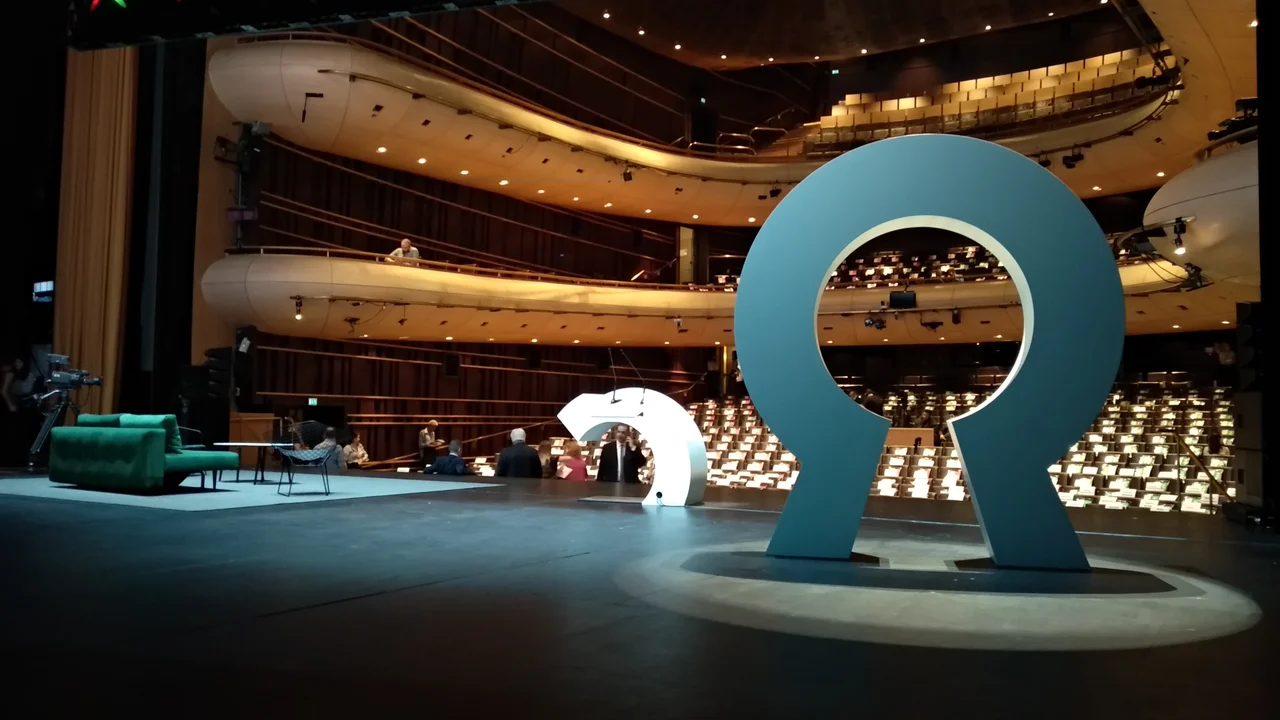
Construction began in 2004 on a privately owned three-acre site funded by the Onassis Foundation, the organisation established by the shipping magnate Aristotle Onassis. The design came from Architecture-Studio, a French firm selected through competitive process, and the result is a building of 18,000 square metres whose exterior — clad in a grid of white marble panels — gives it a distinctive presence on one of Athens's most trafficked boulevards. Inside, two main halls anchor the programme: a large stage with 900 seats and a smaller space for 200. The opening ceremony took place on 7 December 2010, in the presence of President of the Hellenic Republic Karolos Papoulias. The first production on the main stage, directed by Michael Marmarinos and inspired by a Bertolt Brecht poem titled Questions from a Worker Who Reads, was a tribute to the construction workers who had built the building — a choice that said something about the institution's intentions.
Art That Travels
Within its first decade, the Onassis Stegi assembled a programming record that placed it alongside the leading European cultural venues it partnered with. Productions by DV8 Physical Theatre, the choreographer Dimitris Papaioannou, Akram Khan, and others passed through its stages. Aristophanes' The Birds, performed by Nikos Karathanos, played to audiences who found ancient comedy newly urgent. The list of institutional collaborators is a roster of serious European theatre: Münchner Kammerspiele in Germany, Théâtre de la Ville in Paris, the Almeida Theatre in London, Internationaal Theater Amsterdam. The model is co-production and exchange — bringing international work to Athens and sending Greek work into the world. Approximately 300,000 people visit the Stegi annually.
Art Spilling into the Street
The Stegi has not confined itself to its building. In collaboration with the Municipality of Athens, it has installed artworks by Greek artists across the city — in Avdi Square in Metaxourgeio, on Patision Street, in Omonia Square and in Neos Kosmos. In 2022, it organised a major exhibition of digital art, Plásmata: Bodies, Dreams, and Data, in the park at Pedion Areos, with 25 works by Greek and foreign artists. The following year, Plásmata II moved to Ioannina. The pattern is deliberate: an institution that holds a large endowment and a prominent building choosing to meet the city where it lives, not only where it performs.
A Stage for Difficult Truths
The Onassis Stegi has consistently used its platform for social and political engagement, and in ways that have had tangible consequences. In January 2021, Olympic sailing champion Sofia Bekatorou chose a Stegi seminar on gender violence as the moment to speak publicly about the sexual abuse she had experienced — the event marked the beginning of the Greek MeToo movement. The Stegi subsequently produced a documentary, Tack, about the cases of Bekatorou and Amalia Provelengiou, released on 25 November 2024, the International Day for the Elimination of Violence Against Women. The institution has also taken public positions on the trial of the neo-Nazi political party Golden Dawn, on the court proceedings related to the murder of LGBTQI+ activist Zak Kostopoulos, and on the anniversary of the killing of Alexandros Grigoropoulos. These are not the positions of a neutral arts organisation. They are the positions of an institution that has decided what a cultural centre is for.
An Onassis Legacy in the City
Aristotle Onassis was a figure of almost mythological scale — the shipping magnate from Smyrna who became one of the richest men in the world, whose second marriage to Jacqueline Kennedy made him international news, whose life story reads like a novel of the twentieth century. The foundation that bears his name has expressed itself in Athens through a building that is very much of the present. The marble exterior nods to the material that built the Parthenon, visible on its rock from elsewhere in the city, but the programme inside is relentlessly contemporary. Art and performance and debate and digital installation — the Onassis Stegi has made itself indispensable to the cultural life of a city that did not lack for ancient resources but needed somewhere new to think.
From the Air
The Onassis Stegi stands at approximately 37.96°N, 23.72°E on Syngrou Avenue in central Athens, between the city centre and the coast at Faliron. At 3,000 feet, the straight line of Syngrou Avenue is visible below, running from the Acropolis area toward the sea — one of the most legible features of Athens from the air. The Acropolis itself rises to the northwest. Athens International Eleftherios Venizelos (LGAV) is approximately 22 km to the northeast at 37.94°N, 23.95°E. Arriving from the west, aircraft pass almost directly over Syngrou on their approach track into the city basin.
Nearby Stories
- Parnitha 3.4 km away
- Kea (island) 7.3 km away
- Sanctuary of Apollo Maleatas 11 km away
- Sousaki Volcano 12 km away
- Battle of Leuctra 14 km away
- Great Sand Beach 18 km away
- Agios Georgios (island) 23 km away
- Skyros 84 km away