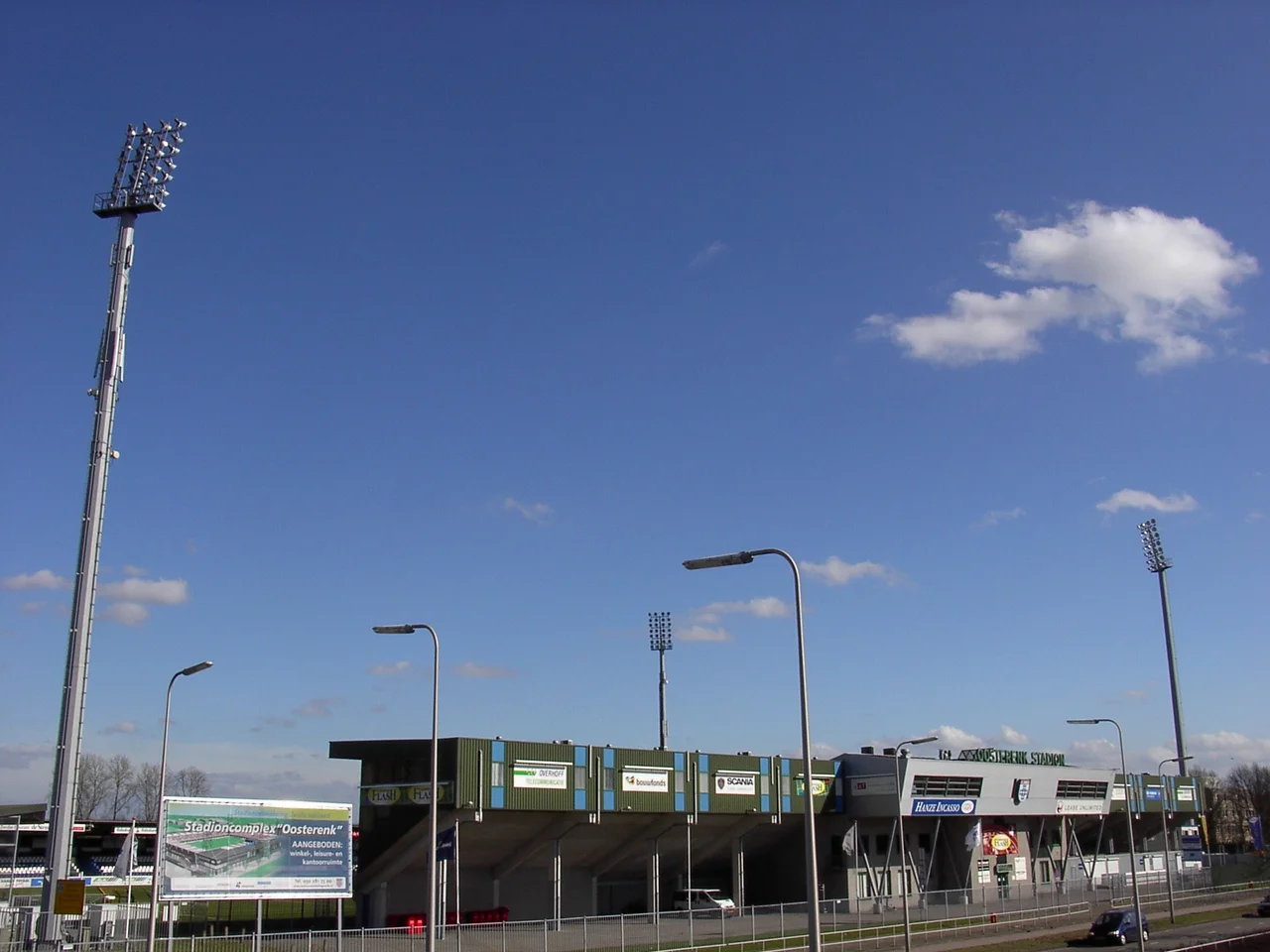

Oosterenkstadion
In May 1984, Johan Cruijff walked off a football pitch in the eastern Netherlands for the last time as a professional player. He was thirty-seven years old. The match was for Feyenoord, his final club; the opponent was FC Zwolle; the ground was the Oosterenkstadion, a tidy 6,865-seat all-seater on the edge of town that had stood since 1934 and was already showing its age. The home crowd at the Oosterenk that day understood what they had just watched. When the stadium was renovated soon afterward, the main stand was named after Cruijff - not for any tie he had to the club, but because the stadium was where his thirty years of professional football had ended.
1934 to 2007
Built in 1934 and thoroughly renovated in the 1980s, the Oosterenk was the kind of ground that defined Dutch provincial football for most of the twentieth century - small, intimate, low-roofed, with terraces that became all-seater under the safety mandates of the 1990s. PEC Zwolle had risen and fallen and merged here, finding moments of brief glory in the upper division and longer stretches in the second tier. The stadium's capacity, 6,865 by the end, was modest by Eredivisie standards but generous for a club that often played at second-tier level. The Cruijff stand was the symbolic heart of the ground. By the early 2000s, however, the building was tired, and the club's ambitions outran what the old structure could hold. Plans for a new stadium on the same site moved forward, and the Oosterenk came down in 2007 to make room for a 10,500-seat successor.
The Casino Referendum
The story of the new stadium is also the story of a small civic revolt. The original plan, announced for a November 2004 construction start, included a casino inside the stadium complex - and to make the casino legal, Zwolle's local gambling regulations had to be amended. The citizens did not like that. A referendum in early March 2005 produced a resounding answer: roughly 76 percent voted against the casino. The municipal government dropped the plan. Two months later, a revised plan reappeared with a casino fitted into the boundaries of existing regulations rather than asking the voters to bend them. Construction finally began in March 2007. The total project cost around fifty million euros and included not just a stadium but a hotel, restaurants, shops, and offices - the kind of mixed-use sports development that was becoming standard in European cities. The new ground opened on 29 August 2009.
Naming the Stands
If you want to understand a football supporter, watch what happens when somebody else tries to choose names for the stands. In May 2007 the board of FC Zwolle invited fans to propose names from among former players of PEC and FC Zwolle. The fans had a different idea: they demanded that one stand be named after Marten Eibrink, the former chairman and club owner whose money and time had kept the club alive through hard years. Within a few days the board agreed, and the north stand - where the most devout supporters stood - became the Marten Eibrink Stand. The remaining three stands were put to a supporter vote among six former players. The fans chose Henk Timmer, Fred Patrick, and Klaas Drost. Jaap Stam, who would later become one of the most famous defenders in world football, did not make the cut. The vote tells you something honest about football allegiance: the players who shaped a club's identity in the trenches matter more to supporters than the ones who became global stars somewhere else.
What Replaced It
The successor ground was christened the FC Zwolle Stadion, then renamed the IJsseldelta Stadion as sponsorship deals shifted - the standard fate of modern European stadium names. PEC Zwolle later returned to the Eredivisie and even lifted the KNVB Cup in 2014, beating Ajax 5 to 1 in one of the great upsets of recent Dutch football. The Cruijff stand and its memory of 1984 are gone. The Marten Eibrink stand survived the renaming wars because supporters insisted, which is a small thing to know about how clubs and stadiums actually work: the people who give a place its soul are not always the people who pay for it, but they are the people you ignore at your cost. From the air today the new stadium is the obvious landmark in the Oosterenk neighborhood on the eastern edge of Zwolle, with the IJssel river curving past a few kilometers west and the flat polders of Overijssel running off toward the horizon.
From the Air
Located at 52.52 degrees north, 6.12 degrees east, in the Oosterenk district on the eastern edge of Zwolle. The current stadium (IJsseldelta Stadion) replaced the original on the same ground; it is a roughly square structure of modern stadium architecture and easy to spot from 2,500 feet. The IJssel river loops around the western side of the city. Nearest airports: Lelystad (EHLE) about 40 km west, Twente (EHTW) about 60 km southeast. Watch for the Zwolle rail junction just south of the city center.
Nearby Stories
- Windpark Noordoostpolder 2.7 km away
- Giethoorn 5.1 km away
- Aviodrome 6.6 km away
- Hans Philipp 7 km away
- Haaksbergen 7.2 km away
- Siege of Zutphen (1591) 8 km away
- Sleen 9.3 km away
- Onze Lieve Vrouwetoren 17 km away