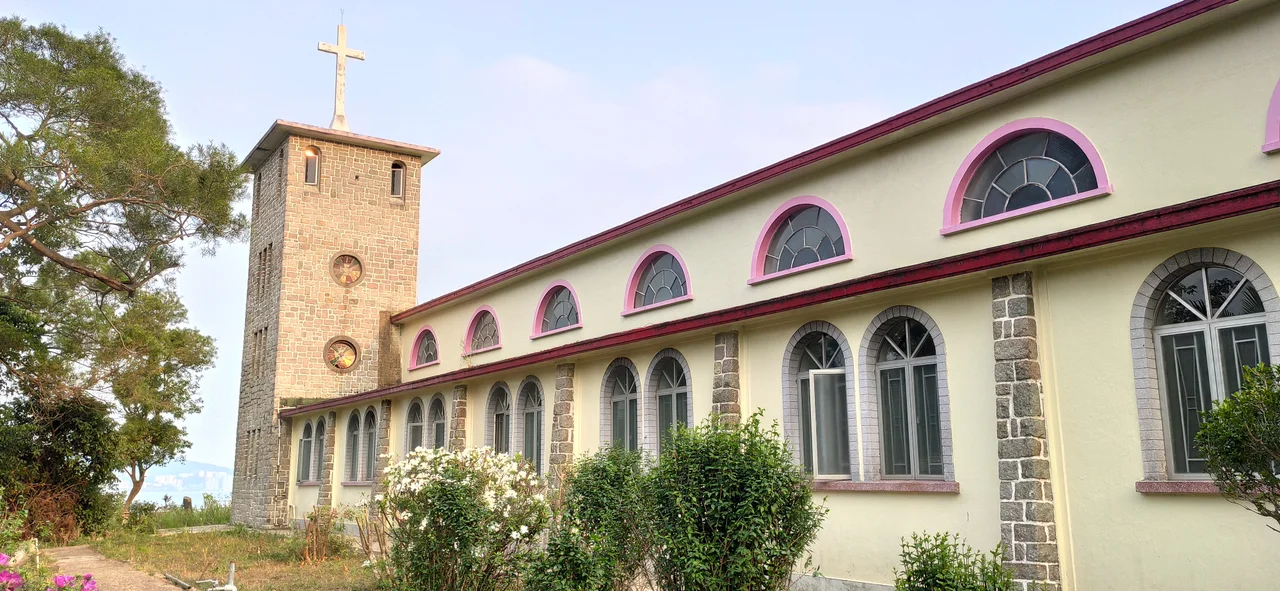

Our Lady of Joy Abbey
The community that now lives in quiet contemplation on the forested hillsides of Lantau Island arrived there only after a journey of extraordinary violence and loss. The Trappist monks of Our Lady of Joy Abbey did not choose Hong Kong because of its scenery. They came because everywhere else they had tried to live, people had come to kill them.
Murder in Hebei
The abbey's roots lie in Chengting, in what was then called Hopeh province — today's Zhengding in Hebei. There, a community of Trappist monks had built a monastery and kept the Cistercian order's disciplines of silence, labor, and prayer. When the Chinese Civil War intensified in the late 1940s, the monastery became a target. Thirty-three of the monks were murdered. The survivors fled.
A companion community at Our Lady of Consolation Abbey in Yangchiaping, Chahar province, fared no better — that monastery was destroyed in 1947 by forces of the Chinese Communist Party. Two communities, both broken. The survivors began moving, carrying with them the relics of what their monasteries had been and the intention of rebuilding somewhere they could survive.
Sichuan and Christmas Day
In 1947, Father Paulin Li led forty monks westward to Hsin-tu county near Chengtu, in Szechwan — today's Xindu within Chengdu, Sichuan. It seemed far enough from the fighting. It was not. The communist forces continued advancing, and by late 1949 the Szechwan monastery was no longer safe either.
On Christmas Day, 1949, communist forces occupied the Chengtu monastery and its surrounding land. In the chaos, several young monks were beaten severely. Three were martyred after torture: Vincent Shi, Albert Wei, and Father You. Father Paulin Li managed to move ten monks to safety — nine Chinese nationals and one Belgian. That small group, carrying the broken thread of two destroyed communities, eventually made their way to Hong Kong.
The loss embedded in that journey is worth sitting with. These were not abstract historical actors but individual men — some of them very young, some of them killed not for politics but because of where they had chosen to live and pray.
Lantau and the Long Rebuilding
The monastery they established at Tai Shui Hang on Lantau Island became, over time, something remarkable: a contemplative community that had earned its peace the hardest way. The abbey operated under various names and governance structures across the following decades — titular priors giving way to superiors, superiors giving way to abbots — reflecting a community slowly rebuilding its institutional footing as well as its spiritual life.
On 15 January 2000, the community officially adopted its current name, Our Lady of Joy Abbey, a name that carries a particular weight given everything that preceded it. Joy is not a naive concept here; it is something the community reached through its opposite.
Trappist Milk and Feral Cattle
The monastery became known to Hong Kong residents not only as a place of prayer but as a source of milk. The Trappist dairy farm produced milk under the Trappist brand — familiar to generations of Hong Kong households — for many years, though the production facility has since moved to Tai Sang Wai in Yuen Long District. What remains at the monastery are the descendants of the dairy herd: feral cattle that now roam the hillsides around Tai Shui Hang, among the last free-ranging cattle in Hong Kong.
There is something quietly affecting about those cattle. Released when the farm closed, they have established themselves in the landscape around the monastery — living reminders of an enterprise that once tied a community of contemplatives to the rhythms of daily Hong Kong life.
Arriving by Ferry
The abbey sits on a hiking trail between Discovery Bay and Mui Wo, accessible on foot through one of Lantau's wooded valleys, or by small kai-to ferry from Peng Chau or Discovery Bay's Nim Shue Wan pier. Either approach involves leaving the urban density of Hong Kong behind, crossing water or ascending forested hills, and arriving at something that feels genuinely removed from the city's pace.
The monks still live by the Cistercian Rule — early rising, communal prayer, manual labor, silence — in a building that looks out over the South China Sea. Visitors who arrive respectfully are generally welcome to walk the grounds. The feral cattle graze nearby. The water is visible through the trees. Whatever the monks came looking for when they finally stopped moving, they seem to have found it here.
From the Air
Our Lady of Joy Abbey sits at 22.2801°N, 114.019°E on the northeastern shore of Lantau Island, roughly 5 km southwest of Peng Chau island and about 12 km northeast of Lantau's Big Buddha. From the air, Lantau's forested interior rises steeply from the coastline; the monastery occupies a sheltered cove at Tai Shui Hang, visible as a cluster of white and grey buildings at the water's edge. Hong Kong International Airport (VHHH) is approximately 15 km to the north, making this area part of the general arrival corridor for aircraft approaching from the east. Suggested viewing altitude: 1,500–2,500 ft over the northeastern coast of Lantau, approaching from the direction of Peng Chau.
Nearby Stories
- Lok Ma Chau Loop 2.3 km away
- Portas do Cerco 2.3 km away
- Kweilin Incident 17 km away
- Wanshan Archipelago Campaign 34 km away
- Nanxiong Formation 115 km away
- Battle of Nanpeng Island 148 km away
- Heyuan 169 km away
- Cape Maobitou 632 km away