.jpg)
Our Lady of Tinos
Every year on 15 August, the Feast of the Dormition of the Theotokos, a silver-and-gold encased icon is carried down a long marble ramp from the Church of Panagia Evangelistria in Tinos to the harbour below. The road is carpeted in flowers. Pilgrims who have come from across Greece — by ferry, by plane, and some on their knees the entire length of the harbour road — press forward to touch the icon's case. The President of Greece is often present. So are warships of the Greek Navy. This is the holiest day of the Greek summer, on the island that most embodies it.
The Nun's Vision
The story begins in 1822, when a nun named Pelagia reported receiving visions of the Virgin Mary on the island of Tinos. In the visions, Mary instructed her to dig beneath a field where an old church of St. John the Baptist had once stood. The excavations began on 30 January 1823. Beneath the earth, workers uncovered an icon depicting the Annunciation — the moment the archangel Gabriel told Mary she would bear the Son of God.
The icon was found in the very first years of the modern Greek state, which had only just declared independence from Ottoman rule. Its discovery was understood immediately as providential. The icon was declared the handwork of Saint Luke the Evangelist — a traditional attribution for icons of great antiquity and power — and a nationwide collection was organized to fund a church to house it. Pelagia died in 1834. She was canonized as an Eastern Orthodox saint in 1970.
The Megalócharē
The church built to house the icon was inaugurated in 1830. It stands on the hill above Tinos town, white and neoclassical, visible from the sea. Inside, the icon itself is almost entirely hidden: over two centuries of veneration, the faithful have covered it in silver, gold, and precious jewels, layer upon layer, until the painted surface beneath is largely obscured. What remains visible is the face of the Virgin and the angel.
The icon is called the Megalócharē — She of Great Grace — or simply the Chárē Tēs, Her Grace. The church is often called by the same name. It is considered a protectress of seafarers and a healer of the sick. The donations the church receives annually — silver and gold ex-votos left by those who believe they have received miracles — are auctioned and the proceeds directed to charity. By 2008, estimates placed annual visitors at around one million, making this Greece's most visited Christian pilgrimage site.
Greece's Lourdes
The comparison to Lourdes in France or Fatima in Portugal is deliberate and widely used. Each of those sites emerged from reported apparitions; each became a gathering place for the sick, the faithful, and the hopeful; each acquired a national as well as a devotional significance. Tinos occupies that same position in Greek Orthodox life — akin but not identical to its Catholic counterparts, shaped by a different liturgical tradition but serving the same human need.
What distinguishes Tinos is the relationship between the icon's discovery and Greek national identity. The icon appeared at the moment the modern Greek nation was being born. Our Lady of Tinos was promptly declared the patron saint of Greece. The two histories — ecclesiastical and national — have been intertwined ever since. On 15 August every year, Greek leaders attend the Dormition liturgy here. The feast is both religious and civic.
The Festival Year
Two dates anchor the liturgical calendar at Evangelistria. The first is 30 January, commemorating the finding of the icon in 1823. On the afternoon of 29 January the icon is carried from the main church to the chapel below — dedicated to the Life-giving Spring — where it is placed on the spot it was originally discovered. The following day, a liturgy is held and the icon is carried in procession through the town before returning to the church. A ceremony honors the builders of the church.
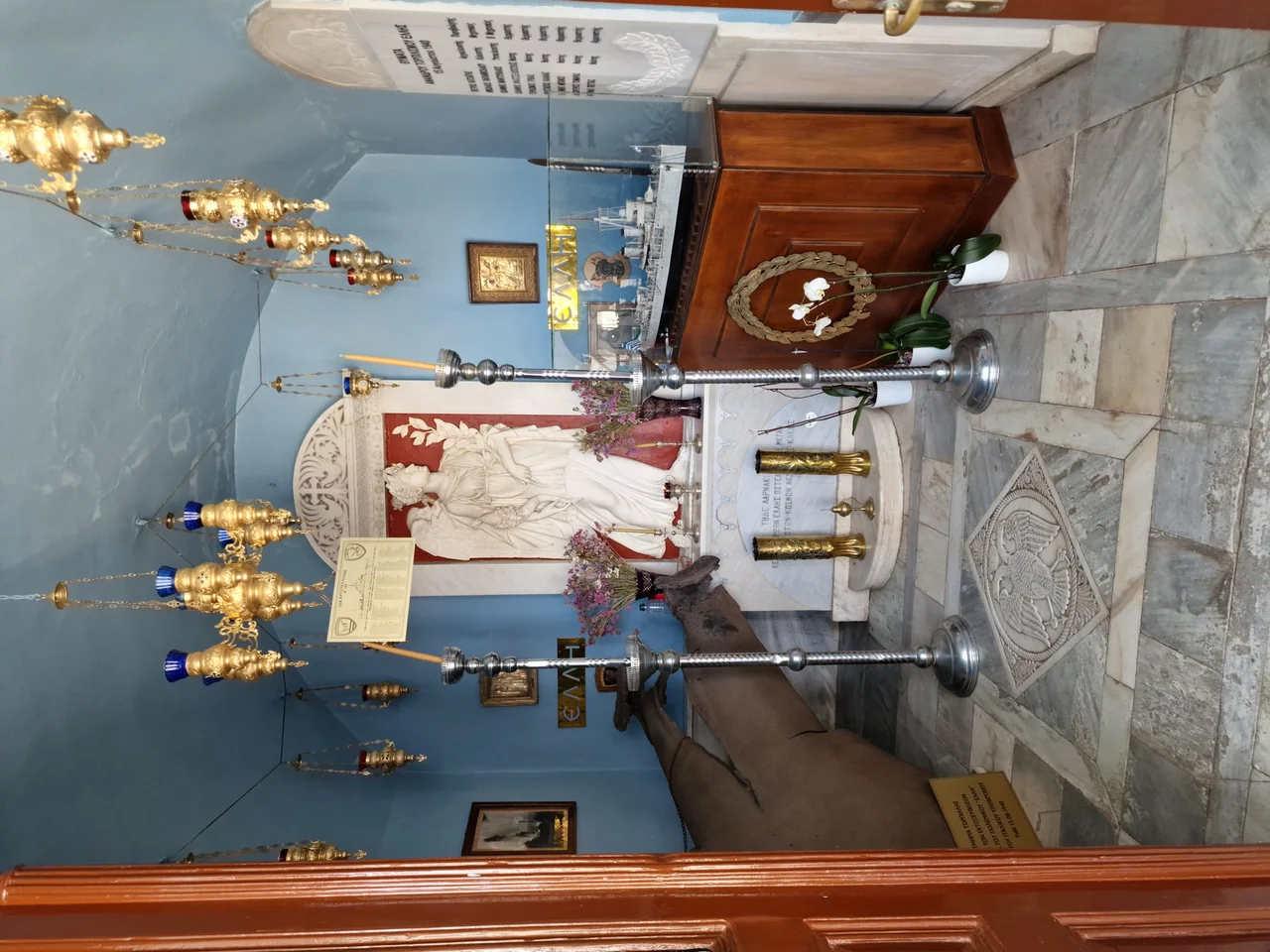
The second date is 15 August, the Feast of the Dormition. It is the larger of the two, the one that draws crowds from across the country and the diaspora. Pilgrims arrive for days beforehand. The harbour fills. Some faithful walk from the dock to the church on their knees — the road laid with red carpet for this purpose — a practice of bodily devotion that requires both commitment and endurance. After the tragedy of 1940, when Italian torpedoes sank the Greek cruiser Elli in this same harbour on this same feast day, the Dormition on Tinos acquired a second, civic dimension of mourning that has never entirely separated itself from the religious one.
From the Air
Panagia Evangelistria stands at approximately 37.54°N, 25.16°E, on the hillside above Tinos town on the south coast of the island of Tinos. The nearest major airport is LGMK (Mykonos National Airport), roughly 25 km to the southeast. The white church on the slope above the harbour is visible from the sea and from the air. From altitude, the long marble processional road connecting the harbour to the church is a distinctive feature. Recommended viewing altitude: 3,000–5,000 feet to see the church, town, and harbour in clear relationship. Ferries from Mykonos, Rafina, and Piraeus serve Tinos harbour regularly.
Nearby Stories
- Serifos 16 km away
- Archaeological Museum of Andros 18 km away
- Loutra, Kythnos 19 km away
- Panagia Ekatontapiliani 20 km away
- Karystos 30 km away
- Ikaria 45 km away
- Amorgos 51 km away
- Emporio, Chios 54 km away