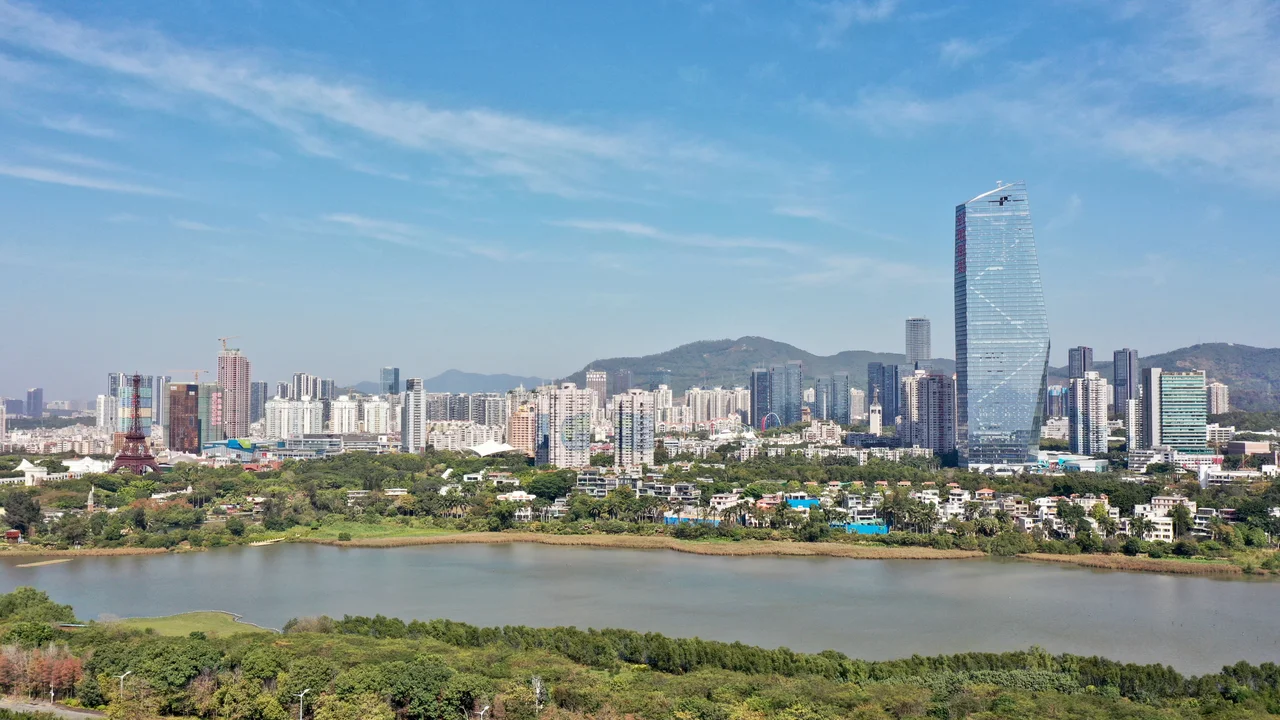

Overseas Chinese Town
Before Overseas Chinese Town had theme parks and metro stations and a contemporary art terminal, it had farms. The Shahe Farmland was established in 1959, comprising three villages — Upper Baishi, Lower Baishi, and Xintang — and its fields were tended years before Shenzhen existed as a city. The transformation from agricultural collective to the most visited tourism district in one of China's fastest-growing metropolises is the story of OCT, and it is inseparable from the story of China's economic opening itself.
From Farmland to Special Economic Zone
China's economic reform, launched on December 18, 1978 under Deng Xiaoping, remade the country from the edges inward. The Shekou Industrial Zone in Shenzhen became the first experimental port to open on January 31, 1979. Two years later, on December 3, 1981, the Guangdong Shahe Overseas Chinese Farmland was formally established from the existing farmland infrastructure. The decisive moment came on November 11, 1985, when the Shenzhen Special Economic Zone government designated 4.8 square kilometers of the former farmland as a development district for foreign businesses and firms, officially naming it Overseas Chinese Town. The location — adjacent to Shekou Port, on a bay opening toward Hong Kong — was deliberately chosen for engagement with the global economy. Factories and warehouses went up first. The cultural amenities came later.
The Theme Parks That Put OCT on the Map
The attractions that most visitors now associate with OCT were developed through the 1990s and early 2000s under Overseas Chinese Town Enterprises (OCTE), the state-owned company that still owns and operates the district. Splendid China, which opened in 1989, offered miniature reproductions of famous Chinese landmarks at a scale of 1:15. The Chinese Folk Culture Village displayed architectural styles and performance traditions from across China's ethnic groups. Window of the World, which opened in 1994, extended the concept globally — dozens of scale replicas of international landmarks, from the Eiffel Tower to the Egyptian pyramids, arranged across a park and accessible via multiple metro lines. Happy Valley Shenzhen added a conventional thrill rides theme park. By the time OCT received its AAAAA scenic area designation from the China National Tourism Administration — the highest classification in China's tourism rating system — it had become a self-contained leisure city within a city.
Konka, ZTE, and the Industrial Legacy
OCT was never only about tourism. In its early years, the foreign investment that flowed into the district supported electronics manufacturing, and two companies that emerged from or were significantly enabled by the OCT environment became household names in China: Konka, a consumer electronics firm, and ZTE, now a major telecommunications equipment manufacturer. The connection between OCT's foreign-investment infrastructure and the rise of Chinese tech manufacturing is a reminder that what looks like a leisure district today grew from an industrial and commercial experiment. By 1995, OCT's Gross Industrial Output Value had reached 33.76 billion yuan — 18.6 times its 1985 figure. Gross income reached 54.7 billion yuan. These are the numbers of a serious economic intervention, not a tourist precinct.
Art and Architecture in the Contemporary District
As Shenzhen matured and its economy moved up the value chain, OCT evolved again. The OCT Contemporary Art Terminal — known as OCAT — brought experimental visual art programming to the district. The OCT Tower punctuates the skyline. Contemporary urban design elements, galleries, and creative businesses moved into spaces that older industrial uses had vacated. Shenzhen Bay Park, accessible via the Meilin Line's Shenzhen Bay Park station, extends OCT's reach toward the waterfront facing Hong Kong. The University of Hong Kong-Shenzhen Hospital serves the district. What was once three villages of farmland now supports a community with its own schools — OCT Elementary School and OCT High School — and even a Korean weekend school that drew around 600 students in 2007, reflecting the international character of the district's resident population.
The Wider OCT
The OCT brand has extended beyond its original 4.8 square kilometers. Overseas Chinese Town East, developed in Yantian District on Dapeng Bay, brought the tourism model to the eastern edge of Shenzhen. OCT Bay (also called OCT Harbour) created a waterfront entertainment and residential district. These extensions carry the initials but differ in character from the original Nanshan district campus — they're newer, more polished, less burdened with industrial history. The original OCT, though, retains something those newer developments don't quite replicate: the residue of an experiment that mattered. It was here, on repurposed farmland beside Shekou Port, that Shenzhen's integration of foreign capital, overseas Chinese networks, and Chinese state enterprise first took visible shape.
From the Air
Overseas Chinese Town is located at approximately 22.54°N, 113.98°E in Nanshan District, Shenzhen. From the air at low to medium altitude approaching from the west over Qianhai Bay, OCT is recognizable by the density of its development and the distinctive profile of the Window of the World theme park, including scale replicas of international landmarks visible from above. The Shenzhen Bay Bridge crossing to Hong Kong's New Territories is visible nearby to the southwest. Shenzhen Bao'an International Airport (ZGSZ) is approximately 17 nautical miles to the northwest. Hong Kong International (VHHH) is approximately 22 nautical miles to the southwest. Multiple metro lines serve the area, with the Window of the World station on Line 1 being the primary transit hub.
Nearby Stories
- Hong Kong Disneyland 4.1 km away
- Mount Guanyin (Dongguan) 7 km away
- 2024 Lixinsha Bridge Collapse 7.4 km away
- Portas do Cerco 12 km away
- Lotus Hill 15 km away
- Nanxiong Formation 78 km away
- Heyuan 130 km away
- Checheng Fu'an Temple 629 km away