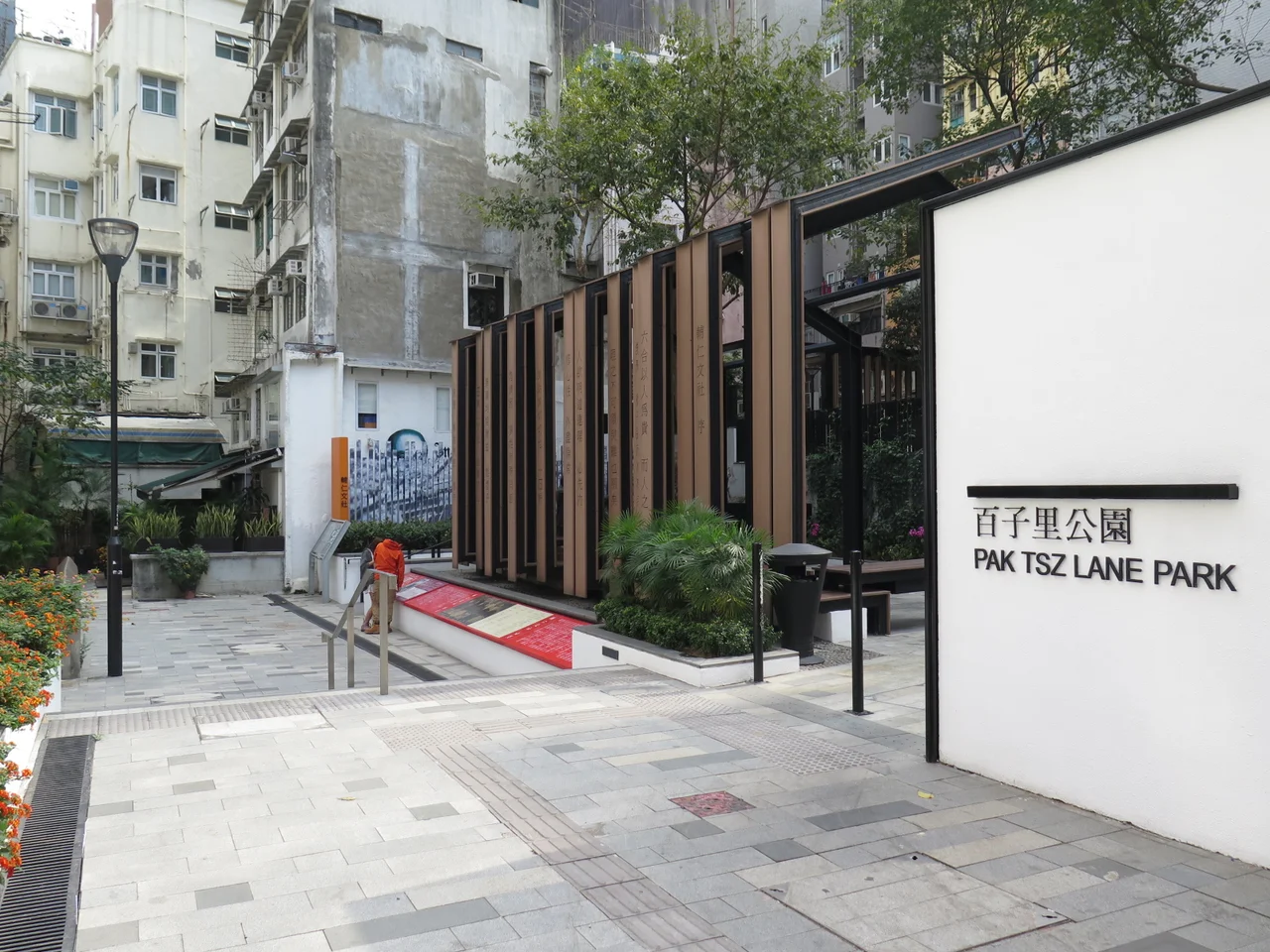

Pak Tsz Lane Park
The men who met at 52 Gage Street chose the location deliberately. Behind Aberdeen Street, tucked between Hollywood Road and Peel Street, the neighborhood's warren of narrow lanes offered something essential to anyone conducting illegal meetings in British colonial Hong Kong: multiple escape routes. Sam Ka Lane. Pak Tsz Lane. A man could be gone before anyone knew which direction he had taken. The Furen Literary Society held its meetings there in the 1890s. One of its members was a young medical student named Sun Yat-sen.
The Society with Two Purposes
The Furen Literary Society was founded in the early 1890s in Hong Kong as a cover for anti-Qing revolutionary activity. Its president was Yeung Ku-wan, an intellectual and organizer who had studied in England and returned committed to ending Qing rule in China. Sun Yat-sen, who would later become the founding father of the Republic of China, was among the society's leading members, along with Tse Tsan-tai, an Australian-born Chinese journalist and activist.
The Furen Literary Society later merged into the Hong Kong chapter of the Revive China Society — Sun Yat-sen's first political organization, formally established in 1894. The society organized two rebellions: the First Guangzhou Uprising of 1895 and the Huizhou Uprising of 1900. Both failed. But the networks, ideas, and determination built in those Gage Street meetings eventually contributed to the Xinhai Revolution of 1911, which ended the Qing dynasty and established the Republic of China.
Yeung Ku-wan and the Cost of Revolution
The leader of the Furen Literary Society did not survive to see the revolution succeed. Yeung Ku-wan taught at the premises at 52 Gage Street — the back of that building is now Stop 7 on the Dr Sun Yat-sen Historical Trail — and his meetings there made him a known target for Qing Dynasty intelligence operatives.
Qing agents eventually tracked him down and assassinated him. The date and specific circumstances are recorded in the park itself, which displays a copy of Sun Yat-sen's letter of condolence to Tse Tsan-tai following Yeung's death. That letter, reproduced on a slatted panel in the park, is one of the few artifacts here that carries direct emotional weight — not a map of events, but one man telling another that their friend is gone.
A Park Built for a Centenary
Pak Tsz Lane Park as it exists today opened in May 2012, designed by architecture firm Ronald Lu & Partners and financed with HK$40 million from the Hong Kong Urban Renewal Authority. The timing was deliberate: it was built in anticipation of the centenary of the Xinhai Revolution, observed in October 2011, which marked 100 years since the uprising that ended imperial China.
The park's design emphasizes commemoration over beauty. Information panels recount the Furen Literary Society's founding and its members. Maps on slatted displays mark the sites of the 1895 Guangzhou and 1900 Huizhou rebellions. An interactive installation based on a children's street game uses rotating discs to reveal paired photographs of revolutionary events. There is also an old well that has nothing to do with the revolution but has been preserved anyway — a piece of the neighborhood's longer history, kept because erasure is not the only alternative to commemoration.
The Sculpture at the Center
The park's most immediate image is a bronze sculpture: a Western-dressed man using scissors to cut the queue — the long braided pigtail that Qing Dynasty law required all Han Chinese men to wear — from the head of a man in traditional Manchu dress. The gesture was explosive in its time. The queue was a symbol of submission to Qing authority; cutting it was an act of political defiance with real legal consequences. That the man doing the cutting is dressed in Western clothes and the one wearing the queue is dressed in Manchu garb clarifies the sculpture's argument.
The revolutionaries who met on Gage Street and Pak Tsz Lane understood that clothing was political. Sun Yat-sen spent years moving between British colonial Hong Kong, Japan, Europe, and the Americas, wearing different clothes for different audiences, fundraising for a revolution that was still years away. The queue sculpture catches something essential about that era — the physical, visible markers of the old order, and the deliberateness required to reject them.
Finding It
The park sits in a quiet square that most people in Hong Kong have never visited. There are no English-language explanatory signs within it, and no signposts on adjacent streets directing visitors toward it. This is not quite an accident — the park was built primarily as a resource for local residents and as a commemoration for the Chinese-speaking community — but it does mean that anyone who arrives without already knowing where they are going will find it unexplained.
Pak Tsz Lane is Stop 8 on the Dr Sun Yat-sen Historical Trail, a walking route through Central that connects sites associated with the early revolution. Following the trail from its beginning provides the context that the park itself does not quite supply. Walking through the lanes that the revolutionaries used as escape routes — still narrow, still easily missed — it becomes easier to understand why they chose this neighborhood. Some things about Central Hong Kong have changed completely. Some things, at lane level, have not changed much at all.
From the Air
Pak Tsz Lane Park sits at 22.2834°N, 114.153°E in Central Hong Kong, on the lower slopes of the hillside that rises toward the Peak. From the air, the Mid-Levels neighborhood is visible as a dense residential zone stepping up the hillside above the commercial core of Central and the harbor. The park itself is too small to identify from altitude, but it lies approximately 1 km south of the Star Ferry pier and 500 meters north of the Peak Tram lower terminus. Hong Kong International Airport (VHHH) is 29 km to the northwest. Suggested viewing altitude: 500–1,000 ft over Central harbor, looking south toward the hillside grid of the Mid-Levels.
Nearby Stories
- Lok Ma Chau Loop 2.3 km away
- Portas do Cerco 2.3 km away
- Kweilin Incident 17 km away
- Wanshan Archipelago Campaign 34 km away
- Nanxiong Formation 115 km away
- Battle of Nanpeng Island 148 km away
- Heyuan 169 km away
- Cape Maobitou 632 km away