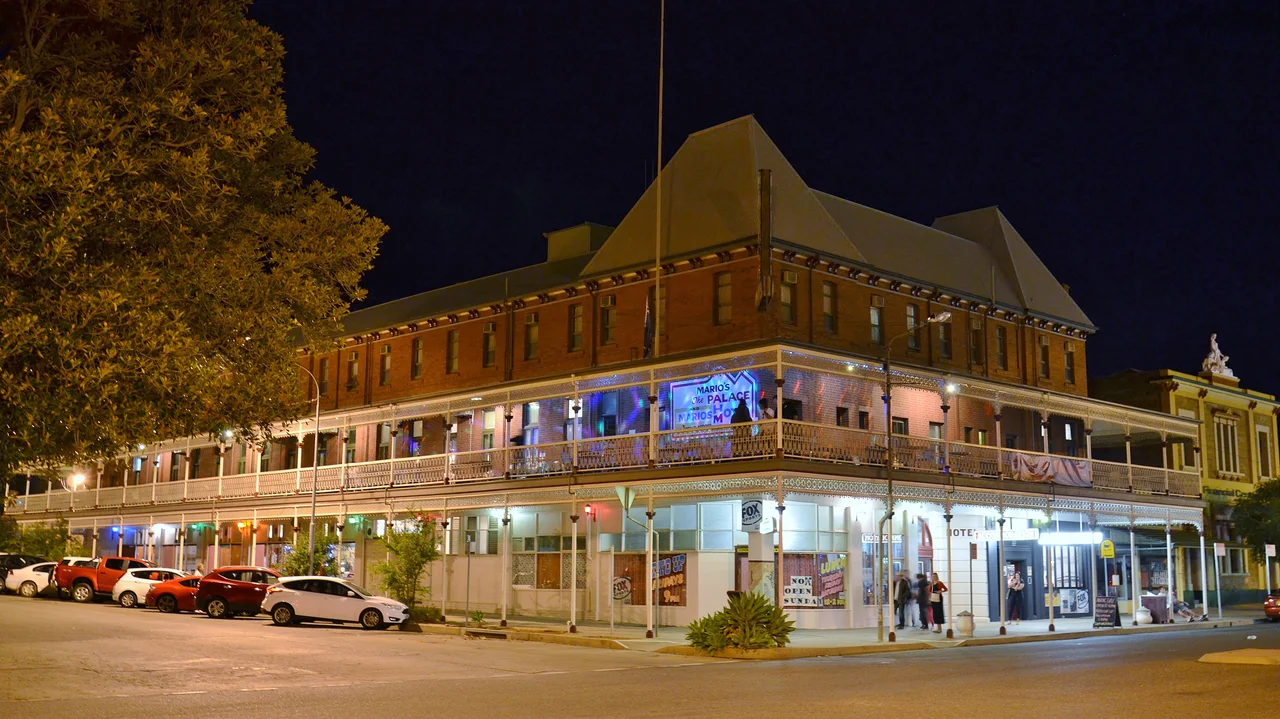

Palace Hotel, Broken Hill
Push open the door and the desert disappears. Inside the Palace Hotel, almost every surface — walls, ceilings, the great staircase — is painted: lush green landscapes, a copy of Botticelli's Venus rising from the sea, scene after scene that turns a pub in one of the driest corners of Australia into an impossible oasis. It is gloriously, defiantly over the top. The film that made it famous called the murals 'tack-o-rama.' Generations of travellers, and one busload of drag queens, would beg to differ.
Built to Defeat the Bottle
The great irony of the Palace is that it was built to keep people sober. In 1889, at the height of Broken Hill's silver boom, members of the local temperance movement commissioned it from the Melbourne architect Alfred Dunn as the Broken Hill Coffee Palace — a grand alcohol-free hotel where miners could find comfort and company without a public bar. It opened on 18 December that year, having cost £12,190. The model did not survive contact with a mining town. The coffee palace ran at a loss for three straight years, and by July 1892 the press was reporting that the company and its lessees were flatly 'stone broke.' That same month the lessee applied for a liquor licence, won it, and renamed the building the Palace Hotel. The temperance dream was over; the pub had begun.
An Oasis Painted on the Walls
The murals came nearly a century later, and they began with one man's enthusiasm. Mario Celotto, an Italian immigrant who bought the hotel in 1973, painted the first of them around 1980 — that ceiling Venus, copied from Botticelli. He then commissioned Gordon Waye, an Aboriginal artist from Port Augusta, to paint the rest. Over the following years Waye covered the interiors with scenes of Country and green landscape — close to fifty paintings in all — until the Palace became a destination in its own right, a desert hotel whose walls dreamed of water and forest. The effect is overwhelming and sincere, the work of artists filling every inch of a building because they could.
Priscilla's Palace
In 1994 the hotel found a global audience. The Australian comedy-drama The Adventures of Priscilla, Queen of the Desert filmed many of its Broken Hill scenes inside the Palace, and the place fit the film perfectly — producer Al Clark called it 'drag queen heaven.' The script teased the murals as 'tack-o-rama,' but the love was real, and it stuck. After the film, international visitors began arriving specifically to see the hotel from the screen. The Palace had become a pilgrimage site for fans of one of the most beloved queer films ever made.
A Meeting Place, Now Recognised
By 2009, when Esther La Rovere bought the hotel, the pub was already drawing a steady stream of international tourists who had come to see it because of the film. The Palace was first heritage-listed in April 1999, but in January 2025 New South Wales did something rarer: it expanded the listing to formally recognise the vibrant LGBTQIA+ history that had flourished within its walls. Over the decades the hotel had become a symbolic meeting place, woven into people's coming-out stories — a welcoming room in a remote mining town, a long way from anywhere, where people could simply be themselves. From a temperance hall built to deny pleasure, to a mural-drenched oasis, to a landmark of queer Australia, the Palace has spent more than 130 years becoming the opposite of what it was meant to be. Few buildings wear their reinvention so joyfully.
From the Air
The Palace Hotel stands at 31.960°S, 141.464°E on Argent Street, in the heart of Broken Hill's heritage commercial grid just south of the Line of Lode. From the air the Line of Lode and its memorial atop the ridge are the obvious landmark; the Palace itself sits in the dense central street pattern below. Recommended viewing altitude is 1,500 to 2,500 feet AGL, with field elevation around 1,000 feet. Broken Hill Airport (YBHI) is roughly 4 nautical miles southwest. Outback visibility is typically excellent; watch for summer heat haze and occasional blowing dust.
Nearby Stories
- Mount Gipps Station 5.4 km away
- Radium Hill 33 km away
- Honeymoon Uranium Mine 35 km away
- Menindee, New South Wales 44 km away
- Mutawintji National Park 64 km away
- Kinchega Woolshed 70 km away
- Kinchega National Park 86 km away
- Mount Chambers Gorge 178 km away