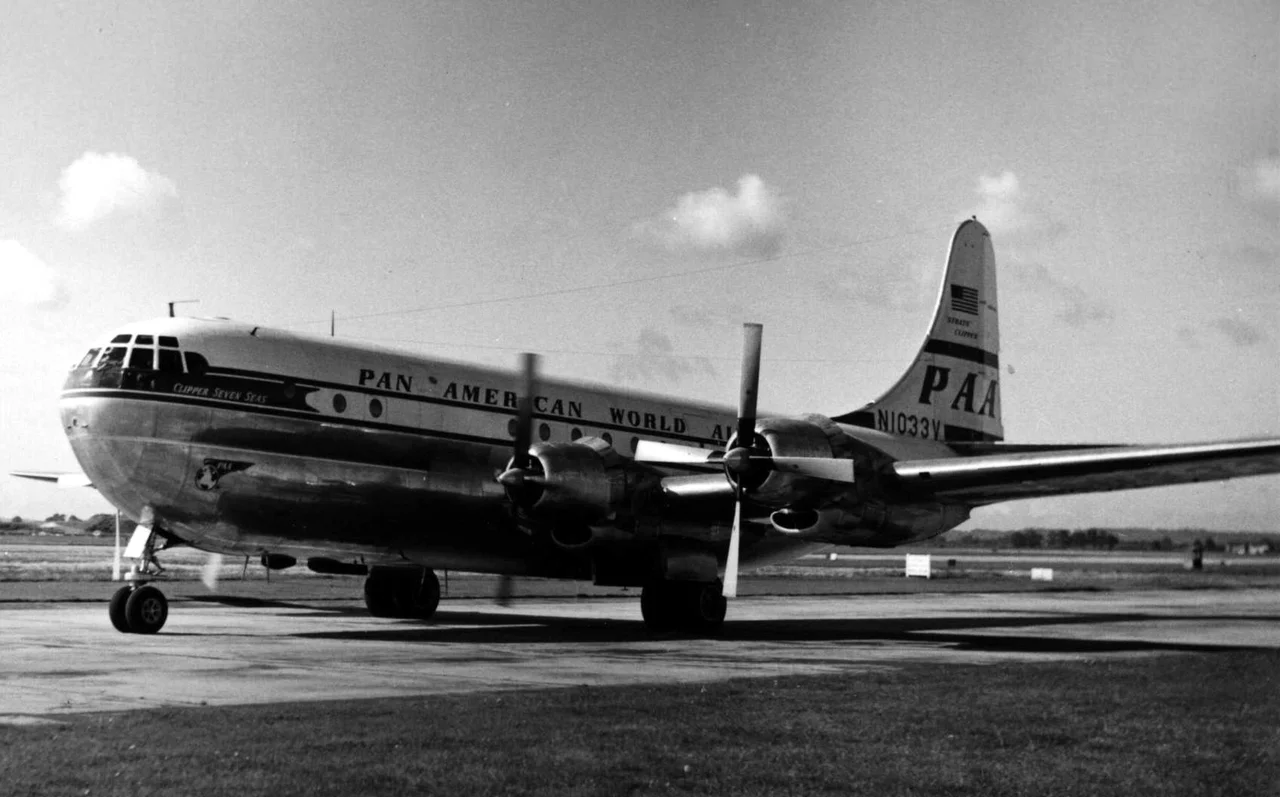

Pan Am Flight 202
On April 29, 1952, a Boeing 377 Stratocruiser named Clipper Good Hope left Rio de Janeiro on what should have been a routine third leg of a four-leg Pan Am service to the Caribbean. It never reached Port of Spain. The pilots did not report passing Carolina, Maranhão, as scheduled. They did not report abeam Santarém, further northwest. When calls to the aircraft went unanswered, Brazilian authorities opened a missing aircraft alert. Fifty people were aboard, and they had gone down somewhere in the Amazon basin. Finding them would take two days for the wreckage and nearly four months for investigators to reach it on the ground. The jungle does not yield its secrets easily.
The Clipper Good Hope
The Boeing 377 Stratocruiser was one of the great piston-engine airliners of its era, a double-deck aircraft with spiral staircases, cocktail lounges, and sleeping berths that carried passengers between continents in the years before jets took over. Clipper Good Hope, registration N1039V, first flew on September 28, 1949. By April 1952 it had logged 6,944 airframe hours - a mid-life aircraft by the standards of the time. Pan American World Airways operated it on long-haul routes that stitched South America to the Caribbean and on to New York. Flight 202 followed one of those arcing services: Buenos Aires northward through Rio de Janeiro, then across the interior of Brazil to the Caribbean, then up to New York. The segment from Rio to Port of Spain crossed the length of the Amazon basin, an area where navigation aids were sparse and weather could hide everything.
A Silent Radio
The flight plan routed Flight 202 roughly northwest over the interior, passing abeam the town of Carolina in what is now Maranhão and then abeam the city of Santarém further toward the Atlantic mouth of the Amazon. Crews of that era reported position by radio at set checkpoints, and when Clipper Good Hope failed to report passing Carolina, and then Santarém, the silence was ominous. Local authorities moved first, initiating a missing aircraft alert. The search that followed brought in Brazilian Air Force aircraft, the United States Air Force, and the United States Navy to sweep the jungle, while Brazilian Navy ships searched the coastal waters off northern South America in case the Stratocruiser had overflown the continent and ditched at sea. For two days, nothing. The plane had gone down in one of the densest, least-mapped forests on the continent.
The Discovery
On May 1, 1952, a Pan American Curtiss C-46 Commando freighter found what everyone had feared. The wreckage lay about 281 nautical miles southwest of Carolina, in territory of the Karajá people. A 27-member investigation team chartered a seaplane to Lago Grande, a small village on the Araguaia River less than 40 nautical miles from the crash site. The plan was to trek overland to the wreckage. The terrain had other ideas. All but seven members had to turn back before reaching the site. Those seven pressed on, running dangerously low on water, food, and supplies. When they reached the wreckage, they could only confirm the worst - that everyone aboard had died on impact and a huge fire had consumed the fuselage. They had neither the resources nor the equipment to examine the wreckage properly. They had to retreat.
Three Sections in the Forest
A properly provisioned second investigation team built a base camp northwest of Lago Grande and finally reached the wreckage on August 15, 1952 - more than three and a half months after the crash. What they found told a story of in-flight breakup. The wreckage had fallen in three main sections. The fuselage, starboard wing, and right-side engines, along with the root of the left wing and the nacelle for the No. 2 engine, lay in dense forest 13 nautical miles northwest of the base camp. The outer port wing and the No. 1 engine had fallen 765 yards to the northwest of the main debris field. The empennage - the tail - and fractured parts of the No. 2 engine lay roughly 1,100 yards north of the main wreckage. The pattern was unmistakable. The aircraft had come apart in the air.
The Missing Engine
The No. 2 engine itself was never found, along with its propeller. But damage patterns on the port wing root, the engine nacelle, the vertical stabilizer, and the horizontal stabilizer pointed to an engine and propeller failure in flight. The Boeing 377 had a history with its propellers. Two prior engine separation incidents had occurred on January 24 and 25, 1950. Investigators hypothesized that a propeller failure on Clipper Good Hope had produced highly unbalanced loads on the No. 2 engine, which eventually tore free from the port wing. Debris from the propeller likely flew outward, damaging control surfaces as the aircraft rolled into catastrophic structural failure. The investigation took place under exceptionally unfavorable conditions, and the exact cause of the accident was never definitively established. Fifty people, including crew and passengers, died in a forest that made the investigation itself a struggle for survival. They deserved better answers than the Amazon was willing to give.
From the Air
Crash site located at approximately 9.75°S, 50.78°W in the Amazon basin of central Brazil, about 281 nautical miles southwest of Carolina, Maranhão. Terrain is dense tropical forest in what was historically Karajá territory, near the Araguaia River. Lago Grande village provided the staging point for investigators. Recommended viewing altitude 15,000-25,000 feet for regional context. No surface memorial is accessible. Visible from altitude: the Araguaia River system; the transitional forest-cerrado landscape that still covers much of this region; Serra do Pardo and other protected areas nearby. The aircraft's original route would have tracked northwest from Rio de Janeiro toward Santarém before continuing to Port of Spain.
Nearby Stories
- Cantão State Park 24 km away
- Araguaia National Park 55 km away
- Varig Flight 254 153 km away
- Gol Transportes Aéreos Flight 1907 230 km away
- Tocantins 233 km away
- Nascentes da Serra do Cachimbo Biological Reserve 372 km away
- Carajás National Forest 388 km away