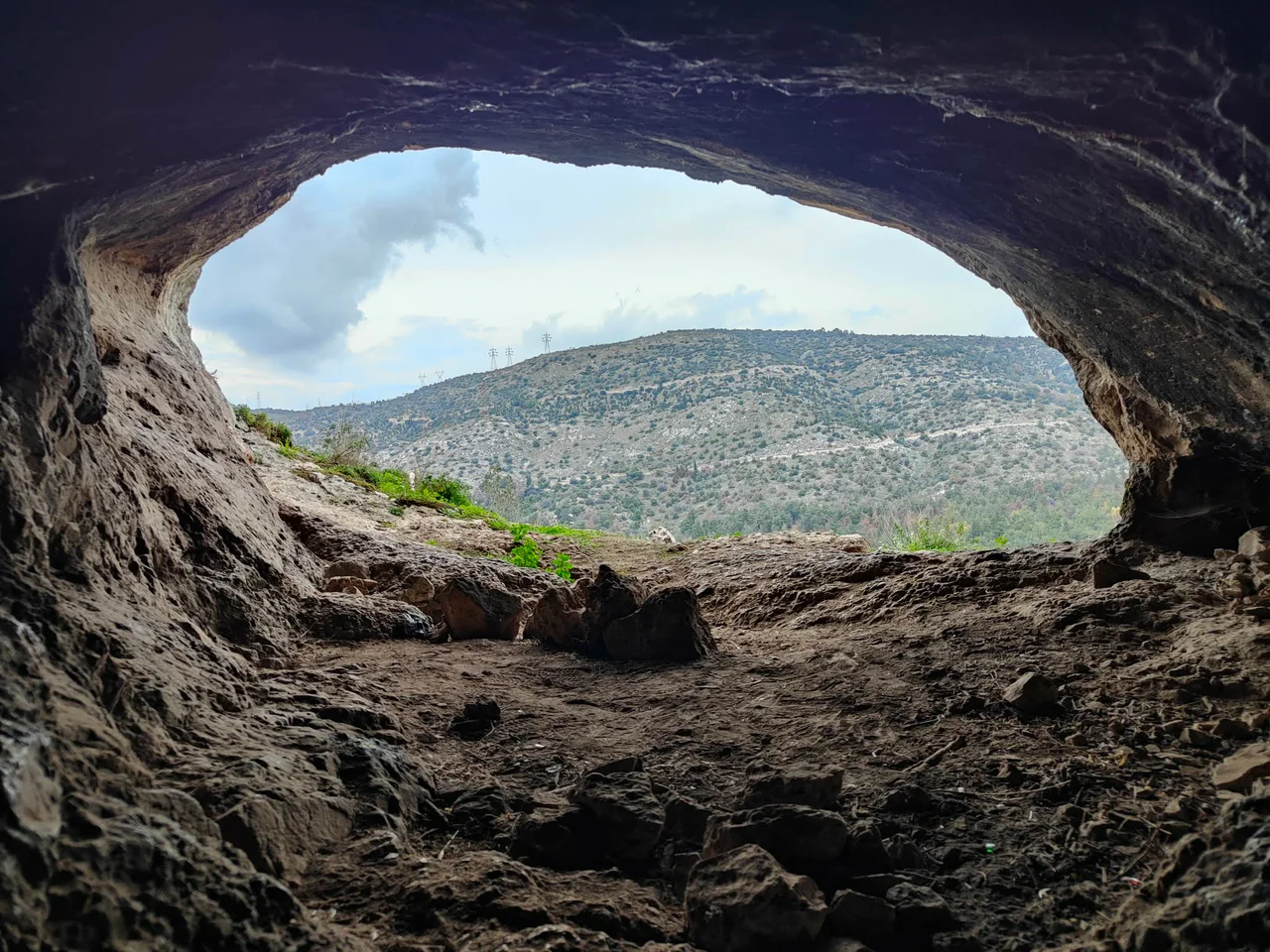

Pan's Cave (Haidari)
Picture a shepherd in the fifth century BC, climbing a wooded hill west of Athens with a clay lamp and a small goat. He ducks into a narrow cave that opens to the north, its walls smoothed with plaster, the floor dark with old ash and the bones of earlier offerings. He has come to leave something for Pan - the half-goat god of wild places, who is said to haunt exactly this kind of remote, shadowed hollow. The cave at Daphni, in modern Haidari, kept the residue of countless such visits, and centuries later it gave them up to the archaeologist's trowel.
A Hollow Shaped for a God
The cave is small and intimate rather than grand. Conical in shape, it runs back about 11.5 meters from an opening some 7.8 meters wide and 3.4 meters high, facing north. A flat forecourt once extended about two meters in front of it, a kind of natural threshold for whatever rituals took place at the mouth. Traces of mortar survive on the side walls, the floor, and the forecourt, showing that these surfaces were deliberately plastered - an effort to civilize the raw rock into a sanctuary. Such settings were exactly what the ancient Greeks associated with Pan: secluded, wooded, easily reached by shepherds and travelers looking for shelter, far enough from the city to feel like the god's own country.
What the Earth Held
The first modern study began on 25 March 1932, led by the Greek architect and archaeologist Ioannis Travlos. Beneath a thin layer of soil and animal dung, the excavators found the debris of worship: animal bones, some of them burnt, and fragments of goat horns - the residue of sacrifices and burnt offerings. There were seashells, pottery sherds, an intact clay lamp, and ash from old hearths. Many of the pottery fragments came from loutrophoroi, the tall vessels tied to ritual and to the thresholds of life and death. Most evocative were the clay figurines: the god Pan himself, the goddess Aphrodite, the Silenoi - earthy companions of Dionysus linked to flowing water and fertility - and a number of female figures. Some sherds carried scenes suggestive of nymphs, the deities who, in myth, kept Pan constant company.
A Brief, Bright Window
The finds were modest in number, but they were enough to date the cave's active life with some confidence. Worship here flourished in a fairly narrow window - from the time of the Greco-Persian Wars through the mid- to late fifth century BC. After that the evidence simply stops. No younger artifacts have turned up, so archaeologists assume the cult faded out by the close of the fifth century BC. It is a poignant detail: a shrine that burned bright for only a few generations, then went quiet. Why people stopped coming, no one can say for certain. The cave kept no record of its own abandonment - only the absence of anything left behind after a certain point.
Second Lives
The cave did not stay empty forever. In early Christian times, with the great Byzantine monastery of Daphni rising nearby, the hollow found new purpose. There are signs it served again as a sanctuary, or perhaps as a retreat for hermits drawn to its isolation - and a large painted cross still marks the left wall of the interior, a quiet overwriting of the pagan past. Soot on the cave's roof speaks of fires lit across many eras. Later still, likely during the centuries of Ottoman rule and after the monks had gone, the same space was put to humbler use as a temporary sheep stable. A cave first sacred to a goat-god ended, fittingly enough, sheltering goats - the divine and the daily folded into the same patient stone.
From the Air
Pan's Cave lies in the wooded hills of Daphni, in the suburb of Haidari west of central Athens, at approximately 38.0112 N, 23.6312 E, near the Byzantine Daphni Monastery (a UNESCO World Heritage Site, a useful landmark from the air). From above, this is the green saddle of Mount Aigaleo separating the Athens basin from the Thriasian plain toward Eleusis - the historic route west out of the city. The nearest airport is Athens International Airport 'Eleftherios Venizelos' (ICAO: LGAV), about 30 km to the east across the basin. Recommended viewing altitude is 2,500-4,000 ft to pick out the monastery and the wooded ridge. Visibility over the hills is generally good, with possible summer haze in the basin to the east.
Nearby Stories
- Great Sand Beach 5 km away
- Battle of Delium 7.7 km away
- Tower of Aliartos 9 km away
- HMHS Britannic 10 km away
- Saronic Gulf 15 km away
- Sousaki Volcano 17 km away
- Sanctuary of Apollo Maleatas 24 km away
- Skyros 66 km away