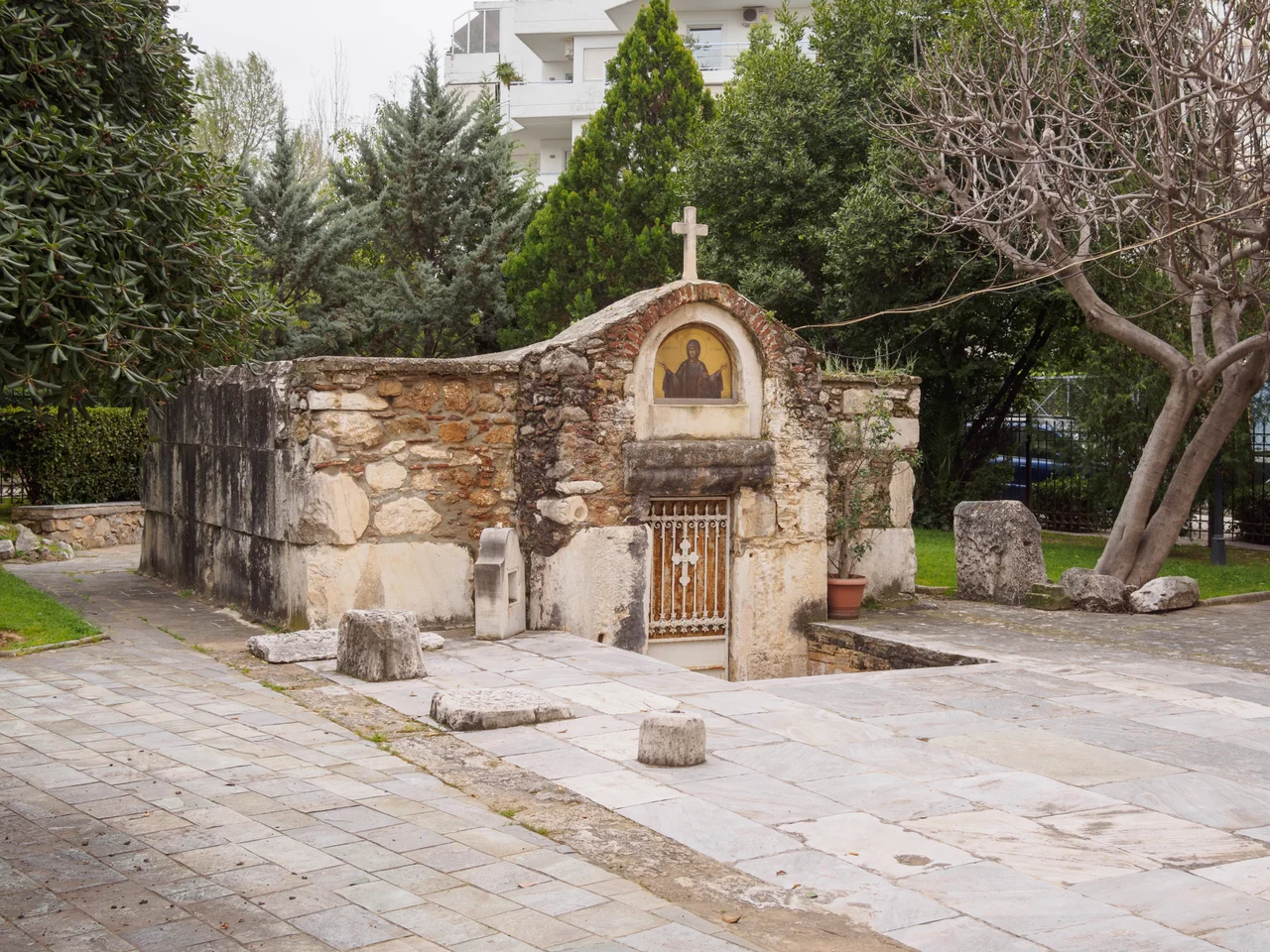

Panagia Marmariotissa, Chalandri
To reach it, you walk down. The little chapel of Panagia Marmariotissa sits with its floor several meters below the modern street, as if the centuries had quietly buried it where it stands. Tucked behind a larger, newer church of the same name in the Athens suburb of Chalandri, it is easy to pass without noticing. But this small, semi-hexagonal building has lived two very different lives - first as a rich man's tomb in Roman Greece, and only later as a house of Christian worship. Its very name keeps the secret of what it was: Marmariotissa, from the marble it was lavishly built to last.
A Tomb Worth Remembering
Long before it was a church, the building was a mausoleum, raised in Roman times in the territory of ancient Phlya - the old deme that lay where Chalandri now stands. The expense of its construction tells its own story. The costly materials, marble above all, mark it out as the resting place of someone wealthy and important, a prominent resident with the means to commission something built to outlast him. Most of the dead of that era left little trace. This one left a structure solid enough that, two thousand years on, it still stands in remarkably good condition - the work of someone who clearly intended to be remembered, and, in a way he could never have foreseen, succeeded.
An Echo of Herodes Atticus
Whose tomb was it? The building offers a tantalizing clue in its design. It closely resembles the funerary monument of Kifissia, a now-ruined mausoleum built by Herodes Atticus - the fabulously rich Athenian aristocrat, orator, and benefactor of the second century AD who lavished monuments across Greece, including the great odeon that still bears his name beneath the Acropolis. The likeness has led scholars to suggest that Herodes Atticus himself may have been behind the Chalandri monument, or at least someone working in his orbit and to his taste. It is a suggestion rather than a certainty, but it places this modest suburban chapel within the ambit of one of Roman Athens' greatest patrons of the built landscape.
From Mausoleum to Mary
At some point the tomb stopped serving the dead and began serving the living. Christians reshaped the Roman structure into a small church dedicated to the Panagia - the Virgin Mary - reorienting it for worship. The transformation left visible seams. In the original monument the entrance stood on the eastern side; today that east end holds the sanctuary of the little semi-hexagonal temple, exactly where Orthodox tradition requires the altar to face. The repurposing was practical and reverent at once: a sturdy, sacred-feeling space was simply turned toward a new faith. Buildings in Attica have a way of doing this - shedding one set of gods and taking up another without ever falling down.
Beneath the Modern Street
Stand inside today and the most striking thing is the ground itself. The chapel's floor lies a few meters below the present surface, a measure of how much the land around it has risen over the centuries as the suburb grew up over the ancient one. Above and around it, modern Chalandri carries on - traffic at the junction of Panagia Marmariotissis and Sofoklis Venizelou streets, the bustle of a northern Athens neighborhood - while this small marble survivor keeps its quiet at a lower level, half sunk in time. It is one of those places where the ordinary city, almost by accident, has preserved something extraordinary: a Roman's bid for immortality, still standing, still in use, under a name that simply means 'of the marble.'
From the Air
Panagia Marmariotissa stands in Chalandri, a northern suburb of Athens, at approximately 38.0156 N, 23.7983 E, at the junction of Panagia Marmariotissis and Sofoklis Venizelou streets. From the air, Chalandri reads as a dense residential district in the northeastern part of the Athens basin, between the city center to the southwest and the slopes of Mount Pentelicus to the northeast. The nearest airport is Athens International Airport 'Eleftherios Venizelos' (ICAO: LGAV), about 15 km to the east-southeast. Recommended viewing altitude is 2,500-4,000 ft to place the suburb within the basin; Mount Hymettus lies to the southeast and Lycabettus and the Acropolis to the south for orientation. Visibility over the basin is generally good, with summer heat haze possible.
Nearby Stories
- Great Sand Beach 5 km away
- Battle of Delium 7.7 km away
- Tower of Aliartos 9 km away
- HMHS Britannic 10 km away
- Saronic Gulf 15 km away
- Sousaki Volcano 17 km away
- Sanctuary of Apollo Maleatas 24 km away
- Skyros 66 km away