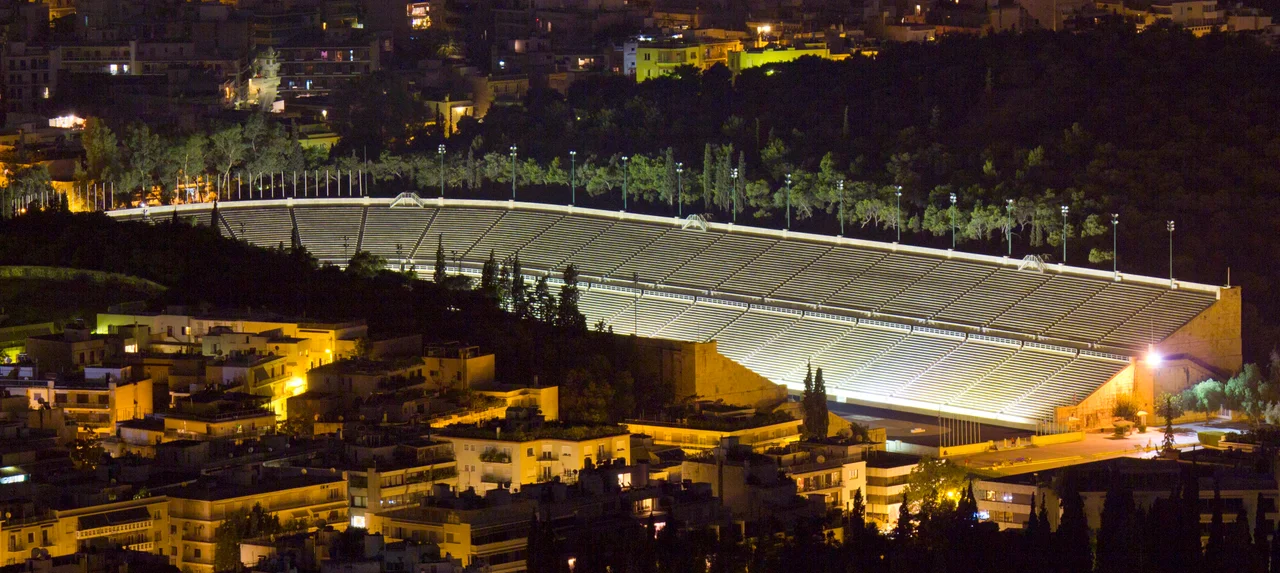

Panathenaic Stadium
On 6 April 1896, a day that fell simultaneously on Easter Monday for both Western and Eastern Christian churches and on the anniversary of Greek independence, an estimated 60,000 people filled a horseshoe of white marble set into the hills east of Athens. What they were watching was the opening of the First Olympiad of the modern era. The stadium they sat in was ancient — its origins traced back to the Athenian statesman Lykourgos in the 4th century BC, and later vastly expanded by the Roman benefactor Herodes Atticus in the 2nd century AD. But it had lain in ruins for centuries, its marble quarried away for other buildings, wheat growing where athletes once ran. The Panathenaic Stadium's resurrection for the first modern Games is one of the more remarkable acts of architectural restoration in history.
The Marble That Endures
Marble is the word that defines the Panathenaic Stadium. Specifically, Pentelic marble — the same gleaming white stone quarried from Mount Pentelicus that built the Parthenon. The stadium's cavea, the seating bowl, curves in a long horseshoe around the track, entirely clad in this material; it is the only stadium in the world built entirely of marble. Herodes Atticus had the seats decorated with owls in relief, symbolising Athena, the patron goddess of the city whose games this was. One scholar described his approach as an act of architectural self-representation: Roman in scale but self-consciously rejecting the Roman monumental facade and extensive vaulting, instead making allusions to the Classical Greek past. The design announced: this is Athens, not Rome. The stadium sits in a natural valley between two hills, the Ardettos and the Agra, at 37.97°N, 23.74°E — a basin that concentrates both the crowd noise and, in summer, the Attic heat.
Centuries of Ruin and Revival
Emperor Theodosius I banned the Hellenistic festivals and their associated spectacles in the late 4th century AD. The games stopped. Gradually the stadium was forgotten, and a field of wheat grew over the site. During the Latin rule of Athens, Crusader knights held tournaments in the ruins. A 15th-century traveller still saw rows of white marble benches and a portico at the entrance. But the marble was also being taken — incorporated into other buildings across the city. By the 19th century, European travellers recorded folk legends: 'magical rites enacted by young Athenian maidens in the ruined vaulted passage, aimed at finding a good husband.' The stadium had become a ruin haunted by superstition. Two earlier attempts to revive the Olympic spirit were made here: the Zappas Olympics of 1870 and 1875, funded by the Greek benefactor Evangelis Zappas. These proto-modern Games gave the stadium its first post-ancient competition. But the full restoration came in the 1890s, funded by another Greek benefactor, Georgios Averof, who paid for the complete reclad in Pentelic marble — the structure we see today.
Opening Day, 1896
The confluence of dates on that April morning was deliberately chosen and felt to Greek spectators like a statement of destiny. Independence Day. Easter Monday. The Olympic Games. The track inside the stadium measured approximately 333 metres per lap — longer than the modern standard — and the finishing straight ran directly toward the entrance arch, so that the crowd in the curved seating bowl could see every runner driving toward them. Twelve nations competed; 241 athletes, all male, all amateur by the era's definition, participated in 43 events. The stadium held the opening and closing ceremonies. It also hosted the 1906 Intercalated Games, an intermediate celebration that took place in Athens between the regular Olympiads. And in 1968, the stadium was adapted for basketball: AEK Athens defeated Slavia in the FIBA European Cup Winners' Cup final before an audience of around 70,000 inside the arena and another 10,000 standing near the entrance.
The Living Stadium
The Panathenaic Stadium has never stopped being used. For the 2004 Athens Games, it 'needed no major refurbishing' according to the Olympic organisers; it hosted archery and served as the marathon finish. In 2011 it was the site of the Special Olympics World Summer Games opening ceremony. The stadium also appears on the reverse of every Olympic medal awarded since 2004 — Athens, Beijing, London, Rio, Tokyo. As a concert venue it has broken records: in July 2009, Sakis Rouvas performed before 50,000 people in a concert that held the record as the largest single-artist Greek attendance until Anna Vissi broke it in October 2024, when 65,000 attended. Vissi returned in September 2025 for two sold-out nights drawing 130,000 total. The stadium's image was chosen for a Greek €100 commemorative gold coin minted in 2003. And Albert Speer noted it during a 1935 visit to Athens, using it as partial inspiration for his planned Deutsches Stadion in Nuremberg — a comparison the Panathenaic Stadium bears without comfort.
Ghosts of the Track
To stand at the gate of the Panathenaic Stadium in the early morning, before the day-trippers arrive, is to feel the strange compression of time that only very old places produce. Runners use the track. Tourists walk the marble steps. The hill of Ardettos rises to the east, where, in ancient times, the Olympic judges swore their oaths. The Acropolis is visible in the background from the entrance arch — you can see it in photographs from the 1896 Games, a reminder that ancient and modern Athens have always watched each other. The marble is warm to the touch on a summer afternoon, the way all Greek stone is warm — as if it has been absorbing sun since the 4th century BC and hasn't quite finished yet.
From the Air
The Panathenaic Stadium sits at 37.97°N, 23.74°E in a natural valley between the Ardettos and Agra hills, approximately 2 km southeast of the Acropolis. From the air the horseshoe-shaped marble structure is immediately recognisable, its white stone contrasting with the surrounding urban fabric. At 500–1,500 feet on approach from the west, the stadium appears between the National Gardens to its northwest and the First Cemetery of Athens to its south. Nearest major airport: Athens International Eleftherios Venizelos (LGAV), approximately 23 km to the east.
Nearby Stories
- Parnitha 3.4 km away
- Kea (island) 7.3 km away
- Sanctuary of Apollo Maleatas 11 km away
- Sousaki Volcano 12 km away
- Battle of Leuctra 14 km away
- Great Sand Beach 18 km away
- Agios Georgios (island) 23 km away
- Skyros 84 km away