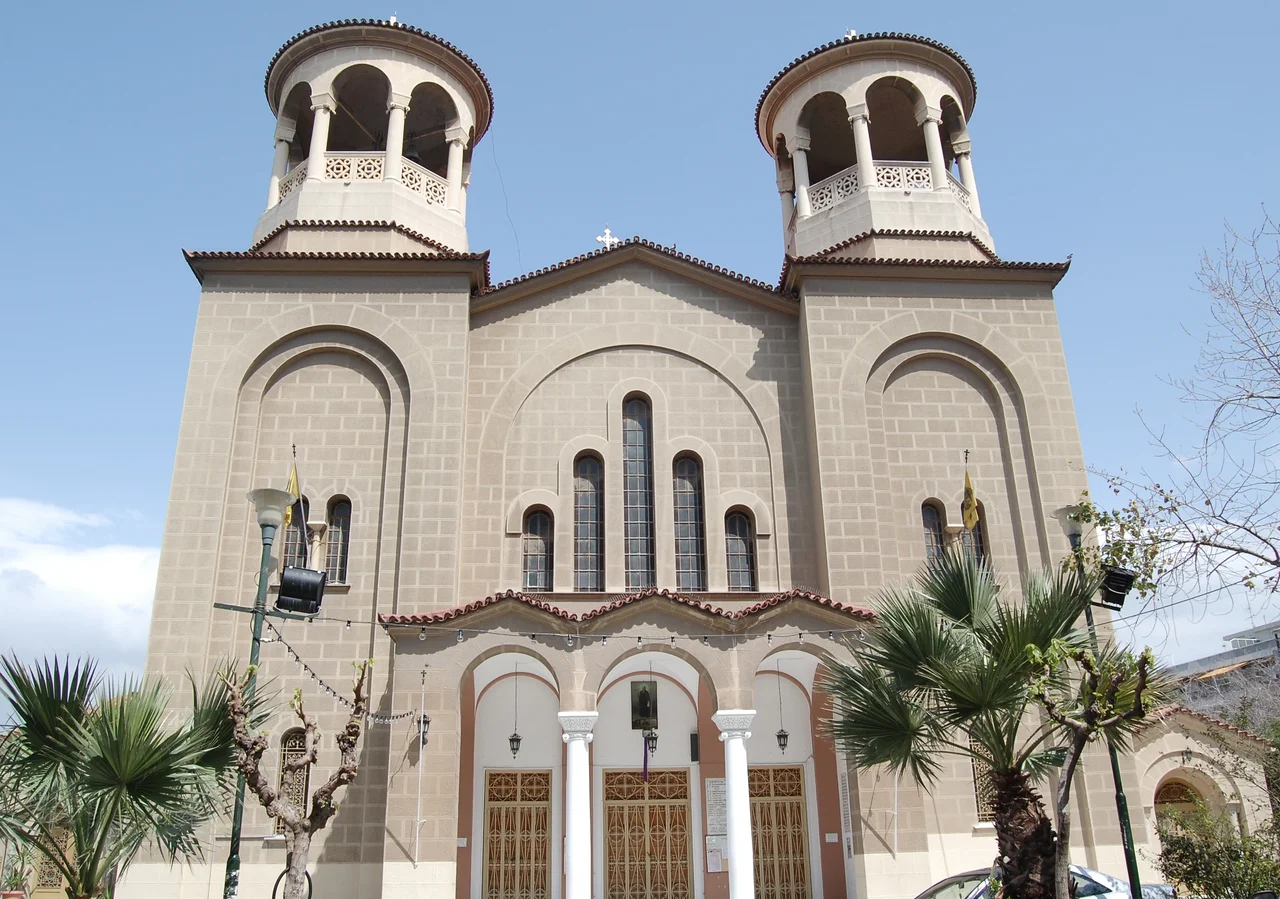

Pangrati
Every neighbourhood in Athens claims some connection to antiquity, but Pangrati's is stranger than most. It takes its name from a sanctuary dedicated to Hercules Pancrates — 'the All-Powerful' — a cult site that once stood here in the valley of the Ilissos river. The ancient Ilissos, now channelled underground, once ran openly through this terrain; Plato set dialogues on its banks. The neighbourhood that grew up around the sanctuary is now one of the most lived-in, café-packed, and intellectually dense quarters of the Greek capital, a place where Nobel laureates wrote poetry in apartments above bakeries, and where a 2nd-century marble stadium still anchors the southern end of the map.
Geography of a Neighbourhood
Pangrati is technically part of the municipality of Athens — not a suburb, though its position between Kolonaki to the west, Kaisariani to the north, and the suburban towns of Vyronas to the east sometimes leads visitors to mistake it for one. The neighbourhood lies between Vasilissis Sofias Avenue to the north and the Panathenaic Stadium to the south, with the Ilissos valley running through its middle. To the east, the slopes of Mount Hymettus once formed a natural boundary; as Athens expanded between the wars, the city spilled over that edge, and the modern boundary is now defined by streets rather than hillsides. Population figures place the neighbourhood at approximately 35,173 residents, though the energy of the place — its squares, its restaurant-lined streets near the Kallimarmaro, its morning coffee drinkers — suggests a busier community than any census number captures.
The Squares of Daily Life
Pangrati is a neighbourhood of squares. There are eight of them: Plastira, Pangratiou, Messolongiou, Proskopon, Profitis Ilias, Agios Spyridon, Deliolani, and Varnava. Each has its own character. Around Varnava Square, the area directly behind the Kallimarmaro Stadium, classy restaurants and tavernas fill the evenings. Plastira Square serves as a trolley junction, the node where three trolley networks converge. Proskopon Square, just behind the Presidential Mansion, has bars and cafés that stay busy well past midnight. Agios Spyridon Square gained new significance in October 2019 when the Goulandris Museum of Contemporary Art opened beside the church of the same name, bringing Van Gogh, Picasso, Chagall, Gauguin, El Greco, and Cézanne to the neighbourhood — a world-class collection assembled by the Goulandris shipping dynasty, now housed permanently in Pangrati.
A Neighbourhood of Artists
Poets and composers have always found Pangrati. Giorgos Seferis — diplomat, poet, the first Greek to win the Nobel Prize in Literature, awarded in 1963 — lived here. Manos Hatzidakis, who won the Academy Award for Best Original Song in 1961 for 'Never on Sunday,' is the figure most associated with the neighbourhood: his music, rooted in rebetiko and classical traditions both, has a certain Pangrati quality — sophisticated but accessible, haunted by the sea. Maria Callas studied at the Athens Conservatoire, which lies within Pangrati. Other artists who lived or worked here include the poets Nikiforos Vrettakos and Kostas Varnalis, the painter Yiannis Moralis, and the playwright Dimitris Psathas. More recently, film director Yorgos Lanthimos — whose work The Lobster, The Favourite, and Poor Things brought him international attention — grew up in the area. Princeton University has established its Athens Center for Research and Hellenic Studies in a 1930s townhouse in Pangrati, its only research centre outside the United States.
The Stadium at Its Feet
At the southern boundary of Pangrati stands the Panathenaic Stadium — the Kallimarmaro, 'the beautiful marble one' — which hosted the first modern Olympic Games in 1896. The stadium is so woven into Pangrati's daily geography that locals use it as a compass point, directions given as 'above the Kallimarmaro' or 'behind it.' The First Cemetery of Athens, the official municipal cemetery of the capital, also lies within the neighbourhood's limits. These two institutions — one for athletic glory, one for remembrance — give the southern end of Pangrati its particular tone: a neighbourhood that takes both living and dying seriously. The National Gallery of Athens, following a major expansion project completed in recent years, holds the largest collection of Greek paintings in existence and is one of the neighbourhood's defining cultural anchors.
Renaissance and Rents
Pangrati spent much of the late 20th century as a solidly middle-class residential neighbourhood, well-regarded but not fashionable. That changed in the 2010s. The neighbourhood attracted a younger, creative population — writers, designers, musicians — and with them came the café-bars, wine shops, and independent bookstores that now line streets like Empedokleous and Frinictou. The rents followed. Housing prices rose sharply; housing affordability decreased. The word 'gentrification' appeared in descriptions of the neighbourhood in multiple languages. Whether Pangrati's transformation represents gain or loss depends on who is speaking. The neighbourhood's old residents — people who have lived here since the rebuilding years after World War II, when Athens was refilling itself — feel the change in ways the newcomers do not. Both groups are right.
From the Air
Pangrati sits at 37.97°N, 23.74°E in central Athens, a few kilometres southeast of the Acropolis. From the air, the white horseshoe of the Panathenaic Stadium marks the neighbourhood's southern edge with unmistakable clarity. The National Gardens appear as a rectangle of green to the northwest. Nearest major airport: Athens International Eleftherios Venizelos (LGAV), approximately 23 km to the east-northeast. Best viewed from 1,000–2,000 feet on an eastward approach over the city.
Nearby Stories
- Parnitha 3.4 km away
- Kea (island) 7.3 km away
- Sanctuary of Apollo Maleatas 11 km away
- Sousaki Volcano 12 km away
- Battle of Leuctra 14 km away
- Great Sand Beach 18 km away
- Agios Georgios (island) 23 km away
- Skyros 84 km away