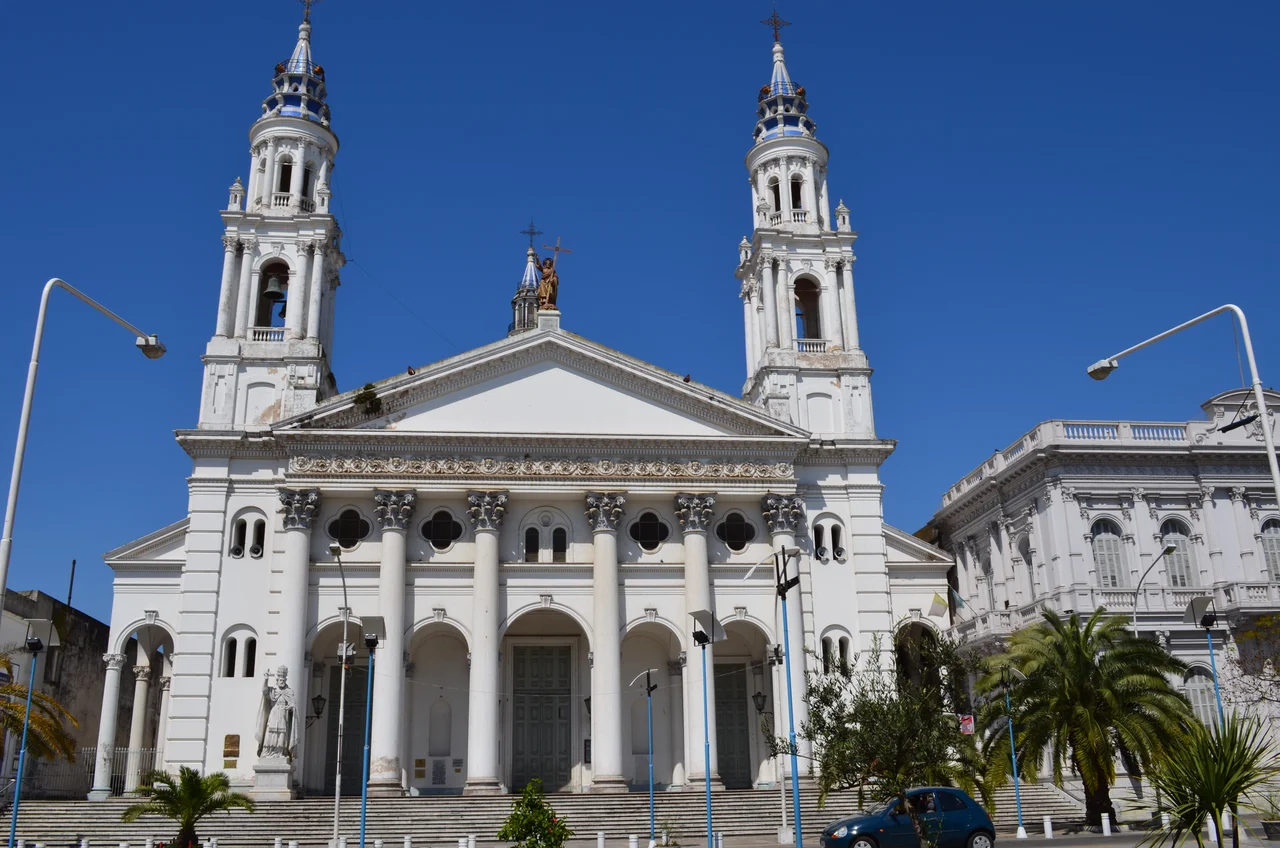

Paraná, Entre Ríos
The city did not begin with a grand founding. Sometime around 1730, people from Santa Fe drifted across the wide Paraná River and settled on the higher eastern bank, calling their new home the Bajada del Paraná, the descent to the Paraná. For more than a century it was a modest river town overshadowed by its older neighbor across the water. Then, in the 1850s, history reached down and lifted it: with Buenos Aires in open secession, the provinces chose this bluff-top town as the capital of the Argentine Confederation. For eight extraordinary years, Paraná was the seat of a nation, and the boost it received then still shows in the city it became.
The City That Climbed
Paraná's geography is its defining feature. Unlike the flat river towns nearby, it rises on bluffs above the Paraná, giving it heights, viewpoints, and a relationship with the water that is more balcony than waterfront. Across the river sits Santa Fe, its sister city and old parent, and the two are now joined by an engineering marvel: the Hernandarias Subfluvial Tunnel, which runs beneath the riverbed rather than over it, one of the earliest immersed-tube road tunnels in South America. To stand on Paraná's heights and look west is to see the great river spread into islands, with Santa Fe shimmering on the far bank, the two cities forever facing each other across the water that both connects and divides them.
Eight Years as a National Capital
In 1853 the provinces of the Argentine Confederation, having broken with a seceded Buenos Aires, named Paraná their capital, with the Entre Ríos caudillo Justo José de Urquiza as the Confederation's first president. From 1854 to 1861 the federal authorities resided here: the president, the congress, the machinery of a country determined to function without its largest city. Those years transformed Paraná, accelerating its economic, cultural, and population growth far beyond what a provincial town might have expected. When Buenos Aires rejoined the reunified republic in 1861, Paraná lost the national seat, but it kept the institutions, the buildings, and the civic confidence the capital years had given it, and it remains the capital of Entre Ríos Province to this day.
A City of Players and Poets
For a city of its size, Paraná has sent a striking number of people into Argentina's sporting and cultural life. It produced Roberto Ayala, one of the most-capped defenders in the history of the national football team, and the rugby star Martín Castrogiovanni, born here before becoming an Italy international and a household name. The writer Manuel Gálvez and the poets Evaristo Carriego and Andrés Chabrillón all have roots in the city. Paraná lives its sport loudly: the basketball club Atlético Echagüe competes in Argentina's top professional division, the footballers of Patronato and Club Atlético Paraná draw passionate local crowds, and in 2023 the city hosted the inaugural U-23 Men's Softball World Cup.
Looking Out Over the River
Modern Paraná is a green provincial capital of over a quarter-million people, defined still by the river it climbs above. Its parks line the bluffs; its avenues funnel toward viewpoints over the water; its identity is bound to the Paraná the way a port city's is bound to its harbor, except that here the relationship is one of elevation and outlook rather than docks. The city keeps ties around the world through sister cities from Quebec to Salto to Muscatine, Iowa, but its truest companion remains the one directly across the channel. Paraná and Santa Fe have spent three centuries in conversation across the water, two cities that began as one and never quite stopped looking at each other.
From the Air
Paraná sits at approximately 31.73°S, 60.53°W on the high eastern bank of the Paraná River, capital of Entre Ríos Province. From the air the city is distinctive for its elevation: it rises on bluffs above a broad, island-filled stretch of river, directly opposite the larger city of Santa Fe on the western shore. The two cities are linked by the Hernandarias Subfluvial Tunnel, which crosses beneath the riverbed; from above, look for the tunnel's approach roads converging on the river rather than a bridge. The river, wide and braided with green islands and side channels, dominates the scene. The city's own airport, General Justo José de Urquiza Airport (ICAO SAAP), lies just outside Paraná and is the nearest field; Rosario's Islas Malvinas International Airport (ICAO SAAR) is downriver to the south. A viewing altitude of 4,000 to 6,000 feet shows the full Paraná-Santa Fe pairing and the river's intricate delta-edge channels. Visibility over the flat surrounding plains is typically excellent in clear weather.
Nearby Stories
- Predelta National Park 18 km away
- Sa Pereira Rail Disaster 26 km away
- Esperanza, Santa Fe 27 km away
- Rafaela 37 km away
- San José Palace 158 km away
- El Palmar National Park 170 km away
- San Carlos Castle 201 km away
- The Pampas 343 km away