
Parc Slip Colliery
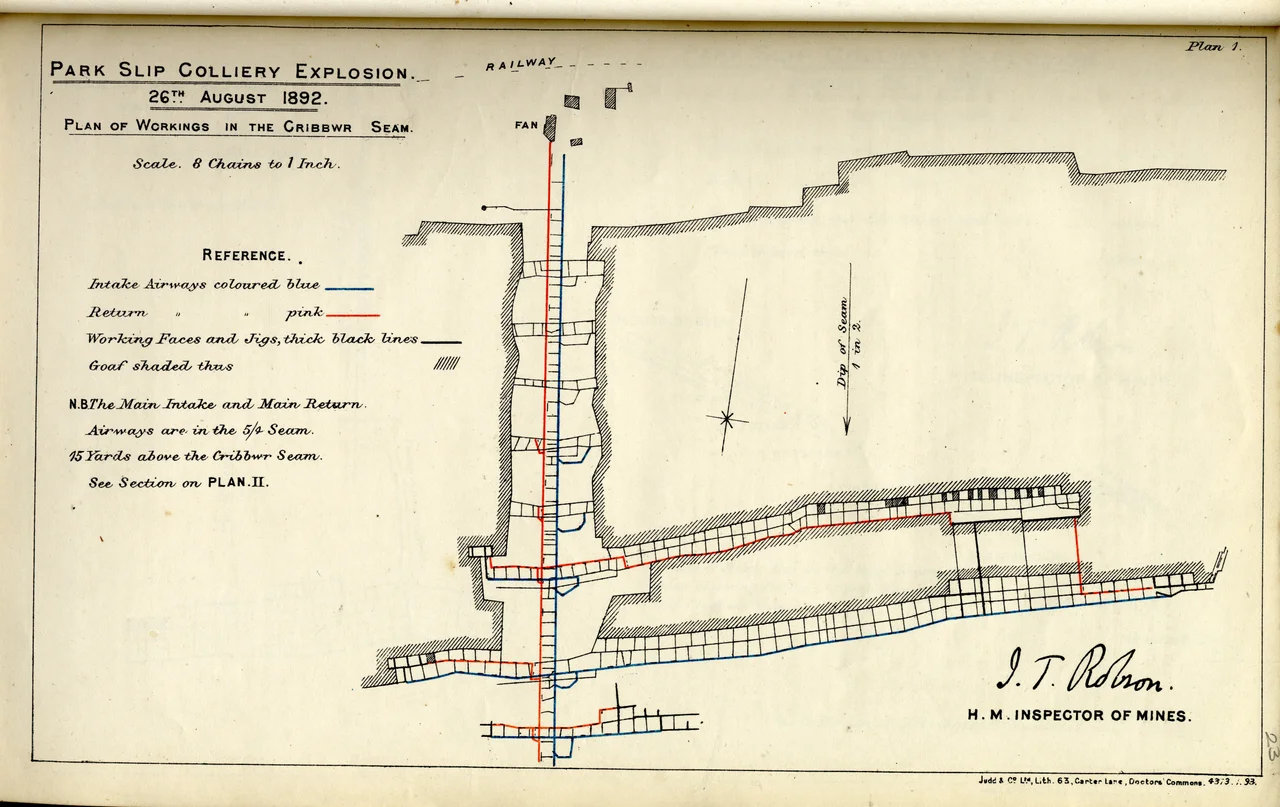
It was the morning of the St Mary Hill Fair - the biggest local holiday of the year - and the men and boys who walked through the gates of Parc Slip Colliery at Aberkenfig on Friday 26 August 1892 expected to be back above ground in time to wash and change and go to it. The weather was fine. One hundred and forty-six of them descended that morning. The explosion came at twenty past eight. The villagers above heard it and knew. By the end of the day, 42 had been brought out alive, some of whom died later of their injuries. The final death toll was 112 men and boys. The hole in a single Davy lamp had ended a hundred and twelve lives, and ended Parc Slip's working life too, even if the pit hung on twelve more years before it finally closed.
The Pit Before the Disaster
Parc Slip was opened in the 1860s by John Brogden and Sons, working the difficult geology near the southern outcrop of the South Wales coalfield. In 1872 the Brogdens merged with the Llynfi Coal and Iron Company to form the Llynfi, Tondu and Ogmore Coal and Iron Company, which failed in 1878. Eventually the colliery passed to North's Navigation Collieries Ltd, who held it through its working years. The pit produced steam coal of the kind that powered the Royal Navy and the merchant fleets of half the world. Like every Welsh deep mine, it lived on the assumption that the men below had the equipment, the supervision, and the luck to come back up - and on the steadier assumption that some of them, eventually, would not.
The 26th of August
The Davy lamp had been invented seventy-six years earlier specifically to keep firedamp - methane - from igniting in mines. Its principle was simple: a fine wire mesh enclosing the flame would cool any flammable gas passing through it below ignition temperature. The principle worked if the mesh was intact. On the morning of 26 August 1892, one of the lamps had a hole in it. The roof falls that followed the explosion blocked the rescue parties for hours. Forty-two miners came out alive that afternoon, some dying later. Among the dead were many boys; some Welsh pits worked children as young as twelve, and Parc Slip was no exception. Each name carried a household: a widow, parents, siblings, a chapel that would hold the service, a grave dug by hands that knew the man inside the box. The St Mary Hill Fair that year went ahead nearby, but Aberkenfig and Tondu did not go. They were burying their dead.
After the Pit
Parc Slip Colliery closed in 1904. For sixty years the surface workings sat as ruined headstocks and slag-blackened ground, the way so much of South Wales sat after the deep mines went quiet. Then in the 1960s the National Coal Board returned and turned the site into something else entirely. Margam Opencast Mine, as it was renamed, spread across more than 300 acres, swallowing the old workings whole. After British Coal was privatised in 1994, the site was mothballed. It reopened in 2001 under Celtic Energy as a land reclamation scheme - mining the last accessible coal while supposedly restoring the surface. Extraction finally ceased in 2008. The reclamation that was supposed to follow ran into legal trouble. In 2013, the Serious Fraud Office charged two former directors of Celtic Energy with conspiracy to move ownership of Parc Slip and five other sites to companies in the British Virgin Islands, allegedly to escape the cost of putting the land back. The High Court dismissed the case in late 2014.
A Memorial, a Marsh, a Place to Sit
What the Council eventually agreed to with Celtic Energy in 2016 was different from the original plan. Rather than fill in the flooded former opencast workings, they would be left as lakes, the size reduced, the surrounding tips reshaped, the whole landscape seeded and softened. The Wildlife Trust of South and West Wales took over management. Today, Parc Slip Nature Reserve runs across the old colliery and opencast ground - a patchwork of grassland, woodland, and wetland that has attracted lapwings, redshank, dragonflies, and a steady stream of human visitors who walk dogs across the same ground where the bodies came up in 1892. Near the visitor centre stands the memorial to the 112 men and boys who died in the explosion. Their names are listed by age. Many of them were teenagers. The youngest were children. The memorial is small. The list is long.
Where to Find It
From the air, the site sits about a mile north-west of Aberkenfig and the same distance south-east of Tondu. The old colliery footprint has been entirely erased by opencast and then by reclamation, so what you see now is a roughly oval cluster of green - grassland and ponds where pit waste once was - immediately west of the A4063 and just south of the M4 motorway. The lakes catch the light. The memorial is at the visitor centre on the southern edge of the reserve, where the lane runs in from Aberkenfig village. The road they walked in along that August morning is still there too.
From the Air
Located at 51.541N, 3.596W, between Aberkenfig and Tondu in Bridgend County Borough, south Wales. Nearest airport is Cardiff (EGFF, about 18 nautical miles east); Swansea (EGFH) lies about 17 nautical miles west. Best viewed at 1,500-3,000 feet AGL. The reserve appears from the air as a patchwork of small lakes and grassland immediately west of the A4063 and a mile north of the M4 corridor. The Bridgend conurbation is to the south-east and the Llynfi valley climbs to the north. The site is unobtrusive - a memorial of green where there is no longer any visible trace of the pit that produced it.
Nearby Stories
- Brecon and Merthyr Tydfil Junction Railway 2.4 km away
- Abergwili 3.6 km away
- Whiteford Lighthouse 7.1 km away
- Llanthony Priory 13 km away
- Hinkley Point C nuclear power station 14 km away
- Porlock 15 km away
- Brecon Beacons National Park 20 km away
- Moreton House, Bideford 35 km away