.jpg)
Parys Mountain Windmill
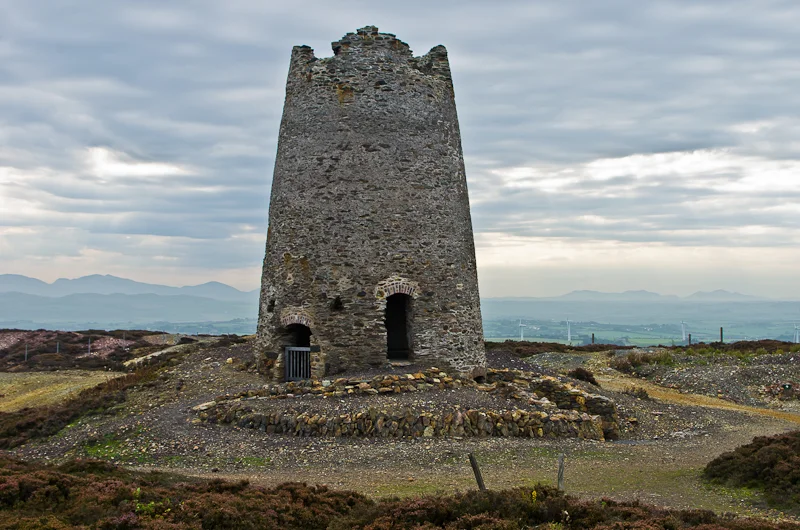
Most tower windmills have four sails. Parys Mountain Windmill had five. That is its first oddity. The second is that this mill, built in 1878 on the highest point of Parys Mountain near Amlwch, was the last tower windmill ever built in Wales - the final flowering of a technology that the steam engine had been making obsolete for a hundred years. The third oddity is its purpose. It was not built to grind grain. It was built to pump water out of a copper mine. By the 1870s the shafts at Parys had been sunk so deep into the orange-stained mountain that water was filling them faster than the existing steam engines could lift it. The owners decided to add wind to the equation - free power if you could harvest it, free coal saved if you could harness it. So they raised a stone tower mill at the summit, 138 metres above sea level, with five sails because more sails caught more wind.
The Mountain Underneath
Parys Mountain has been mined for copper for several centuries; the Romans worked the outcrops here, and small-scale extraction continued through the medieval period. The big strike came in 1768, when a substantial seam of copper ore was discovered close to the surface. Within a decade Parys was the largest copper mine on Earth, supplying ore for the sheathing of Royal Navy hulls, the firing of Welsh smelting furnaces and the rolling of copper coins. The town of Amlwch at the foot of the mountain swelled to about ten thousand people and became, briefly, the second-largest town in Wales after Merthyr Tydfil. The cost was the mountain itself. The vast open pits, the deep shafts beneath them, and the slow leaching of metals into the rock have left a landscape of orange, ochre and dark red spoil heaps that still shows the surface scars from the air. The water that filled the shafts was acidic, metal-laden, and a serious technical problem.
Five Sails and a Cellar
The windmill was built specifically as a pumping engine. Its sails turned a shaft that drove the pump rods reaching deep into the mine workings below. It also lifted ore to the surface and lowered machinery into the shafts. A 1975 survey by the Royal Commission on the Ancient and Historical Monuments of Wales recorded the structure at 10.8 metres high, with a 2.3-metre-deep cellar - presumably to house the lower bearings and the connection to the pump rods. Three doorways pierced the tower, more than the usual two; the layout suggests the mill was as much an industrial control point as a wind engine. Five sails were unusual but not unique nationally; Lincolnshire's Heckington and Sibsey mills both still carry five (and Heckington has eight). The extra sail gave a smoother delivery of power, which mattered for pumping where the torque needed to be steady. For two and a half decades the mill turned in the prevailing south-westerly wind across the top of the mountain.
Decline
The Parys mine had been losing the global copper price war since the 1840s, as cheaper ore came in from Chile and the United States. By the 1880s the operation was uneconomic at scale; only specialist demand and the recovery of by-products kept it open at all. Production wound down through the 1890s. The mine closed in 1904, twenty-six years after the windmill was built. Without the mine, the windmill had no purpose - and unlike a grain mill it could not be readily converted. It stood. The sails came off. By the end of the 1920s observers were describing the building as a 'capless shell.' That is essentially what survives today: a Grade II-listed stone tower on the windswept summit of the mountain, the eaves and cap long gone, the cellar accessible only with care. It is the last tower mill built in Wales, surviving where many earlier and grander mills did not, because nobody ever found another use for it.
Why the Hill Looks This Way
From the windmill on a clear day, the orange and ochre spoil heaps of Parys Mountain spread away to the east, the harbour at Amlwch sits two miles north on the coast, and the Irish Sea opens to the north-east. The whole mountain is now part of the GeoMon UNESCO Global Geopark, recognising its mineralogical and industrial significance. Heritage trails climb past the windmill on the way to the Great Opencast, the vast quarry pit that swallowed the original 1768 ore body. The mountain is undergoing slow exploration for possible reopening - small-scale, lower-impact, focused on the rare-earth metals modern industry needs - but no commercial restart has yet happened. The windmill, capless and roofless, watches it all from the summit. It is the only surviving Welsh industrial windmill of any kind, and its silhouette against the sky is one of the most distinctive man-made features of the entire north-Anglesey coast.
From the Air
Parys Mountain Windmill at 53.39 N, 4.34 W, on the highest point of Parys Mountain near Amlwch in north-east Anglesey. The mountain summit is 147 m; the windmill stands at 138 m on the highest exposed point. From the air the orange and ochre spoil heaps surrounding the windmill are unmistakable - a vivid rust-coloured patch of stained ground covering several square kilometres, the most distinctive geological landmark on Anglesey from cruising altitude. Amlwch town and its narrow harbour lie 2 miles north on the coast. Nearest airports: Anglesey/Valley (EGOV) 14 nm west, Caernarfon (EGCK) 18 nm south. The windmill itself is small and best seen from low altitude.
Nearby Stories
- Llandudno Lifeboat Station 3.8 km away
- Glynllifon 6.1 km away
- German submarine U-1024 9.4 km away
- Irish Sea Bridge 11 km away
- Ysbyty Ifan 12 km away
- Irish Sea 18 km away
- Celtic Array 18 km away
- Birkdale Palace Hotel 56 km away