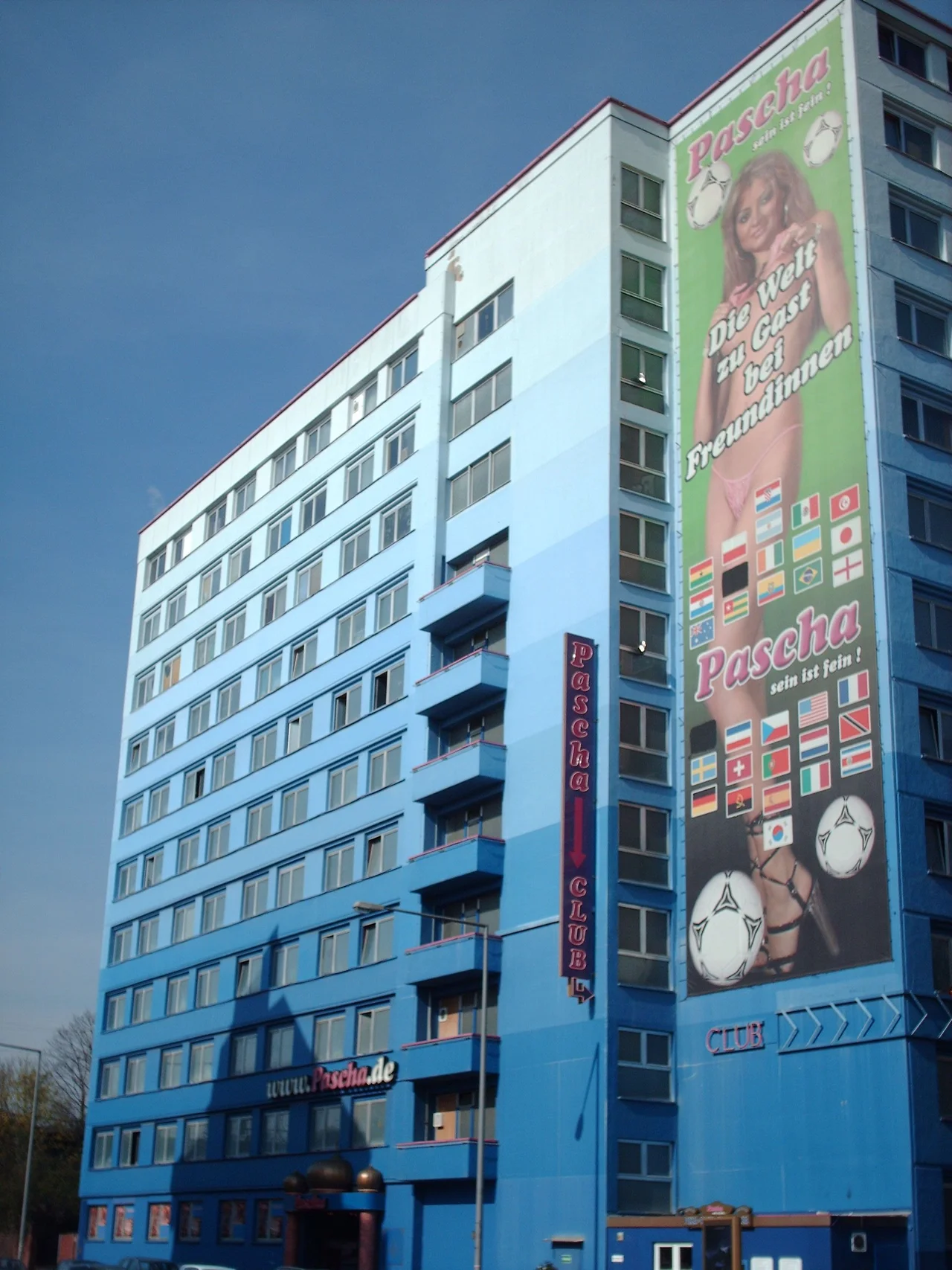

Pascha (brothel)
In September 2020, around 120 women lost their workplace overnight when the Pascha — for almost fifty years the largest brothel in Europe and one of the largest in the world — filed for bankruptcy. The COVID-19 restrictions had made the business mathematically impossible: a building designed around physical contact with as many as a thousand customers a day cannot survive a pandemic that bans physical contact. The twelve-storey block on the Hornstraße in Cologne went dark in January 2021. What had begun in 1972 as the city's officially licensed answer to its medieval red-light district had finally, abruptly, run out of customers. The story of how it got there, and what happened next, is one of the more uncomfortable chapters of postwar German urban policy.
How Cologne Built a High-Rise for Sex Work
The Pascha opened in January 1972, originally under the name Eros Center. The city of Cologne wanted to close down the Kleine Brinkgasse, the medieval red-light district in the city centre, and it did the thing that German municipal governments often do when they want to relocate an industry: it issued a building licence on land it owned, in this case on the outskirts of town, and underwrote the construction of a single twelve-storey building to consolidate everything. It was Europe's first high-rise brothel. The sex workers of the Kleine Brinkgasse sued to stop their old district from being demolished. They lost. In 1995 the original owner went bankrupt, and the building was renamed Pascha. By the 2000s it had branches in Salzburg, Munich, and Linz, and a kind of grim notoriety as a tourist destination.
The Economics of a Rented Room
The Pascha did not employ the women who worked there. It rented them rooms — 126 of them, spread across seven floors — for a daily fee of 180 euros, which covered meals, medical care, and the 20-euro daily tax that German authorities collected per sex worker, including a 6-euro "pleasure tax" levied by the City of Cologne. About 30 percent of the women were German; the rest came from across Europe and beyond. They negotiated directly with customers who wandered the hallways, and they kept whatever they earned beyond their rent. Some lived in their rented rooms. Others rented a second room for sleeping. Others kept apartments elsewhere in the city and treated the Pascha purely as a workplace. The arrangement made the building's owners landlords rather than pimps, a legal distinction that German prostitution law made possible after 2002.
The Things That Went Wrong
Over the decades the building accumulated the kind of incidents that follow any institution where strangers meet behind closed doors. In June 2003 a Thai sex worker was stabbed to death by a customer; she managed to press the alarm in her room and security caught the killer. In January 2006 another woman was attacked with a knife and survived. A 2005 police raid found a gun, cocaine, and 23 people in violation of immigration laws; it also uncovered that four of the women working there were 14 or 15 years old, carrying forged documents from Africa that listed them as adults. In 2007 a Turkish man tried to set the building on fire with Molotov cocktails after a conflict with one of the women and security staff. The Pascha's founder, Hermann Müller, was sentenced in 2017 to three years in prison for tax evasion connected to one of his Munich brothels. The publicity stunts — discounts for senior citizens, lifetime free entry for men who tattooed the Pascha logo on their arm — earned headlines, but the incidents kept happening to the women, not to the brand.
Bankruptcy, Sale, and the Smuggling Case
After the bankruptcy and closure, the building sat empty until March 2021, when it was sold to a Chinese investor — represented in the deal by a German lawyer and another Chinese businessman — for eleven million euros. A German manager took over operations and the brothel reopened in March 2022; the top floor had been converted into a hotel. Then in September 2024 the German authorities seized the building, blocking any future sale. Prosecutors suspected the eleven million euros that bought it had come from an organised crime ring smuggling wealthy Chinese citizens into Germany. Day-to-day operations continued. Inside, the women still rented their rooms by the day. Outside, an investigation tried to work out who, in the end, the building actually belonged to.
From the Air
The Pascha building stands at Hornstraße 2 in the Neustadt-Nord district of Cologne, at roughly 50.956°N, 6.940°E, about 1.5 km north-northwest of the cathedral and just west of the Mediapark district. From the air the twelve-storey building is recognisable mainly because it is taller than most of the surrounding inner-city blocks. Nearest airport is Cologne Bonn (EDDK / CGN), 16 km southeast across the Rhine.
Nearby Stories
- Diamond Interchange: How a Simple Idea Reshapes Towns Like Julich 2.8 km away
- Dusseldorf-Unterbach 6.1 km away
- Baumwollspinnerei Ermen & Engels 11 km away
- RAF Bruggen 15 km away
- Hagen Open-air Museum 21 km away
- Belgium 130 km away
- Marcinelle Mining Disaster 173 km away
- Zwingenberg Castle 178 km away