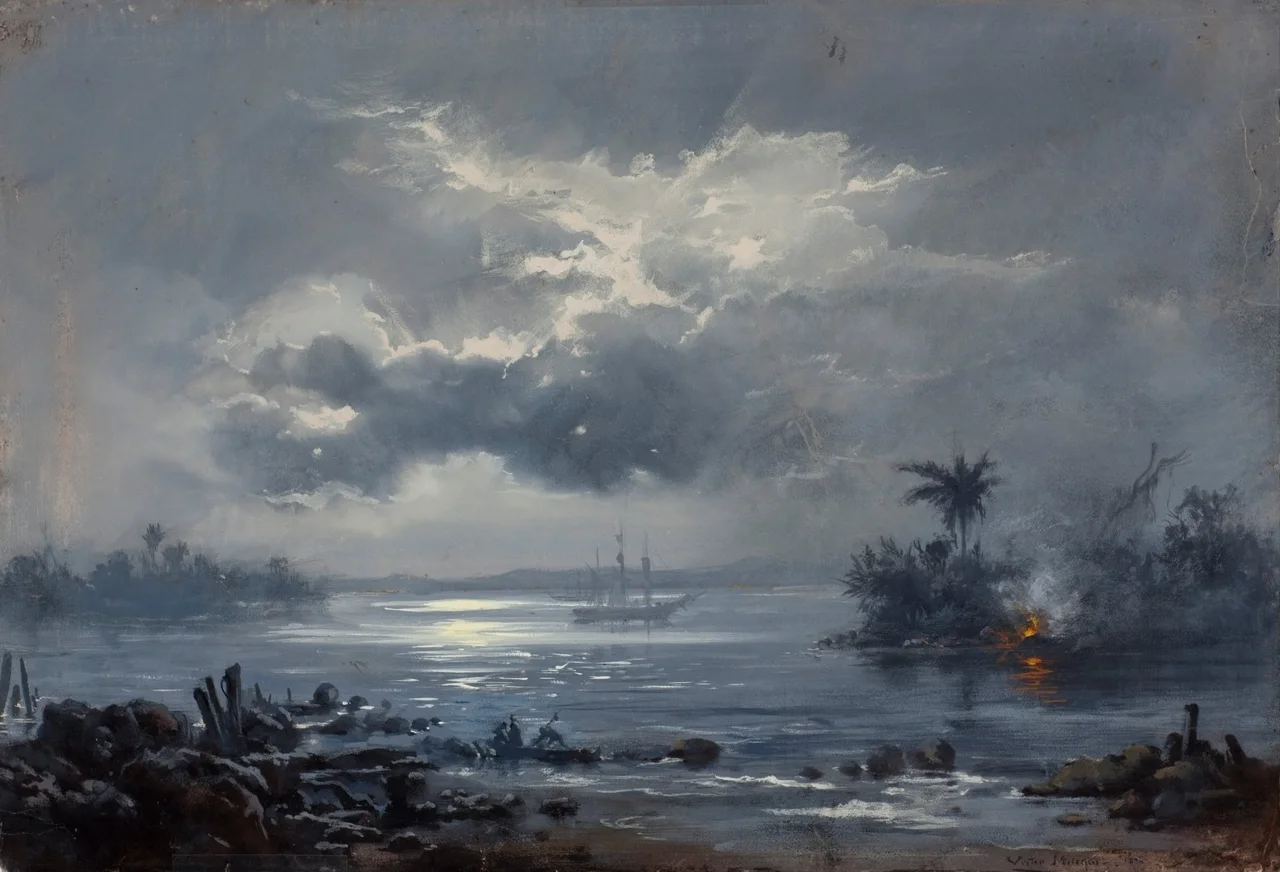

Passage of Humaitá
Just before four in the morning on 19 February 1868, a signal rocket arced over the River Paraguay and burst against the dark. It meant the first pair of ironclads had cleared the chains. For the men crouched inside those iron boxes, breathing coal smoke and listening to shot ring off the plating, it meant they were still alive. Ahead and behind lay the fortress of Humaitá, a mile of artillery on a river bend so tight the channel narrowed to two hundred yards. Foreign officers who had inspected those batteries called the passage nearly impossible. The squadron was about to find out whether they were right.
The Gibraltar of the River
Humaitá earned its nickname honestly. Paraguay had spent years turning a concave bend of the River Paraguay into a killing zone - more than a mile of heavy guns set atop a low cliff, with a chain boom that could be raised to pin shipping under those guns while the artillery did its work. On the landward side, eight miles of trenches held a garrison of 18,000 and 120 heavy cannon. The largest gun at the outer fort of Curupayty threw a ten-inch ball and was called the Cristiano, because it had been cast from church bells melted down across the country. To Marshal-President López, the fortress was the bolt on Paraguay's door. So long as it held, no enemy fleet could steam upriver toward Asunción. It was the calculation on which he had gambled a war against two far larger neighbors.
A War That Consumed a Nation
The War of the Triple Alliance, fought from 1864 to 1870, was the deadliest conflict in South American history - and, measured against Paraguay's population, very possibly the deadliest modern war anywhere. These were not abstractions. Paraguayan gunners, whom even their enemies praised as superbly brave, served their cannon knowing the country had been cut off by blockade and was running short of everything. The Allied ranks - Brazilian, Argentine, Uruguayan - had already buried thousands and were stalled in a sliver of swampy ground in the country's southwest. After the catastrophe at Curupayty in 1866, where a frontal assault failed disastrously, morale on both sides curdled into exhaustion. By late 1867 a Brazilian general wrote to a friend of the longing to end "this cursed war which has ruined our country, and whose duration shames us."
The Admiral Who Would Not Go
The man who should have led the dash refused to. Admiral Joaquim José Inácio had been a brave officer in the age of sail, but decades of desk work had left him, in one historian's phrase, "a ghost of an admiral" - ill, depressed, and certain the passage meant ruin. For months his ironclads sat trapped between Curupayty and Humaitá, supplied by an emergency tramway the navy laid through the Chaco swamps, its wooden sleepers nearly floating on the mud. The fleet shelled the one structure it could see, the church of San Carlos Borromeo, and otherwise waited. But the river had its own logic. In February 1868 it rose to an unusual height, then began to fall. Wait too long and the heavy hulls would ground. Inácio still would not lead. His son-in-law, Delfim Carlos de Carvalho, volunteered instead.
The Flaw in the Chains
Every fortress has a weakness, and Humaitá's lay underwater. Military doctrine of the day warned that a chain boom should never float on hollow supports, because an enemy could simply sink them. Humaitá's three great chains rested on canoes and pontoons. For three months the ironclads fired patiently at those floats until, one by one, they sank - and the chains settled into the river mud, buried two feet deep across seven hundred yards of channel. When Carvalho's squadron came through in pairs that February night, lashed together so the smaller monitors could fight the current, the boom that was meant to trap them lay harmless on the bottom. The river ran so high there were twelve to fifteen feet of water over the chains. The ships passed clean over the obstacle that had paralyzed a fleet.
Rockets on the Water
The Paraguayans had guessed the attack might come at night. As the ironclads advanced, defenders skimmed rockets across the water and lit fires along the Chaco bank to blind the pilots. Hugging that western shore, the squadron took most of the incoming fire on the mud rather than the hull - yet the ships were struck again and again, and a few miles on, an unsuspected battery at Timbó opened up in the gathering dawn and did damage as cruel as Humaitá's. Still they got through. In Brazil the news brought what one account called "veritable delirium"; bands played through Rio for three days. The fortress, cut off at last, fell on 25 July 1868. Far from ending the war, the passage only opened its longest, bloodiest chapter. The fighting ground on for two more years, and a generation of Paraguayan men did not survive it - the human cost behind a feat the world's newspapers ranked beside Trafalgar.
From the Air
The ruins of Humaitá lie on the east bank of the River Paraguay in Ñeembucú Department, near 27.07°S, 58.50°W, roughly 430 km south of Asunción and close to the Argentine border. From the air the great river bend that made the fortress so formidable is still the dominant feature - a sharp concave loop where the channel pinches tight. The brick shell of the San Carlos Borromeo church, the only major structure to survive the bombardment, marks the old fortress line. Best viewed from 2,500-4,000 ft AGL in clear morning light, when low sun rakes the riverbank and the surviving walls cast long shadows. Nearest major airport is Asunción's Silvio Pettirossi International (ICAO SGAS), about 230 km north; Encarnación's Teniente Amín Ayub González (ICAO SGEN) lies to the east. Expect summer haze and afternoon storms in the wet season (October-April); winter mornings offer the clearest visibility over the wetlands.
Nearby Stories
- Battle of Estero Bellaco 26 km away
- Corrientes 38 km away
- Chaco National Park 62 km away
- Ypoá National Park 107 km away
- Ibera National Park 120 km away
- Concepcion de Buena Esperanza 141 km away
- Pilcomayo River 175 km away
- Campo del Cielo 264 km away