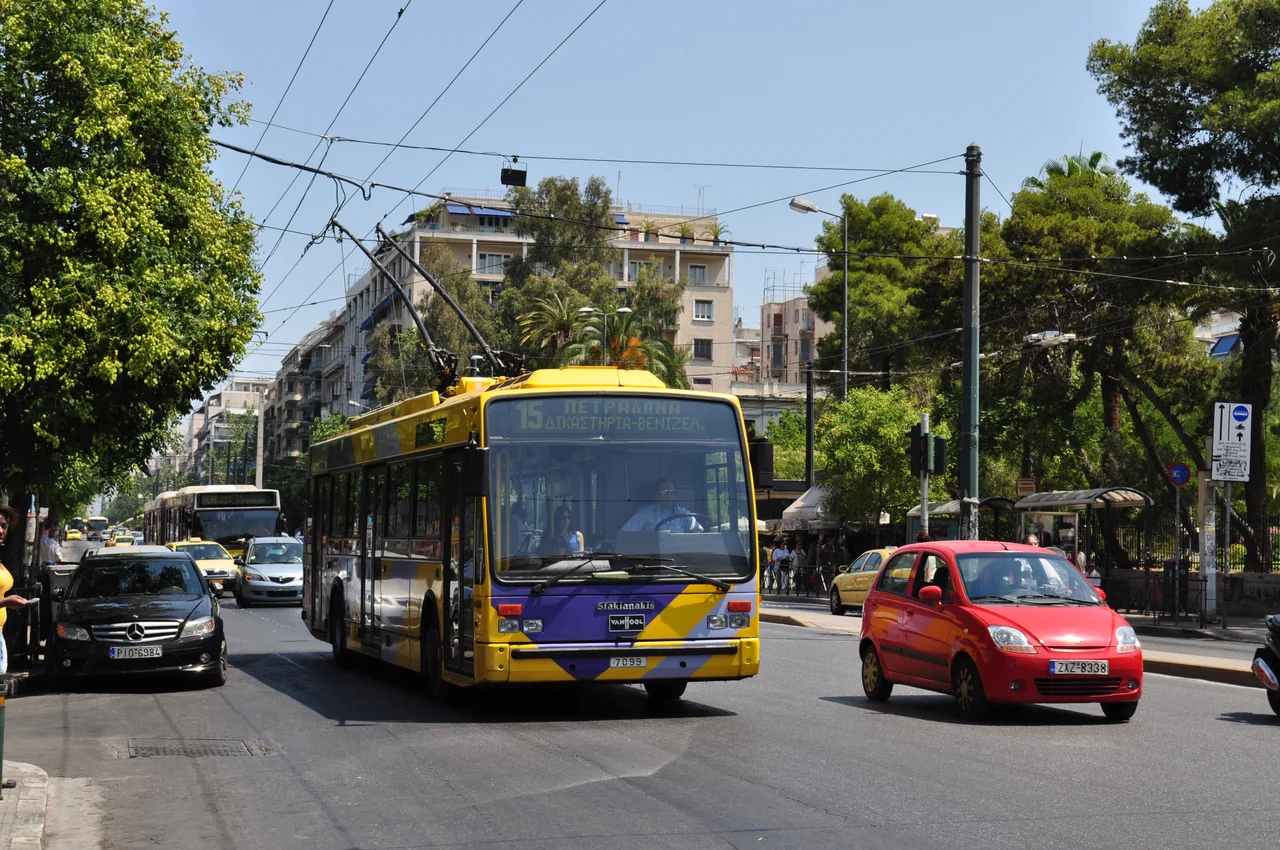

Patission Street
A street can be a calendar. The grandest stretch of Patission Street does not honour a person or a place but a single word spoken on a single morning. On 28 October 1940, the Greek leader Ioannis Metaxas rejected Mussolini's ultimatum demanding that Greece submit to Italian occupation. The refusal pulled Greece into the Second World War, and the country has marked the day ever since. The avenue that runs north from Omonoia Square was renamed 28 October Street to carry that date forever. Athenians, true to form, still mostly call it Patission anyway.
The Avenue of Defiance
Mussolini's ultimatum arrived in the small hours of 28 October 1940 and demanded free passage for Italian troops into Greece. The answer, remembered across the country as the day of 'OXI' - 'No' - threw a small nation against a much larger one and, against expectation, the Greeks pushed the Italian invasion back into the mountains of Albania. The avenue's official name fixes that morning in the street grid of the capital. Yet the renaming was layered. The road first carried the date informally during the war, and in 1946, after the bitter years of Nazi occupation had ended, it was formally proclaimed 28 October to celebrate the national anniversary of liberation. Two acts of defiance, the beginning and the end of the ordeal, folded into one name.
Plots Along the Pavement
During the occupation, the street became a stage for resistance. At Patission 8, on a Sunday in September 1942, a small resistance group called PEAN carried out a daring sabotage against the headquarters of ESPO, a collaborationist organization that was recruiting young Greeks into the German war machine. The blast struck at the heart of a recruitment effort and made the saboteurs heroes of the underground. Two years later, in December 1944, as the occupation collapsed into the violence that would become civil war, fighters of the resistance army ELAS blew up the General Security building at the corner of Patission and Stournari. The avenue's handsome facades hid a city at war with itself.
A Bourgeois Boulevard
Before the wars, Patission was where comfortable Athens came to live and be seen. The road was laid out in 1841 over older rural tracks during the reign of King Otto, modern Greece's first monarch, and the royal couple were said to favour it for outings. By the early twentieth century it was lined with neoclassical mansions, art-deco facades, and the new modernist blocks of a confident middle class - the Livieratos and Isaias palaces among them. Electric trams arrived after 1908, replacing the horse-drawn line that had run to Syntagma since 1882. The emblematic Acropole Palace hotel, built in the late 1920s, hosted high society until 1980 and was declared a protected monument in 1991.
The Diva and the Strongman
Two very different performers left their mark here. In a house on Patission lived the young Maria Callas, who would become the most celebrated operatic soprano of the twentieth century, her voice shaped in this ordinary corner of Athens before the world's great stages claimed her. Decades earlier, in 1903, the strongman Panagiotis Koutalianos drew crowds at an open-air theatre across from the Archaeological Museum, performing improvised feats of muscular power. And in 1958, the Radio City Cinema - in its 1950s heyday - welcomed Elizabeth Taylor herself. For a long avenue that most guidebooks ignore, Patission has hosted an unlikely parade of fame.
From the Air
Patission Street runs roughly north-south through central Athens, with its surveyed point near 38.003°N, 23.734°E, connecting the district of Patisia in the north with Omonoia Square at the city's heart. From the air it appears as a long straight artery cutting through dense urban fabric north of the Acropolis. Nearest airport is Athens International (LGAV), about 28 km to the east-southeast. Clear morning light gives the best view before the summer haze settles over the Attica basin.
Nearby Stories
- Great Sand Beach 5 km away
- Battle of Delium 7.7 km away
- Tower of Aliartos 9 km away
- HMHS Britannic 10 km away
- Saronic Gulf 15 km away
- Sousaki Volcano 17 km away
- Sanctuary of Apollo Maleatas 24 km away
- Skyros 66 km away