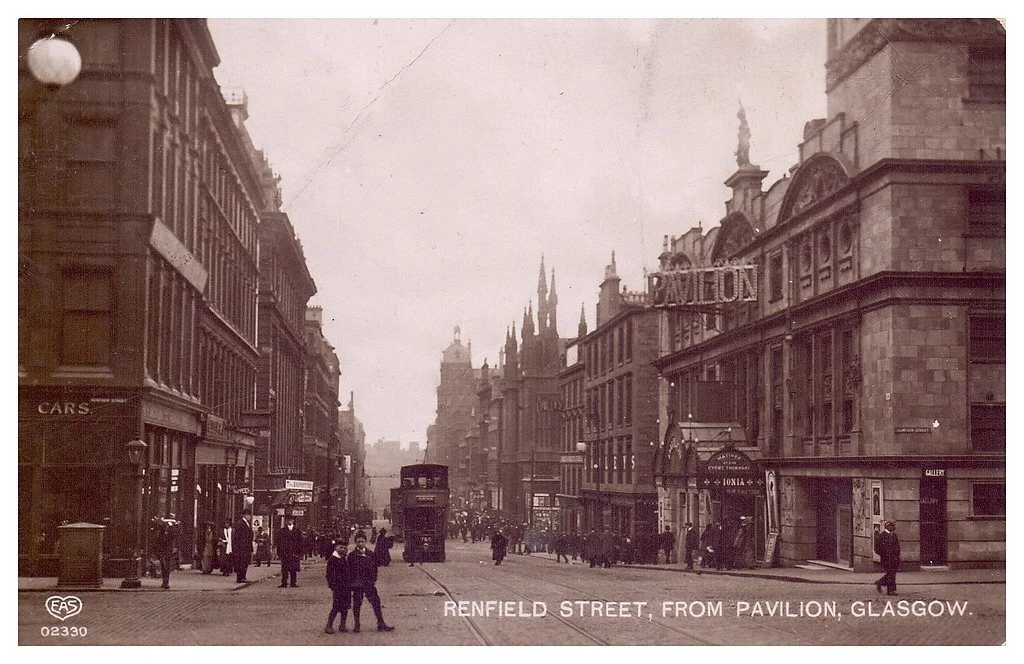

Pavilion Theatre (Glasgow)
It opened on 29 February 1904 - a leap day, a date that should only really exist once every four years - and it has been throwing itself into the present tense ever since. The Pavilion Theatre on Renfield Street is the only privately run theatre in Scotland. No subsidy, no grant, no quiet government cheque to keep the lights on. For more than a century it has paid its way with pantomime, music hall, comedy, and the occasional touring band on the so-called nostalgia circuit. A young Charlie Chaplin played here before anyone in America had heard of him. Sarah Bernhardt played here. Marie Lloyd played here. Today the Krankies bring the kids in at Christmas. The building has barely changed.
Pure Louis XV
The Pavilion Theatre of Varieties was the brainchild of Benjamin Simons, whose father Bailie Michael Simons - chairman of theatre owners Howard and Wyndham - guaranteed the funding. It was one of three Glasgow venues built for Thomas Barrasford's expanding chain of British music halls. The other two were the Glasgow Hippodrome in New City Road and the Palace in Main Street, Gorbals. The architect was Bertie Crewe, the great variety-theatre specialist of the era. His owners described the decor as pure Louis XV: Rococo plasterwork curling across the proscenium arch and box fronts, terrazzo flooring underfoot, leadlight glazing catching the lamps, and rich mahogany finishes warming the auditorium. The facade was glazed buff-coloured terracotta in the French Renaissance style. The ventilation was state of the art for 1904: an electrically operated sliding panel in the roof above the auditorium. The capacity worked out to 1,449 seats - 677 stalls, 341 circle, 413 balcony, and 18 box seats. It is now a Category A listed building, which in Scotland means the highest level of architectural protection.
A Roll Call of Variety
In its first three decades, every major name in British music hall passed through. Marie Lloyd, the brilliant and beloved star whose suggestive songs scandalised respectable opinion and delighted everyone else. Little Tich, the small-bodied comedian whose physical routines influenced generations of clowns. Harry Lauder, the kilted Scotsman who became the highest-paid performer in the world. Sarah Bernhardt, the great French tragedienne, on tour. And a then-unknown Charlie Chaplin, before he ever stepped in front of a camera. From 1919 to 1957 the theatre was run by Fred Collins and his son Horace, who built the Collins Variety Agency next door. During the Second World War, Horace served as ENSA director for Scotland, organising entertainment for British forces. The Collins family also leased or owned other variety venues - Aberdeen's Tivoli, Dundee's Palace, Edinburgh's Theatre Royal, and Liverpool's Shakespeare.
Panto Country
In 1920 the Pavilion started producing pantomimes, and it never really stopped. Pantomime - the peculiar British Christmas tradition where men play widowed dames, women play heroic boys, fairy-tale plots get garnished with topical jokes, and audiences shout call-and-response at the stage - became the theatre's identity. Glasgow Pantomimes have run here for over a century. The Krankies, Jim Davidson, Michelle McManus, and Natalie J Robb have all headlined. In 2004, Janette Krankie was seriously injured during a performance of Jack and the Beanstalk and made a full recovery. Some of the older Collins-era pantomimes were filmed for posterity, and Glasgow University with the Orchestra of Scottish Opera has helped restore and remaster the recordings.
The Survivor
How the Pavilion stayed independent is partly geography, partly stubbornness. Sitting at the top of Renfield Street, near Cowcaddens, opposite Cineworld Glasgow and a block from the Royal Conservatoire of Scotland, it caught city-centre foot traffic when other venues fell to redevelopment or amalgamation. In 2007 the theatre reinvented itself as the Scottish National Theatre of Variety, with stars onstage for the relaunch and general manager Iain Gordon making the announcement. The Mighty Boosh found an audience here - Arctic Boosh and Autoboosh ran for a five-night stint in 2000, and their Boosh Live shows in September 2008 set a Pavilion record by selling out both nights in three hours. The model still works: populist productions, pantomime, alternative comedy, touring tribute acts, and the steady weekly traffic of Glaswegians who still want to come into the city centre to watch a show. No subsidy. Same building. Same Rococo plasterwork.
From the Air
Located at 55.8651 degrees N, 4.2557 degrees W at the corner of Renfield Street and Renfrew Street in central Glasgow, in the Cowcaddens area. Best viewed from 1,200-2,500 feet. Nearest ICAO airports: Glasgow International (EGPF) about 7 nm west and Glasgow Prestwick (EGPK) about 25 nm southwest. The Royal Conservatoire of Scotland is one block away; the Cineworld Glasgow IMAX tower is across the street and a useful landmark from the air.
Nearby Stories
- Mauchline 3.6 km away
- Shotts 4.2 km away
- HMS Ulysses (1917) 7.7 km away
- Rothesay Castle 8.8 km away
- Inchcailloch 10 km away
- Strachur 14 km away
- Battle of Dollar 16 km away
- Crawford Castle 16 km away