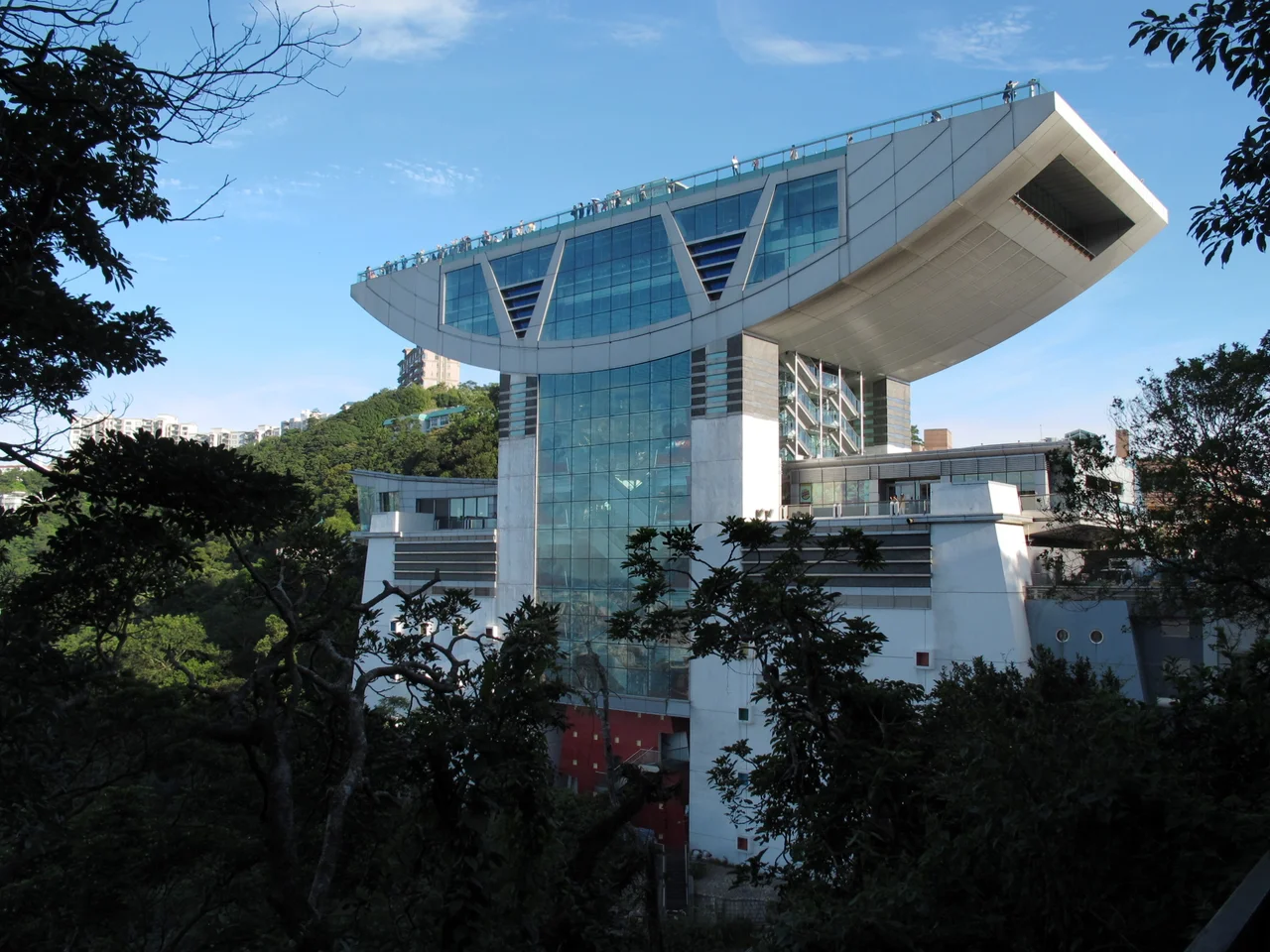

Peak Tower
The architect had a problem: how do you build a landmark on a hill without ruining the hill? Terry Farrell's answer, completed in 1997, was to dig the Peak Tower into a natural dip along the ridgeline and cap it with a shape that nobody in Hong Kong could ignore — a giant inverted wok, its curved steel rim gesturing at the skyline below while the building itself barely breaks the natural contour of the Peak. It is the most-visited tourist attraction in Hong Kong, and it sits 156 meters below the actual summit of Victoria Peak.
The Tram That Came First
The Peak Tram opened in 1888, thirty-seven years before any building deserving the name 'tower' existed at its upper terminus. The original upper station was a wooden structure — functional, modest, built for the colonial residents who were beginning to flee the harbor-level heat for the Peak's cooler hillside air. The tram was immediately popular. It has been running continuously (with interruptions for war and maintenance) ever since, making it one of the longest-operating funicular railways in the world.
The first proper Peak Tower was designed by Hong Kong architect Chung Wah Nan and opened on 29 August 1972, with a restaurant on the top deck and a coffee shop below. Its two columns created a clear visual space between upper and lower sections — a structural idea that Terry Farrell would consciously retain when he replaced the building a quarter-century later, giving the new tower a visual lineage even as he transformed its shape entirely.
Terry Farrell's Wok
The current Peak Tower is the work of British architect Terry Farrell, completed in 1997 — the same year Hong Kong returned to Chinese sovereignty, which gave the building's opening a particular historical charge it had not planned for. Farrell's design places the tower at 396 meters above sea level, in the natural saddle of Victoria Gap, and caps it with the distinctive curved steel structure that gives the building its shape. The overall height reaches 428 meters above sea level, kept deliberately low to avoid interrupting the ridgeline.
The wok form is deliberate: it creates a concave viewing platform at the building's top that frames Victoria Harbour below like a stage set. Seven floors of retail and attractions fill the interior; the viewing terrace at the top was relocated from the third floor to the roof during a HK$100 million renovation completed in 2006, which also glassed in the lower portion to expand retail space. The renovation changed the building's profile somewhat, but the signature curved top remains the element that identifies it from across the harbor.
What the View Encompasses
On a clear day — and clarity over Victoria Harbour is not guaranteed, given the particulate levels that can settle over the city — the viewing terrace takes in the full arc of the harbor, from the financial towers of Central to the Kowloon Peninsula and, beyond it, the hills of the New Territories receding toward the mainland Chinese border. To the southwest, the view extends toward Aberdeen and the southern coast of Hong Kong Island.
Severe air pollution is a documented problem here. The Wikipedia source that underlies this story notes it plainly: 'severe air pollution often hinders the outlook.' On bad days, the skyline dissolves into a warm grey haze and only the nearest towers are visible. On good days, which tend to cluster in autumn and winter when northerly winds clear the sky, the panorama is as advertised. Most visitors take their chances.
Madame Tussauds and the Entertainment Layers
The Peak Tower has, over time, become something of a palimpsest of Hong Kong's entertainment history. The original 1972 building housed the Tower Restaurant. The 1997 building added attractions including Ripley's Believe It or Not! Odditorium and a motion simulator called the Peak Explorer. An attraction called Hong Kong's Historical Adventure — described as the first computer-operated entertainment ride in Hong Kong — ran until 2000.
When Hong Kong's Historical Adventure closed, Madame Tussauds Hong Kong moved into the vacated space, becoming in 2000 the first permanent Madame Tussauds outlet in the Asia-Pacific region. The wax figures of world leaders and celebrities now occupy space once given over to scenes of Hong Kong's early history — a substitution that says something about the changing priorities of entertainment, or perhaps just about which stories are easiest to monetize.
Owned by the Peninsula's People
The Peak Tower and the Peak Tram are both owned by the Hongkong and Shanghai Hotels group — the same company that owns the Peninsula Hotel at the tip of Kowloon, one of Hong Kong's most iconic buildings. The connection between a luxury hotel and a funicular railway might seem odd, but the Peak has always attracted a wealthy clientele, and the ownership consolidates two of the territory's most recognized tourist brands under one corporate roof.
The Peak Galleria, a second shopping and leisure complex, sits adjacent to the tower, built over the bus station used by the public buses and minibuses that approach the Peak from the other side of the hill. Together, the two buildings turn the summit area into a small commercial district floating above the city — a place where you come for the view and stay, if the shops have anything to say about it, for rather longer than you planned.
From the Air
Peak Tower sits at 22.2715°N, 114.15°E near the summit of Victoria Peak on Hong Kong Island. At 396 meters above sea level, the tower is a significant terrain feature and a navigation landmark visible from the harbor and from Kowloon. Aircraft approaching Hong Kong International Airport (VHHH) from the east pass roughly 25 km to the west of the Peak; the tower is clearly visible from final approach altitudes. Victoria Peak itself reaches 552 meters; the 428-meter restricted height of the tower is well below the summit but still a serious consideration for low-altitude operations. Suggested viewing altitude: 1,500–2,000 ft over Victoria Harbour, southwest of Kowloon, looking south toward the Peak's distinctive ridgeline with the curved tower profile visible against the sky. ICAO airport: VHHH (Hong Kong International), approximately 27 km northwest.
Nearby Stories
- Lok Ma Chau Loop 2.3 km away
- Portas do Cerco 2.3 km away
- Kweilin Incident 17 km away
- Wanshan Archipelago Campaign 34 km away
- Nanxiong Formation 115 km away
- Battle of Nanpeng Island 148 km away
- Heyuan 169 km away
- Cape Maobitou 632 km away