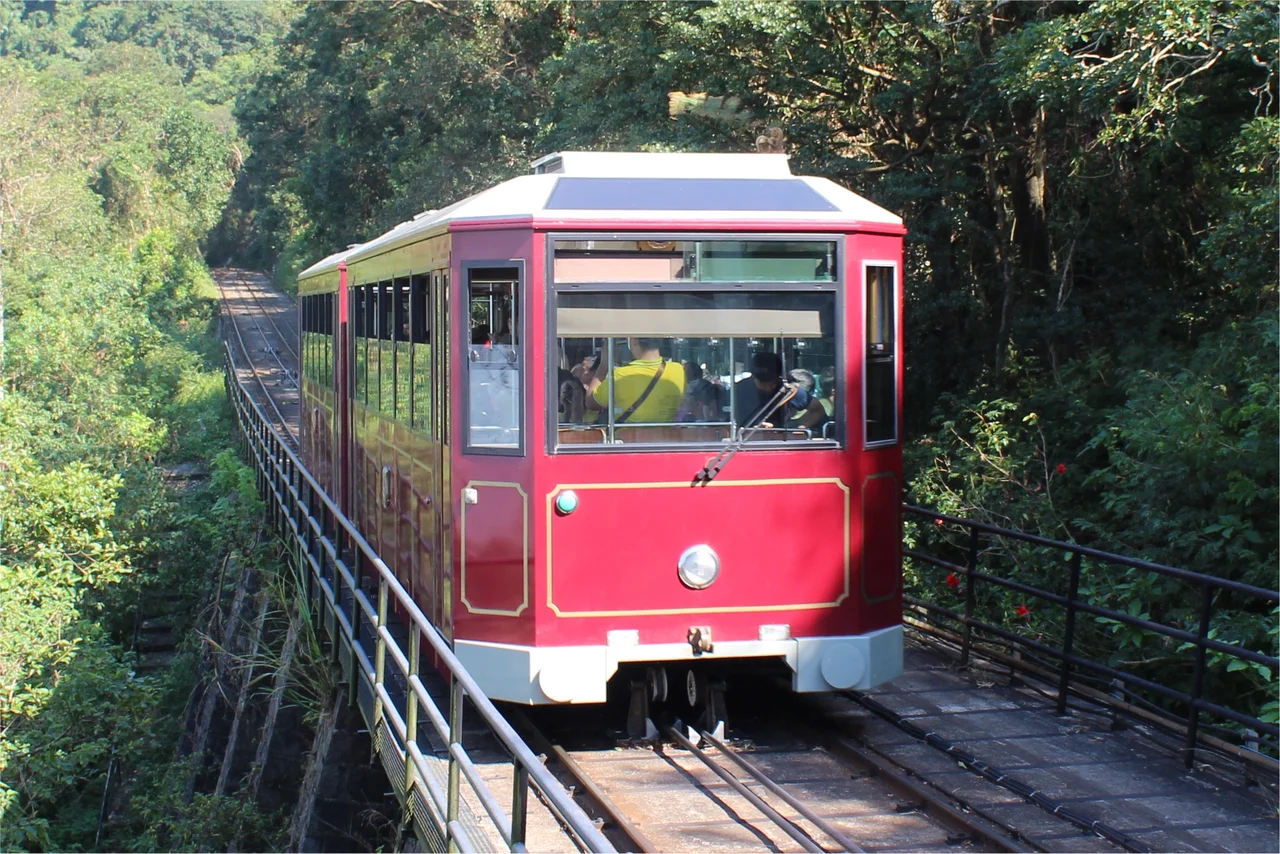

Peak Tram
Before Alexander Findlay Smith could convince anyone his idea would work, he had to convince himself. He spent years travelling to San Francisco, Scarborough, Rigi, Lucerne, and Mount Vesuvius — studying every mountain railway in Europe and America — before returning to Hong Kong certain that a funicular up Victoria Peak was not merely possible but necessary. Construction began in September 1885. On 28 May 1888, the line opened for public service, becoming the first funicular railway in Asia. More than 135 years later, it is still running.
One Man's Obsession
The Peak Tram exists because of one man's meticulous stubbornness. Alexander Findlay Smith first proposed the project in 1881, petitioned the governor, waited two years for enabling legislation, then spent more time touring the world's rack railways before he was satisfied his design would hold. The actual construction took three years, from 1885 to 1888. Workers hauled heavy equipment and rails uphill without mechanical assistance, a feat visible in the early photographs of the line. Smith's business partner, N. J. Ede, owned the house adjacent to the upper terminus — originally called Dunheved — which they converted into the original Peak Hotel. The first governor to ride the new tram was Sir George William des Voeux, who opened the service on 28 May 1888. Within years, the tram had accelerated residential development all along the Mid-Levels, transforming a steep hillside into a desirable address.
The Hierarchy Encoded in Iron
From its 1888 opening until 1926, the Peak Tram operated a rigid class system that encoded Hong Kong's colonial hierarchy in three tiers of seating. First Class was reserved for British colonial officials and Peak residents. Second Class carried British military and police personnel. Third Class was for everyone else — and, notably, animals. The fares reflected the divisions: 30 cents upward in First Class, 20 in Second, 10 in Third, with downward journeys charged at half price. Between 1908 and 1949, the front two seats were reserved exclusively for the Governor of Hong Kong, marked by a bronze plaque: "This seat is reserved for His Excellency the Governor." Ordinary passengers could not sit there until two minutes before departure. The tram encoded social order as precisely as any official decree — a hierarchy quite literally on rails.
Engineering at an Angle
The physics of the Peak Tram are straightforward and elegant. Two cable cars act as counterweights for each other: as one ascends, the other descends, and the system requires only enough electricity to manage the imbalance. The 1,364-metre route climbs from 27 metres elevation at the Garden Road terminus to 396 metres at Victoria Gap — a rise of just under 400 metres — with a maximum gradient of 48 percent and track angles between 4 and 27 degrees. The famous visual effect passengers experience, where the hillside appears nearly vertical and buildings seem to lean at impossible angles, is entirely real: the tram's angle does not change how your inner ear interprets the world. A passing loop near May Road allows the two cars to cross on the single-track line. Four intermediate stops — Kennedy Road, MacDonnell Road, May Road, and Barker Road — are all named for former colonial governors or administrators. The journey takes an average of five minutes.
Natural Disasters and a 799-Million-Dollar Rebuild
The line has survived two major flood-related closures. In 1899 and again on 12 June 1966, heavy rainfall washed away steep sections of track between Bowen Road and Kennedy Road. The most recent — and by far the most expensive — interruption was a planned one. In 2021, the line closed for 14 months for a comprehensive HK$799 million overhaul. New Swiss-built CWA carriages replaced the old cars, increasing passenger capacity from 120 to 210 per trip. Power, towing, rail, control and signal systems, and cable bridges were all replaced. The line reopened on 27 August 2022. At the Garden Road terminus, the upgrade was marked by a 10-metre sculpture called Eye of Infinity by Australian artist Lindy Lee, commissioned as part of the project. The Barker Road station, built in 1919 with its semi-circular arches and Art Deco ironwork, is the oldest surviving Peak Tram station — a Grade I historic building that has changed little in over a century.
The View That Made the City Famous
At the top, the view is what people come for: Victoria Harbour laid out below, the dense vertical city of Central tapering into the water, Kowloon on the far shore, and on clear days the hills of the New Territories beyond. The Peak Tower complex — a wok-shaped structure visible for miles — sits just above the tram terminus at Victoria Gap, some 150 metres below the actual summit of Victoria Peak. The view from the upper deck of the tram, as the city tilts and the harbour opens up on the ascent, remains one of Hong Kong's defining experiences. It was this view that drew colonial officials to build their residences on the Peak in the 1880s and 1890s, and it is this view that draws millions of visitors today. The tram that made the Peak accessible made the view famous — and the view made the tram indispensable.
From the Air
The Peak Tram runs from Central (22.2801°N, 114.1577°E) at Garden Road up to Victoria Gap (22.2720°N, 114.1549°E) at approximately 396 metres elevation on Hong Kong Island. Victoria Peak (Mount Austin) summit rises to 552 metres. Recommended viewing altitude 1,500–2,500 feet MSL; approach from the harbour side offers the best profile of the route on the hillside. Nearest major airport: Hong Kong International Airport (VHHH), approximately 30 km west on Lantau Island. The Peak Tower is a visually distinctive landmark — its curved wok shape is recognizable from the air. Harbour haze is common; early mornings tend to offer the clearest views.
Nearby Stories
- Lok Ma Chau Loop 2.3 km away
- Portas do Cerco 2.3 km away
- Kweilin Incident 17 km away
- Wanshan Archipelago Campaign 34 km away
- Nanxiong Formation 115 km away
- Battle of Nanpeng Island 148 km away
- Heyuan 169 km away
- Cape Maobitou 632 km away