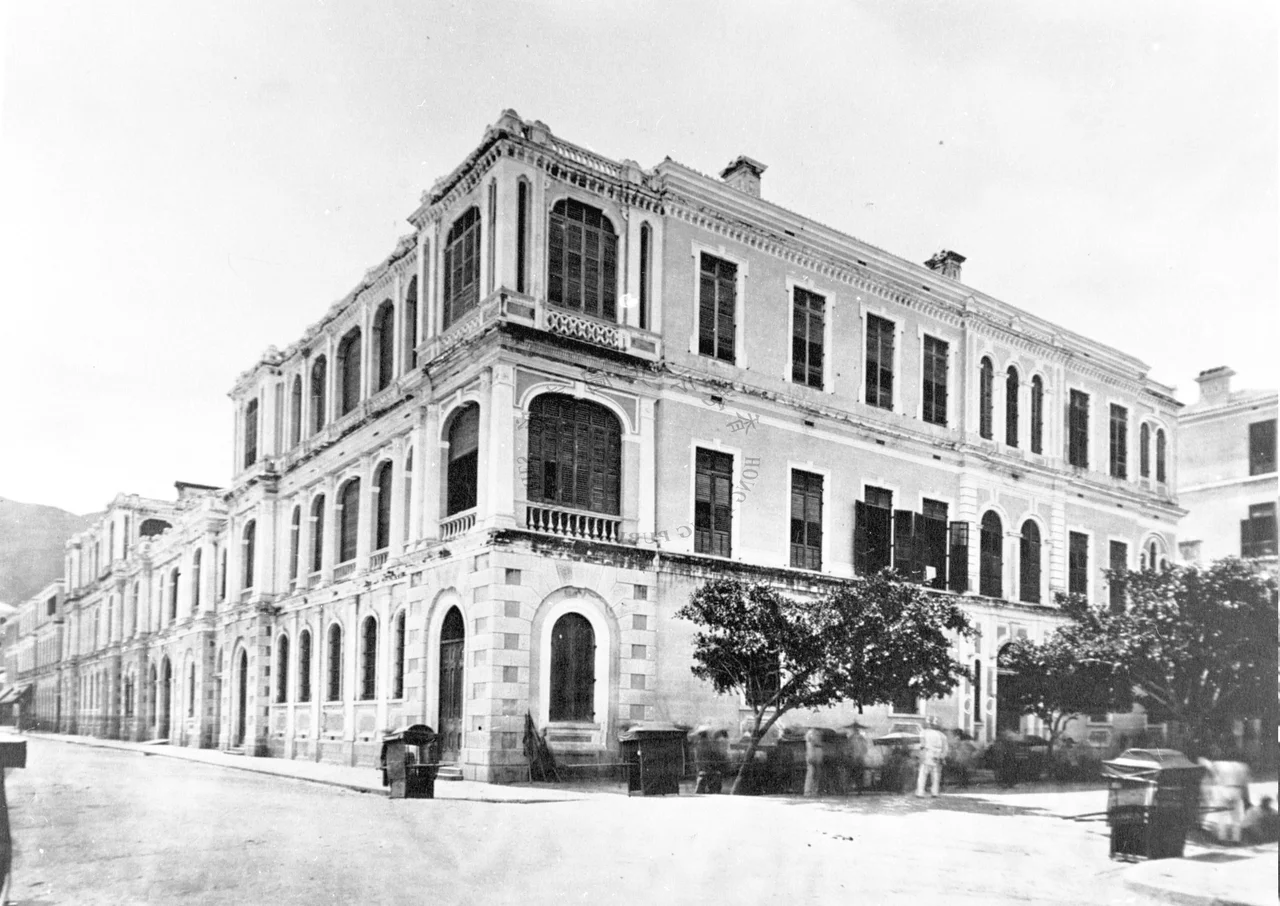

Pedder Street
The man the street is named for never owned property on it, never grew wealthy from it, and probably never imagined it would outlast the empire he served. Lieutenant William Pedder was the first lieutenant of HMS Nemesis — Britain's first ocean-going iron warship — and later Hong Kong's first harbour master. When the colonial surveyors named this short road running north from the harbour to the hills, they chose his name for it. That was in the 1840s. The road is still there, still carrying the name, still at the centre of everything.
The Nemesis and the Naming
William Pedder arrived in Hong Kong in the early 1840s as the colony was being established, his career already shaped by one of the most dramatic naval missions of the era. The Nemesis — an iron-hulled, shallow-draft gunboat — had been decisive in the First Opium War, able to operate in rivers and coastal shallows where traditional wooden warships could not go. Pedder served as its first lieutenant. When he became Hong Kong's first harbour master, the surveyors laying out the new colonial capital gave his name to the road running from Pedder's Hill, where his harbour master's office stood, down to Pedder's Wharf on the Praya — the original Victoria waterfront. It was a modest honour for a man doing a practical job, but the name took root in a way that most colonial street names did not: it still belongs to the street today.
Where the Great Hongs Faced Each Other
In the early decades of British Hong Kong, Pedder Street divided two of the most powerful commercial empires in Asia. On one side stood Dent & Co.; on the other, Jardine, Matheson & Co. Both firms occupied sprawling complexes on the Praya Central, the original waterfront, with their premises flanking Pedder Street on opposite sides. These were the great trading hongs — the merchant houses that had grown rich on the opium trade and then diversified into shipping, banking, and property. Dent & Co. was a founding member of what became HSBC. Jardine Matheson still exists today, one of the largest conglomerates in Asia. When Dent & Co. collapsed in financial distress in 1866, it sold half its Pedder Street land to the newly formed Hongkong Hotel Company, which built Hong Kong's first deluxe hotel on the site. The street had become, in a few decades, the address of power.
The Clock That Chimed at Midnight
At the southern end of Pedder Street, where it met Queen's Road, an 80-foot clock tower rose in 1862. Designed by a Mr. Rawlings and funded by public subscription — though the lack of enthusiasm from the public meant many of its decorative features were dropped — it was the landmark of Central for five decades. The tower chimed for the first time at midnight on 31 December 1862. It was demolished in 1913. The site was eventually redeveloped, rising in the early 1970s as Wheelock House, the current headquarters of Wheelock and Company. The clock tower's footprint survives only in the institutional memory of the street, and in the way pedestrians still pause at that corner — though now they are pausing for the traffic signal rather than checking the time on stone.
The Land That Grew North
Pedder Street is shorter today than it was in the colonial imagination, but longer than it was at the start. The Praya Reclamation Scheme, completed by 1904, pushed the waterfront north — transforming the original shoreline into Des Voeux Road and creating a new strip of land running further north to Connaught Road. The street followed the new geography. A new pier at its northern end was named Blake Pier, after Hong Kong's 13th Governor. The reclamation also explains why so much of Central feels disconnected from the water: the harbour used to come much closer. In February 1886, before the reclamation was complete, workers drove the first pile for the new Pedder's Wharf 38 feet from the original praya wall — a wharf that extended 195 feet out into the water, 40 feet wide, with six sets of steps leading down to the sea. All of that is land now.
What Remains
Today Pedder Street runs for a few hundred metres through the core of Central, flanked by some of the most expensive commercial real estate in the world. The Landmark — a high-end shopping and office complex — occupies a central block. Chater House, Wheelock House, the Pedder Building, and World-Wide House line its edges. The Pedder Building, dating from 1924, is among the older survivors on the street. The Hong Kong Hotel, which opened in 1866 as the city's first deluxe hotel, was closed in 1951, bought by a local investment group, and replaced in 1957 by the present Central Building. Layers of history are compressed into the street's short length: the naval officer, the opium merchants, the clock tower, the reclaimed harbour. None of it is visible. But the name on the signs — Pedder Street, 畢打街 — carries every layer of it.
From the Air
Pedder Street runs north-south through the heart of Central district on Hong Kong Island, centred approximately at 22.2826°N, 114.1580°E. The area is dense with high-rise towers; the International Finance Centre and HSBC headquarters are nearby visual landmarks. Recommended viewing altitude 2,000–3,000 feet MSL for the Central urban grid. Nearest major airport: Hong Kong International Airport (VHHH), approximately 30 km west. The narrow canyon of towers makes Central difficult to identify at street level from the air, but the harbour waterfront immediately north provides clear orientation.
Nearby Stories
- Lok Ma Chau Loop 2.3 km away
- Portas do Cerco 2.3 km away
- Kweilin Incident 17 km away
- Wanshan Archipelago Campaign 34 km away
- Nanxiong Formation 115 km away
- Battle of Nanpeng Island 148 km away
- Heyuan 169 km away
- Cape Maobitou 632 km away