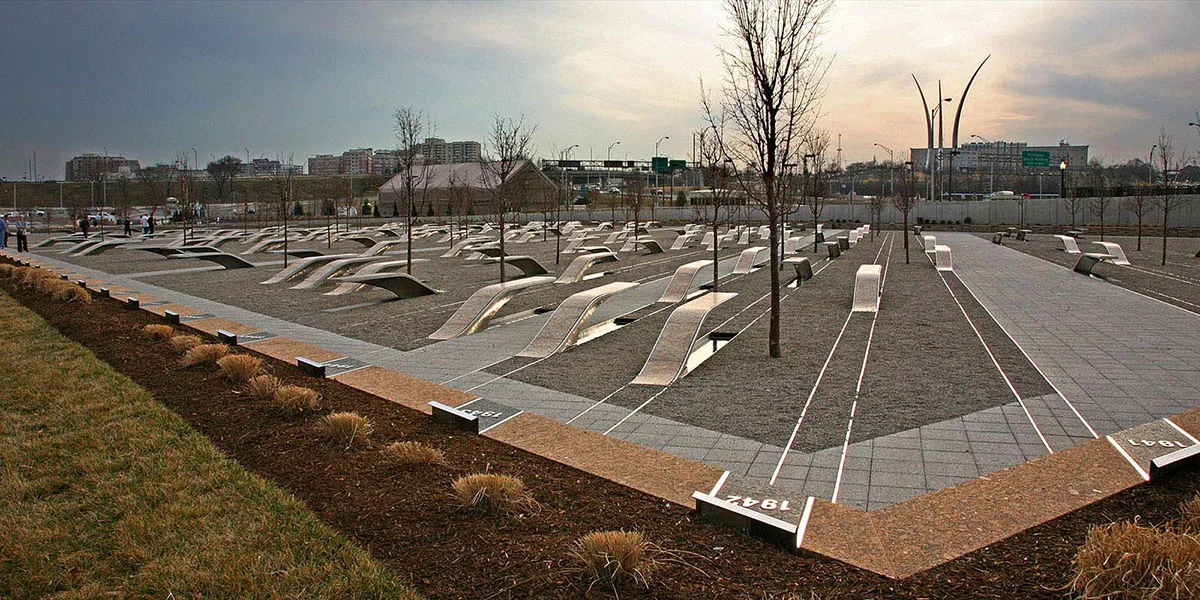

Pentagon Memorial
On the morning of September 11, 2001, American Airlines Flight 77 - a Boeing 757 that had departed Washington Dulles International Airport at 8:20 a.m. bound for Los Angeles - was hijacked over Ohio, turned around, and flown back to Washington. At 9:37 a.m. the aircraft struck the western face of the Pentagon at approximately 530 miles per hour. The impact killed all 64 people on board the plane — 59 passengers and crew members and five hijackers — and 125 people inside the building. A total of 184 lives ended in a span of less than a second. Seven years to the day later, on September 11, 2008, the National 9/11 Pentagon Memorial opened on the patch of ground southwest of the building where the aircraft had come down. Designed by Julie Beckman and Keith Kaseman with the engineering firm Buro Happold, the memorial is 184 cantilevered steel benches set in a deliberately ordered grid across two acres of stone and gravel. Each bench bears one name.
184 Benches, Two Directions
The benches are organized by age - youngest to oldest - reading from the impact line of the aircraft. The youngest victim was three-year-old Dana Falkenberg, who was on Flight 77 with her parents and older sister, traveling to Australia for a sabbatical. The oldest was retired Navy captain John Yamnicky, age 71, also on the plane. The benches at the youngest end of the field stand at one end; the benches representing oldest age extend to the other. Each bench cantilevers from a foundation block over a small reflecting pool. Two distinct orientations distinguish the benches: those representing people who died inside the Pentagon are arranged to face the building; those representing people who died on Flight 77 face the opposite direction, away from the building, toward the open sky where the aircraft had been. A visitor standing at the foot of any bench knows immediately whether the person represented had been in the air or on the ground at the moment of impact. The benches' material is a brushed stainless steel; the reflecting pools beneath are lit at night from below. Each name is inscribed in raised letters at the foot of its bench.
Where the Plane Hit
The Pentagon Memorial occupies approximately two acres of land immediately southwest of the Pentagon's west wall - the wall the aircraft struck. The site falls within the line the aircraft followed during its final seconds of flight. The damaged section of the Pentagon itself was repaired in the year following the attacks, with crews working continuously to restore the affected wedge before the first anniversary of the attack. The America's Heroes Memorial, an indoor space inside the building marking the precise point of impact, opened in September 2002. That smaller interior memorial includes a book of photographs and biographies of the victims, panels displaying the Purple Heart medals awarded to military members killed in the attack and the medals issued to civilians, and panels etched with the victims' names. A small chapel adjacent to the interior memorial includes stained-glass windows with patriotic designs.
Beckman and Kaseman
Julie Beckman and Keith Kaseman were both newly graduated architects when their design was selected from approximately 1,100 entries in the international competition that closed in 2003. They were partners in the firm Kaseman Beckman Advanced Strategies, working out of New York. Their winning entry distinguished itself in two ways: the orientation system that distinguished air victims from building victims, and the deliberately quiet, low-affect architectural treatment of the bench-and-pool elements. They were not interested in dramatic vertical gestures. They wanted, instead, a landscape that could absorb individual mourning - a place where families could find their relative's bench, sit at it, touch it, return year after year. Construction began in 2006. The site opened on September 11, 2008, with the families of the victims invited to a private dedication, followed by public access. The Pentagon Memorial Fund - the nonprofit that had raised the construction funds - has continued to operate the site as a privately maintained but publicly accessible space, with the Defense Department maintaining the surrounding grounds.
The Missing Education Center
Of the three sites struck on September 11, 2001, the Pentagon is the only one without a dedicated visitor education center. The 9/11 Memorial and Museum at the World Trade Center site in New York opened in 2014. The Flight 93 National Memorial in Shanksville, Pennsylvania - which honors the passengers and crew who fought back against the hijackers and forced the aircraft down in a field rather than into its intended target - opened a permanent visitor center and learning center in 2015. The Pentagon Memorial has only the outdoor benches. Visitors who arrive without prior context have no place to learn the story of the attack, the response, the casualties, or the broader history. The Pentagon Memorial Fund has been working since the mid-2010s to build a Visitor Education Center, with a planned completion by 2028. As of recent reporting, the fund has secured a site near Arlington National Cemetery and raised approximately $16 million in private funding. The center requires an estimated $70 million more in federal funding before construction can begin.
Section 60 and the Pentagon's Pentagonal Marker
Beyond the outdoor memorial, additional commemoration of the Pentagon victims exists at Arlington National Cemetery, three quarters of a mile southwest. On September 12, 2002 - the day after the first anniversary of the attacks - Defense Secretary Donald Rumsfeld and Chairman of the Joint Chiefs General Richard Myers dedicated the Victims of Terrorist Attack on the Pentagon Memorial. The structure consists of a five-sided granite marker - intentionally echoing the pentagon shape of the building itself - standing 4.5 feet tall. A portion of the unidentified remains of 25 victims are buried beneath the marker. Around the top of the granite is inscribed Victims of Terrorist Attack on the Pentagon September 11, 2001. Aluminum plaques painted black are inscribed with the names of all 184 victims. The marker stands in Section 60 of Arlington National Cemetery, the section that holds many of the dead from the post-9/11 wars in Afghanistan and Iraq. The proximity is deliberate. The attack that prompted those wars, and the people lost to it, are buried near the people lost in the wars that followed.
From the Air
The National 9/11 Pentagon Memorial sits at 38.8702 N, 77.0577 W, on the southwest grounds of the Pentagon in Arlington County, Virginia, immediately along the western face of the building struck by American Airlines Flight 77. Best viewed from 1,500 to 2,500 feet AGL. The two-acre rectangular memorial grid of 184 cantilevered benches is distinct in aerial photography. The Pentagon's massive five-sided footprint anchors the visual frame immediately northeast. Reagan National (KDCA) lies one nautical mile east; Arlington National Cemetery is one mile northwest. The site is inside the Washington Flight Restricted Zone; GA overflight prohibited. Note: this is one of the most-restricted airspace zones in the United States.
Nearby Stories
- Gunston Hall 1.1 km away
- 2023 Baltimore Shooting 4.9 km away
- Battle of Middleburg 6.6 km away
- Crownsville Hospital Center 10 km away
- Battle of Loudoun Heights 13 km away
- First Battle of Rappahannock Station 20 km away
- Howard County, Maryland 21 km away
- Harriet Tubman Underground Railroad 50 km away