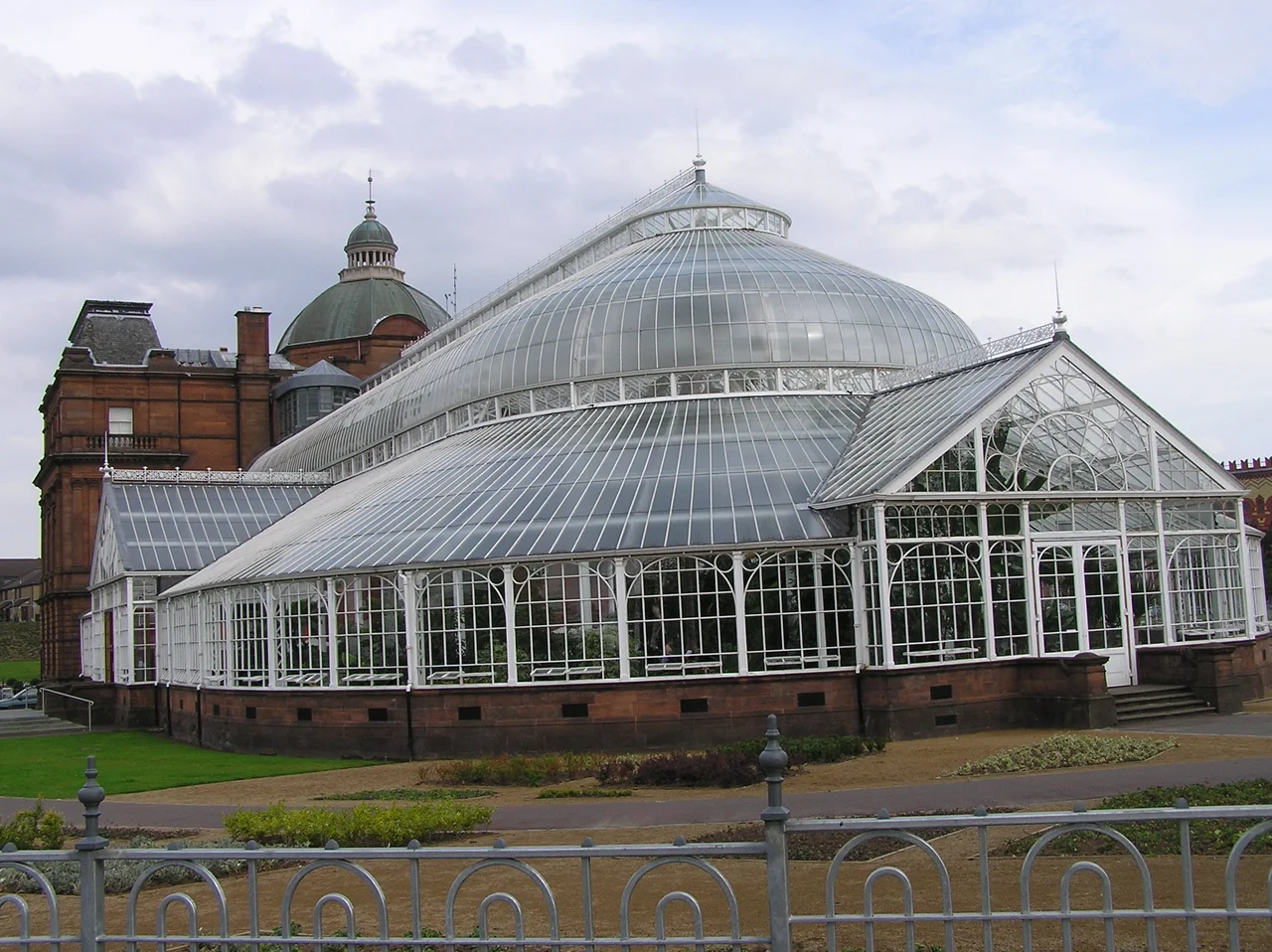

People's Palace, Glasgow
The idea was Victorian and utopian in equal measure: palaces for the people. The phrase came out of writings by John Ruskin, William Morris, and Annie Besant, who argued that beauty and culture should not be hoarded by the wealthy. London built one first, on Mile End Road in the East End. Glasgow followed in 1898 with its own People's Palace and Winter Gardens, designed by City Engineer Alexander B. McDonald and decorated with sculptures representing Art, Science, Shipbuilding, Industry, and Progress by William Kellock Brown. The Earl of Rosebery opened it on 22 January 1898. The location was no accident. At the time, the East End of Glasgow was one of the most overcrowded, unhealthy, and exhausted districts of any British city. A palace for these people was an act of dignity, and a political one.
What a Working City Looked Like
The collections inside are not paintings of dukes and battles. They are the things ordinary Glaswegians used. A reconstructed single end - the one-room tenement home where entire families slept, cooked, washed, raised children, and grieved. Displays about going to the steamie, the communal laundry where women carried their wet bundles and met to talk. Memorabilia from the Barrowland Ballroom, where Glaswegians went to the dancing on Saturday nights. Posters and souvenirs from trips doon the watter - down the Firth of Clyde on paddle steamers like the Waverley, which still sails today as the world's last sea-going paddle steamer. On the first floor sits the campaign desk of John MacLean, the Scottish socialist whom Lenin appointed Bolshevik consul to Scotland in 1918. The People's Palace does not flinch from the politics of who built Glasgow.
The Calton Weavers and the History Mural
When the museum was restored in the late 1990s, the Glasgow-born artist Ken Currie was commissioned to paint a series for the ceiling dome. The eight panels mark the 200th anniversary of the Calton Weavers Massacre of 1787 - a moment when striking weavers in Glasgow's Calton district were fired on by soldiers and several were killed. Currie's panels trace Glasgow's working-class history from that point to the present: organised labour, industrial decline, deindustrialisation, resistance. It is a remarkably uncompromising piece of public art for a civic museum. Outside, the Doulton Fountain - the largest terracotta fountain in the world, 46 feet high and 70 feet across at its base - was gifted to the city in 1888 by Sir Henry Doulton for the International Exhibition of Science, Art and Industry, marking Queen Victoria's Golden Jubilee. Its figures of Canada, Australia, India, and South Africa represent the British Empire. In 2005 it was extensively refurbished and moved to its current position in front of the museum.
Smudge, Trade Unionist Cat
In the 1980s a cat named Smudge lived at the People's Palace, and Smudge became something of a Glasgow icon when she successfully joined the General, Municipal, Boilermakers and Allied Trade Union - the GMB. This came after NALGO, the National and Local Government Officers' Association, refused her membership on the grounds that she was a blue-collar worker rather than a clerical one. A plaque outside the museum still commemorates her. The story is silly, of course, but it is also pure Glasgow: a city where solidarity is taken seriously enough that the question of which union a cat should join is worth pursuing to its logical conclusion.
Closure, Decay, and a Promised Return
The People's Palace closed in January 2019, with rare plants moved out of the Winter Gardens. Photographs of the derelict interior provoked anger - Glasgow MP Paul Sweeney described the situation to The Times as an appalling act of civic vandalism. The Palace section reopened briefly in June 2019 after a £350,000 refurbishment relocated the fire exits, but the pandemic closed it again. The Winter Gardens stayed shut throughout - the sealant attaching the glass to the frame had reached end of life after the 1998 refurbishment, and Glasgow Life lacked the £5 to £7.5 million estimated for repairs. In January 2024 the National Lottery Heritage Fund committed an initial £850,000, with up to £7.5 million available pending a second application. Glasgow City Council allocated further funds toward a £35.9 million restoration. On 14 April 2024, the People's Palace closed again, this time for major works. The original target of 2027 has been delayed indefinitely, with Glasgow Life citing evolving survey findings and funding uncertainty; no revised reopening date had been confirmed as of early 2026. When it does reopen, it will do so alongside the long-shuttered Winter Gardens, last seen by the public in December 2018. For a museum built to honour ordinary lives, the years of closure have been a quiet civic grief - and the return, when it comes, will matter.
From the Air
Located at 55.8512 degrees N, 4.2374 degrees W on Glasgow Green in the East End of Glasgow, on the north bank of the River Clyde. Best viewed from 1,200-2,500 feet. The distinctive Winter Gardens glasshouse is the most visible feature from the air, attached to the rear of the red sandstone museum building. Nearest ICAO airports: Glasgow International (EGPF) about 8 nm west and Glasgow Prestwick (EGPK) about 25 nm southwest. Look for Glasgow Green - the open parkland - immediately south of the building, with the Saltmarket and Templeton Carpet Factory visible nearby.
Nearby Stories
- Mauchline 3.6 km away
- Shotts 4.2 km away
- HMS Ulysses (1917) 7.7 km away
- Rothesay Castle 8.8 km away
- Inchcailloch 10 km away
- Strachur 14 km away
- Battle of Dollar 16 km away
- Crawford Castle 16 km away