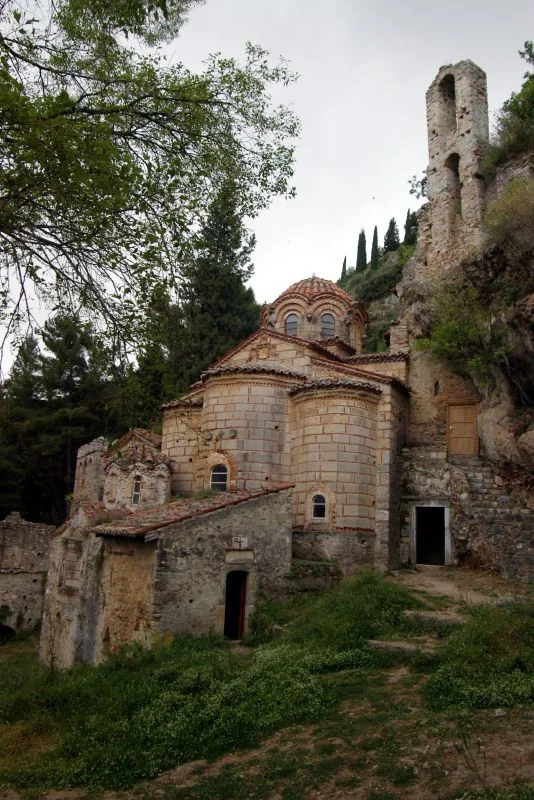

Peribleptos Monastery, Mystras
The word 'peribleptos' means 'conspicuous' or 'admired on all sides' in Greek — an apt name for the celebrated monastery of Constantinople that this Mystras church was named after, and oddly ironic for a building tucked into the side of a cliff. The Peribleptos Monastery at Mystras is not conspicuous in the way a cathedral announces itself on a plain. It is hidden: built into rock, supported by a cave, its squared-stone walls fitted to the contours of the hillside as though they grew there rather than were placed. To find it is to feel you have discovered something. And then you step inside, and the walls open into another world entirely.
Built into the Rock
The monastery was probably built in the mid-14th century by Manuel Kantakouzenos, the first Despot of the Morea — the Byzantine ruler who governed the Peloponnese as a semi-autonomous principality. The construction is unusual: the building is embedded into the cliff face, with a natural cave forming part of its structural foundation. This integration of natural rock into ecclesiastical architecture is characteristic of the 'Mystras style,' a local building tradition that the Peribleptos exemplifies: churches that resemble small fortresses, constructed of squared stones with inlaid tiles, their profiles shaped by the terrain rather than imposed upon it. The complexity of the exterior — irregular surfaces, projecting apses, varied roof levels — creates, inside, the kind of dramatic spatial variety that fresco painters dream of.
A Rare Cycle Survives
The frescoes covering the interior of the Peribleptos church were painted between approximately 1348 and 1380. They constitute a very rare surviving late Byzantine fresco cycle — not individual panels or fragments but a comprehensive program of New Testament images, flowing from surface to surface with what scholars have described as a 'perpetual flow,' one scene leading organically into the next. The curved surfaces of the apse and the undulating walls of the cave-supported structure gave the painters an unusual canvas, and they used it: the images wrap and turn, drawing the viewer's eye around the interior in a continuous narrative. The style has been connected to both the Cretan and Macedonian art schools, though the painters themselves are not identified. The frescoes have been described as 'delicate and subdued' — a restraint that serves them, giving the figures a luminous, contemplative quality.
Icons in Stone and Paint
Among the specific images preserved here is a fresco of Saint John the Baptist in the scene of the Baptism of Christ, one of the great set-pieces of Byzantine iconographic tradition. The monastery also holds an extraordinary relic: the head of Saint Gregory of Nazianzus, the 4th-century Archbishop of Constantinople and one of the three Cappadocian Fathers, whose theological writings shaped the Orthodox understanding of the Trinity. His presence here — both as a painted figure in the iconographic program and as a physical relic — underscores the Peribleptos's status as a place of genuine spiritual and ecclesiastical importance, not merely aesthetic distinction. The Virgin Mary as the dominant devotional focus of Mystras's churches and monasteries is evident here too, in the Marian imagery woven throughout the fresco program.
After the Conquest
Mystras fell to Ottoman forces in 1460, and the Peribleptos, like most of the city's churches, changed hands and function during the centuries of Ottoman and Venetian rule. Byzantine art and architecture survived the conquest in a more than nominal sense: as scholar Karin M. Skawran observed, painting in the region retained its monastic, Constantinople-derived character even as political control changed. The extensive fresco cycle at Peribleptos was not destroyed. It endured. Whether this was because the building's tucked-away position afforded it some protection, or because of decisions made by whoever controlled it during various periods, the result is that a visitor today can stand in a 14th-century Byzantine church and see essentially what a 14th-century Byzantine worshipper saw: the walls alive with figures, the cave behind them, the sacred made tangible in paint on stone.
From the Air
The Peribleptos Monastery sits at approximately 37.072°N, 22.371°E on the lower southern slopes of the Mystras archaeological site, set into the cliff below the main terrace of the medieval city. From the air, it is difficult to distinguish from the surrounding rock and vegetation — its cliff-embedded position makes it nearly invisible to overhead observation, which is part of its character. The broader Mystras site with its Frankish castle is the visible landmark; the Peribleptos lies near the base of the ridge. Nearest major airport: LGKL (Kalamata International), approximately 55 km to the west-southwest. The Taygetus range immediately to the west creates significant orographic effects; approach from the east over the Eurotas valley is smoother.
Nearby Stories
- Iklaina 6.6 km away
- Kalamakia Cave Site 7.8 km away
- Cleomenean War 9.7 km away
- Epidaurus Limera 16 km away
- Leonidio 18 km away
- Lepreum 20 km away
- Franchthi Cave 30 km away
- El-Kouf National Park 448 km away