
Peterborough Museum and Art Gallery
There is a doll's house in Peterborough Museum that fits in your hand. It is made from beef and mutton bones, scrap wood, and slivers of straw, and it was built by a Frenchman who could not go home. Between 1797 and 1814 the British government held tens of thousands of prisoners-of-war from the Napoleonic conflicts at Norman Cross, a few miles south of the city, in what is generally accepted to be the world's first purpose-built prisoner-of-war camp. The men inside had time, no money, and bones from their dinners. Out of that they made miniature ships rigged with human hair, animated automata, lace-fine straw inlay, model guillotines, snuff boxes, and chess sets so detailed that two centuries on they are still the centrepiece of one of the most unusual museum collections in England.
From a Society to a Museum
Peterborough Museum began as the collection of the Peterborough Natural History, Scientific and Archaeological Society, founded in 1871. The Society's collection went on public display in 1880, originally in a single room on Long Causeway. It moved in 1887 to the Becket Chapel on the cathedral grounds, then in 1907 to Barrass Memorial Hall on Queen Street. All three of those early sites have since been demolished. The Society eventually rented a building on Park Road that later housed the Theatre Royal, before its present home was given to the city by the Peterborough Museum Society in 1968. The current building on Priestgate was originally a private house built in 1816, became the Peterborough Infirmary in 1857, and from 1931 housed the museum. Some of the wards are now galleries, and the basement has the kind of cold flagstone smell that old hospitals have.
The Norman Cross Collection
The Norman Cross artefacts are the museum's most distinctive holding. Between 1797 and 1814 the camp held about 7,000 French prisoners at any one time, mostly soldiers and sailors captured during the Napoleonic Wars. Conditions were not gentle. Disease swept through the wooden barracks more than once, and a memorial obelisk now stands by the A1 marking the graves of around 1,770 men who died at the camp. But the prisoners had time, modest rations, and a small commerce was permitted: they could sell what they made through a market held twice a week at the gates. Out of bone, wood, straw and human hair came one of the great folk-art collections of Europe. The Peterborough Museum holds the largest assemblage of Norman Cross work in the world, including the bone and straw-marquetry caskets, model warships rigged so finely you can read the rigging diagram, working mechanical automata, and that doll's house that fits in your hand.
Jurassic Peterborough
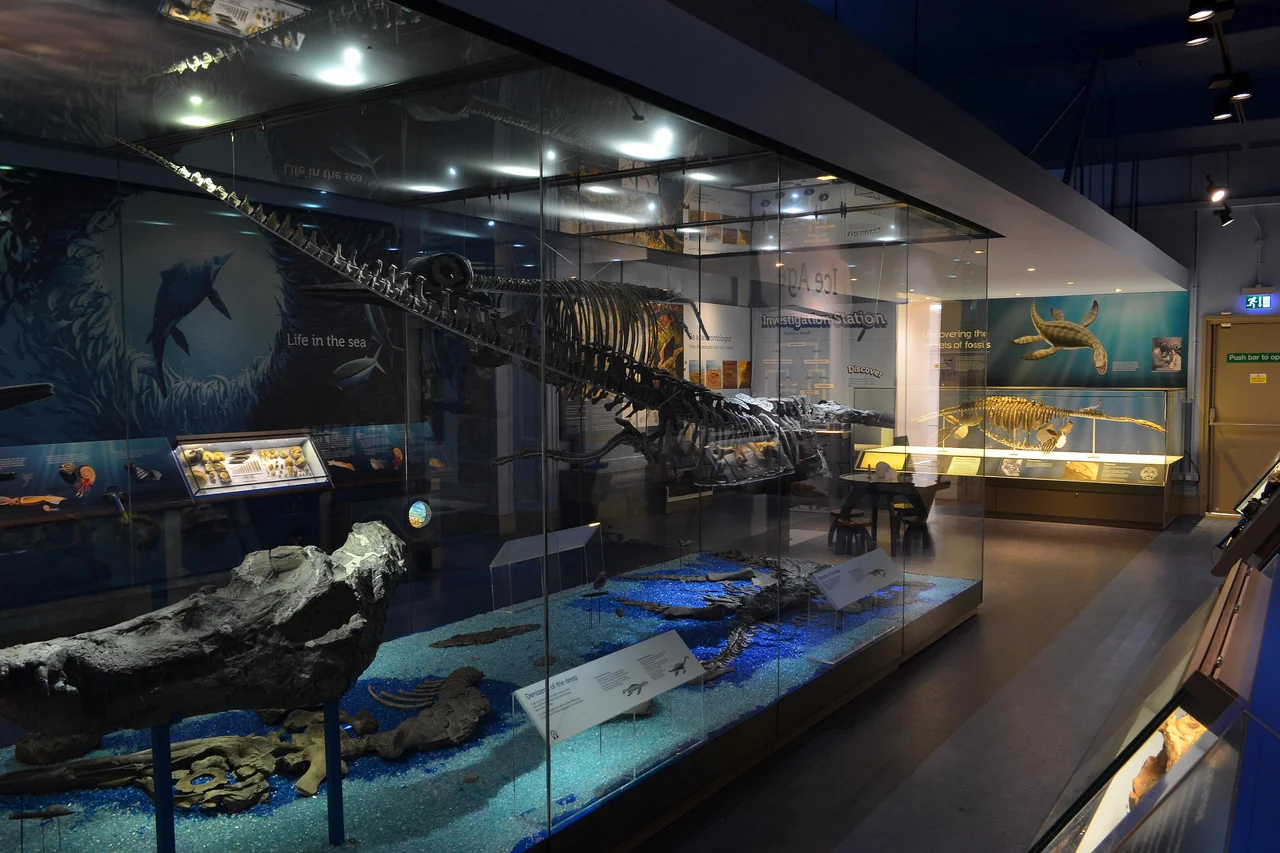
The other internationally significant part of the collection is the marine fossil holdings. Peterborough sits on Middle and Upper Jurassic clay, deposited when the area was a warm shallow sea about 165 million years ago. The Oxford Clay around Peterborough was extensively quarried for the local brick industry in the nineteenth and twentieth centuries, and the brickmakers turned up an extraordinary cross-section of Jurassic sea life. Plesiosaurs, pliosaurs, ichthyosaurs, ammonites, the bivalve Gryphaea, even the giant filter-feeding fish Leedsichthys: all came out of the brick pits, and many ended up here. The display includes a paper from the Palaeontological Association on predation of a Kosmoceras ammonite by a Semionotid fish, which is the kind of detail that signals a serious research museum and not merely a regional collection.
The Peasant Poet
John Clare was born in 1793 in the nearby village of Helpston, the son of a thresher, and became one of the great English nature poets of the nineteenth century. He was called, in his own time, the Northamptonshire Peasant Poet, a label that managed to be both descriptive and slightly patronising. Clare's poems hold the East Midlands countryside the way a Constable painting does, but with more attention to the actual names of birds and grasses. He spent the last decades of his life in mental asylums, walking out of one to find his way home on foot, eating grass by the roadside. The original manuscripts of much of his work are at Peterborough Museum, alongside personal effects. To read his neat, slanted handwriting under glass, in a building that did not exist when he was born and is now older than most of the trees he wrote about, is to feel the layered time of this part of England in a particular way.
227,000 Things
The total collection comes to about 227,000 objects: Roman pottery from local kiln sites, Saxon material, medieval and post-medieval social history, paintings and prints from the seventeenth century to the present, and a thumb-sized portrait of George Montagu, Earl of Halifax, by John Giles Eccardt after Jean-Baptiste van Loo, painted some time around 1739 to 1750. The museum is now run by Peterborough Limited, a Local Authority Trading Company under the city council, having previously been run by Vivacity, a charitable trust, from 2010 to 2019. The Grade II listed Priestgate building is not large by national standards. What is unusual is the density and the storytelling power of what is inside. The Norman Cross prisoners spent fifteen years carving bone in a wooden camp on the fen edge. Their work is what makes this museum worth a detour from anywhere in England.
From the Air
Located at 52.57 degrees north, 0.25 degrees west, on Priestgate in central Peterborough, Cambridgeshire. The museum sits about 200 yards south of Peterborough Cathedral and within 1 nautical mile of the railway station. From altitude central Peterborough reads as a tight cluster of historic buildings around the cathedral, surrounded by twentieth-century residential and industrial estates. Best viewed from 1,500 to 3,000 feet in clear conditions. Nearest active airfield is RAF Wittering (EGXT) 8 nautical miles west, just south of Stamford. Cambridge City Airport (EGSC) lies 30 nautical miles south-southeast. Flag Fen and the Bronze Age archaeology lies 3 nautical miles east.
Nearby Stories
- Oakham Castle and Its Forfeited Horseshoes 3.2 km away
- Huntingdon 5.2 km away
- RAF Downham Market 5.6 km away
- Hunstanton 8.9 km away
- RAF Mildenhall 9 km away
- Sywell Aerodrome 10 km away
- Heckington Windmill 11 km away
- Bingham, Nottinghamshire 17 km away