
Peterborough
Two queens are buried under the floor of Peterborough Cathedral. Catherine of Aragon lies on the north side of the choir, where Henry VIII placed her after her death at nearby Kimbolton Castle in 1536; her grave is still marked each year with pomegranates, her personal symbol. Mary, Queen of Scots was buried here too, after her execution in 1587, until her son James I had her moved to Westminster Abbey in 1612. Most people in Britain do not know this. They know Peterborough as an hour-out-of-London commuter stop on the East Coast Main Line, a city ringed by 1960s housing estates and brick pits, and they keep going north. They are missing the point.
Why the City Is Here
Peterborough sits at the western edge of the Fens, where the higher land drops away into the drained marshes of East Anglia. In Jurassic times the area was a tropical sea, leaving deep beds of Oxford Clay perfect for bricks, plus the limestone that gave the cathedral its stone. The last ice sheet stopped just north of here, and meltwater left gravel banks that made the place easy to build on. The Romans put brickworks here. The Saxons founded the monastery that became the cathedral. From the medieval period onward, Peterborough was the natural crossing point for roads and railways heading north from London, and the East Coast Main Line still puts four trains an hour through the station, the fastest running King's Cross nonstop in 46 minutes. Stansted Airport, Cambridge, Leicester, Manchester, Norwich, Birmingham, Edinburgh: they all reach Peterborough by direct train, and from here you can fan out across the north.
What to See Around the Cathedral
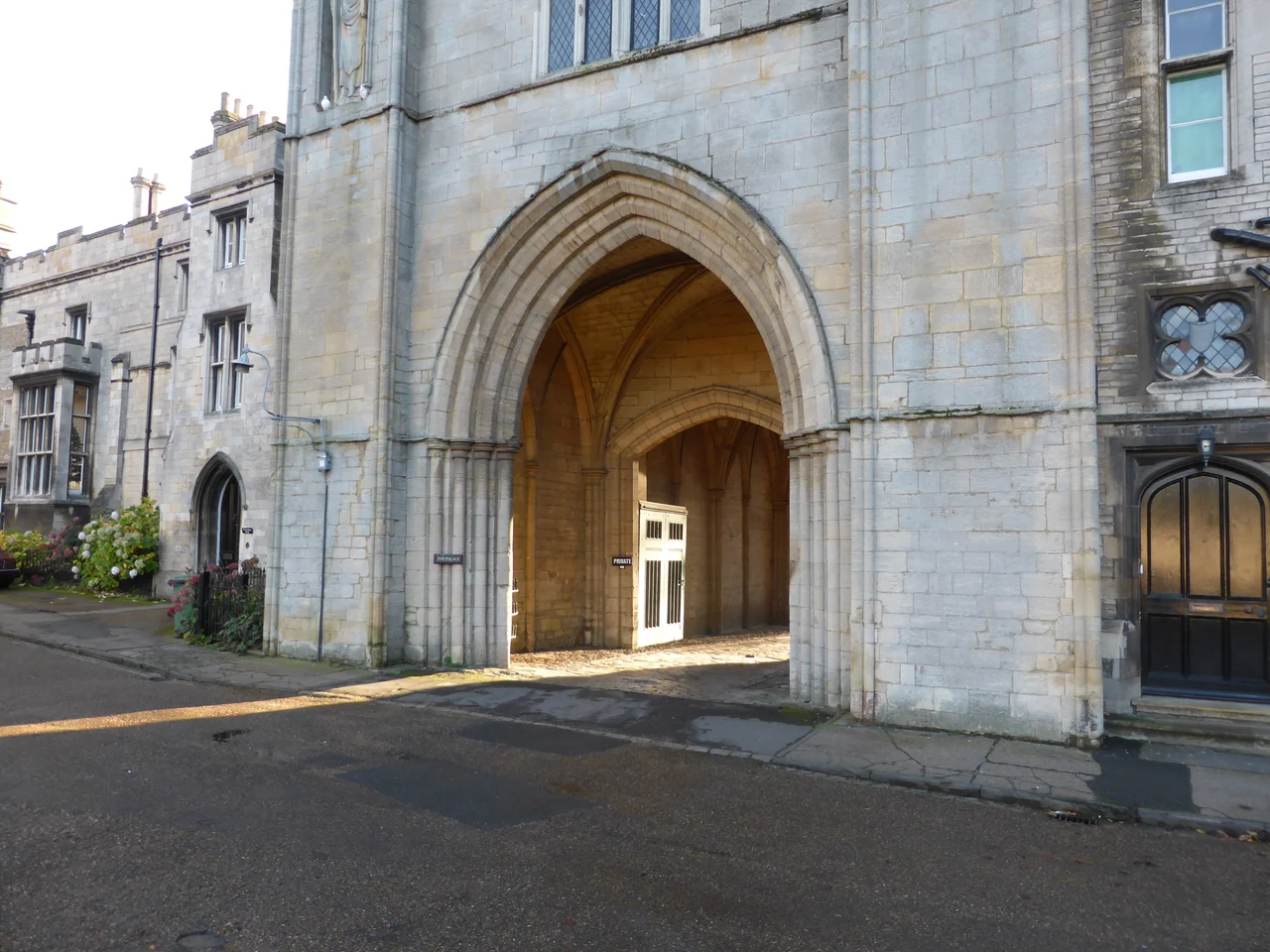
Cathedral Square is the obvious place to begin, but what you see first is not the cathedral itself. The Anglican parish church of St John the Baptist, built in 1407, stands on the square, a striking Perpendicular building with a mostly nineteenth-century interior. The cathedral sits behind it through the medieval Norman Gate. The cathedral nave is one of the finest Norman interiors in England, a long perspective of painted wooden ceiling supported on heavy round columns. The Hedda Stone, a Saxon carved monument from before the Viking sack of the monastery in 870, sits inside. East of the cathedral, the green mound of the old motte-and-bailey castle, known as Mount Thorold, is all that remains of an eleventh-century fortification. The 1671 Guildhall on the square is an open arcaded building with the market space on the ground floor. The Town Hall on Bridge Street, a redbrick Georgian-revival of 1929, looks older than it is. The Peterborough Museum on Priestgate, mentioned in its own story, is a five-minute walk away.
Beyond the Old Centre
Peterborough was officially designated a New Town in 1967, one of several created to absorb overspill population from London. Three brand-new districts were built on greenfield sites: Bretton to the west, Orton to the south, Paston to the north. A fourth was planned and never built. The old centre stayed largely intact, encircled by an outer ring of modest brick housing and roundabouts. Locally the New Town districts have, in fairness, fared better than many other places given the same treatment in the same decade. The architecture is bland rather than brutal, the service-sector employment that replaced manufacturing has held up, and Peterborough's population stands above 200,000 - up from around 60,000 in the early twentieth century. The famous Pizza Express was founded by Peter Boizot, who lived in Peterborough until his death in 2018, and the Peterborough branch of Pizza Express on Cathedral Square has a particular local sentiment about it.
Where to Eat, Drink, Watch Football
Queensgate Shopping Centre and Cathedral Square offer the chain dining that is hard to escape in modern English city centres: Five Guys, Nando's, Wagamama, Cote Brasserie, Pizza Express, Wildwood, Argo Lounge. Broadway and Lincoln Road, a block north, are more interesting and more international: Berneliu Uzeiga for Lithuanian, Shah Jehan and Taj Mahal for the substantial Pakistani and Bangladeshi cuisine that decades of migration have made part of Peterborough's table, Gurkha Durbaar for Nepali. The Brewery Tap is the city's best-known beer pub. Oakham Ales, named after the Rutland town to the west, has its brewery on the southwest edge of town. Peterborough United, nicknamed the Posh, play League One football at the Weston Homes Stadium a mile south of the railway station; they were relegated in 2022 from the second tier. Peterborough Panthers race in the top division of British speedway at the East of England Arena.
Going Onward
Peterborough is one of the great hub cities for the eastern half of England. Stamford, the first conservation area in England, is 25 minutes northwest by train and very much worth a day. Burghley House, the grand Elizabethan mansion of the Cecil family, is a couple of miles south of Stamford. Ely, with its mighty fenland cathedral that locals call the Ship of the Fens, is half an hour east. Cambridge is fifty minutes south by direct train. Flag Fen, the Bronze Age timber causeway, sits three miles east of the city centre and pulls together the older history of this whole landscape. Rutland Water, the largest reservoir by surface area in Britain, is twenty minutes west by car. Peterborough does not look, on a first pass through the railway station, like a place that rewards a deeper visit. It does. It just takes a couple of hours and a willingness to walk to the cathedral.
From the Air
Located at 52.57 degrees north, 0.24 degrees west, in Cambridgeshire on the western edge of the Fens. The city is unmistakable from altitude: a dense historic core around Peterborough Cathedral, ringed by twentieth-century New Town districts and surrounded by flat drained fenland to the east and south. The River Nene cuts through south of the centre. The East Coast Main Line runs north-south through the railway station. Best viewed from 2,500 to 5,000 feet in clear conditions. Nearest active airfield is RAF Wittering (EGXT) 8 nautical miles west; check Wittering operations before transit. Cambridge City Airport (EGSC) lies 30 nautical miles south-southeast. The former Conington airfield is 7 nautical miles south. Flag Fen lies 3 nautical miles east.
Nearby Stories
- Oakham Castle and Its Forfeited Horseshoes 3.2 km away
- Huntingdon 5.2 km away
- RAF Downham Market 5.6 km away
- Hunstanton 8.9 km away
- RAF Mildenhall 9 km away
- Sywell Aerodrome 10 km away
- Heckington Windmill 11 km away
- Bingham, Nottinghamshire 17 km away